
Pascal Philippot
Archean and Proterozoic Earth
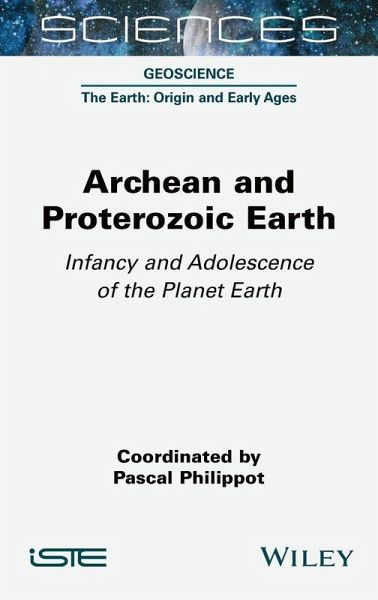
Pascal Philippot
Archean and Proterozoic Earth
- Gebundenes Buch
- Merkliste
- Auf die Merkliste
- Bewerten Bewerten
- Teilen
- Produkt teilen
- Produkterinnerung
- Produkterinnerung
It took nearly four billion years for the Earth to become a hospitable planet. Archean and Proterozoic Earth traces the geodynamic, biological, climatic and environmental upheavals that accompanied this evolution. This book looks at the planet's secular cooling and its implications for the dynamics of the Earth's mantle and the development of plate tectonics, as well as the evolution of magma composition and the formation of a differentiated continental crust. It shows how variations in the intensity of the Earth's magnetic field have proved useful in reconstructing the movement of continents…mehr
Andere Kunden interessierten sich auch für
 Steven M. StanleyEarth System History81,99 €
 Mervin J. Bartholomew (ed.) / Donald W. Hyndman / David W. Mogk / Robert MasonBasement Tectonics 8154,99 €
 GliksonOrganic Matter and Mineralisation: Thermal Alteration, Hydrocarbon Generation and Role in Metallogenesis168,99 €
 Basement Tectonics 8153,99 €
 Archean Geodynamics and Environments99,99 €
 Immanuel VelikovskyEarth in Upheaval25,99 €
 North Atlantic Treaty OrganizationDeep-Sea Food Chains and the Global Carbon Cycle181,99 €
-
-
-
It took nearly four billion years for the Earth to become a hospitable planet. Archean and Proterozoic Earth traces the geodynamic, biological, climatic and environmental upheavals that accompanied this evolution. This book looks at the planet's secular cooling and its implications for the dynamics of the Earth's mantle and the development of plate tectonics, as well as the evolution of magma composition and the formation of a differentiated continental crust. It shows how variations in the intensity of the Earth's magnetic field have proved useful in reconstructing the movement of continents across the surface of the globe. The book also documents the origin of the oceans and the appearance of the first traces of life, and describes the evolution of the major biogeochemical cycles that led to the oxygenation of the atmosphere, the diversification of living organisms and the concentration of substances of economic interest, particularly metals.
Produktdetails
- Produktdetails
- Verlag: John Wiley & Sons
- Seitenzahl: 378
- Erscheinungstermin: 23. Oktober 2025
- Englisch
- Abmessung: 234mm x 156mm x 22mm
- Gewicht: 708g
- ISBN-13: 9781789452051
- ISBN-10: 1789452058
- Artikelnr.: 75572071
- Herstellerkennzeichnung
- Libri GmbH
- Europaallee 1
- 36244 Bad Hersfeld
- gpsr@libri.de
- Verlag: John Wiley & Sons
- Seitenzahl: 378
- Erscheinungstermin: 23. Oktober 2025
- Englisch
- Abmessung: 234mm x 156mm x 22mm
- Gewicht: 708g
- ISBN-13: 9781789452051
- ISBN-10: 1789452058
- Artikelnr.: 75572071
- Herstellerkennzeichnung
- Libri GmbH
- Europaallee 1
- 36244 Bad Hersfeld
- gpsr@libri.de
Pascal Philippot works as CNRS Research Director at Géosciences Montpellier, France. His research interests include the relationships between geodynamics and biogeochemical cycles during the Precambrian, and in particular, the processes that led to the oxygenation of the atmosphere and oceans during the Archean-Proterozoic transition.
Introduction xi Pascal PHILIPPOT Chapter 1 Thermal Evolution of the Earth 1 Stéphane LABROSSE 1.1 Brief historical note 1 1.2 The present-day heat budget 3 1.3 The Hadean Earth 5 1.4 Direct observations of thermal evolution 6 1.5 Parameterized models of evolution 9 1.5.1 Heat transfer by convection 9 1.5.2 Classic cooling models and thermal catastrophe 11 1.5.3 Effect of a different exponent ß 13 1.5.4 Effects of continents 14 1.5.5 Effects of Earth's layered structure 16 1.5.6 Thermal evolution of the core 17 1.5.7 Effects of a stratified mantle 20 1.6 Conclusion 25 1.7 References 26 Chapter 2 Dynamics of the Mantle, Lithosphere, and Crust in the Archean 33 Patrice REY and Nicolas COLTICE 2.1 Introduction 33 2.2 Change in the composition of the upper continental crust: plate tectonics or denudation? 35 2.2.1 A crustal perspective on continental growth 35 2.2.2 A mantle perspective on continental growth 39 2.3 Archean tectonics 42 2.3.1 Beyond observations: numerical geodynamics 44 2.4 Conclusions 59 2.5 References 61 Chapter 3 Precambrian Magnetic Field and Paleogeographic Reconstructions 73 Julie CARLUT and Mélina MACOUIN 3.1 Introductory overview of Earth's magnetic field 73 3.1.1 The magnetic field in the Ediacaran 75 3.1.2 The Proterozoic: tracing back to the Archean (from 635 to 2,500 Ma) 79 3.1.3 In the Archean (and before) 81 3.1.4 Life under an unstable and weak magnetic field 83 3.2 Using the Earth's magnetic field record to build paleogeographic reconstructions 84 3.2.1 Insights from paleogeographic reconstructions 84 3.2.2 Reconstructing the paleopositions of cratonic blocks and paleogeographies: paleomagnetism 85 3.3 Precambrian paleogeographic models 89 3.3.1 Supercratons/supercontinents 89 3.3.2 The Archean and paleoproterozoic 91 3.3.3 From the Paleoproterozoic to the Mesoproterozoic: Nuna supercontinent 92 3.3.4 From the Mesoproterozoic to the Neoproterozoic: the Rodinia supercontinent 92 3.3.5 The end of the Precambrian: toward the formation of Gondwana 93 3.4 References 95 Chapter 4 Archean Magmatism 103 Jean-François MOYEN 4.1 Introduction 103 4.2 The lavas of the greenstone belts 106 4.2.1 Basic and ultrabasic lavas 108 4.2.2 Basic and intermediate lavas with "arc" affinity 113 4.2.3 Acidic lavas and pyroclastic rocks 114 4.3 Granitoids 114 4.3.1 Granitoids derived from the melting of crustal lithologies 117 4.3.2 Granitoids associated with a differentiation lineage: a mantle origin 123 4.4 Gray gneisses 124 4.5 Geodynamic considerations 127 4.5.1 The magmas of the present-day Earth and their geodynamic significance 127 4.5.2 Archean magmas and the dynamics of the ancient Earth 129 4.5.3 On "subduction" 129 4.5.4 The temporal evolution of Archean magmas 131 4.6 References 135 Chapter 5 Temperature and Chemical Composition of Precambrian Oceans 145 Johanna MARIN-CARBONNE and Christophe THOMAZO 5.1 Introduction 145 5.2 Very ancient oceans 146 5.2.1 Liquid water on Earth since the Hadean 146 5.2.2 The origin of water 150 5.3 Ocean temperature during the Precambrian 152 5.3.1 The faint young Sun paradox 152 5.3.2 The importance of cherts in paleo-temperature reconstructions 155 5.4 Characteristics and chemical evolution of the early oceans 161 5.4.1 Ocean salinity 162 5.4.2 Ocean alkalinity 163 5.4.3 Ocean pH 165 5.4.4 A story that smells of sulfur: from ferruginous to euxinic, the redox evolution of the oceans 166 5.4.5 The evolution of metal element concentrations 169 5.5 Conclusions and prospects 170 5.6 References 172 Chapter 6 Oxygenation of the Atmosphere 183 Pascal PHILIPPOT and Pierre SANS-JOFRE 6.1 Introduction 183 6.2 The major steps in oxygenation 185 6.3 The origin of free dioxygen 186 6.4 Factors controlling atmospheric oxygen levels 187 6.5 The beginnings of oxygenation 188 6.5.1 Biological record 189 6.5.2 Geological record 190 6.5.3 Sulfur isotope anomalies (MIF-S) 195 6.6 The great oxidation event (2.45-2.2 Ga) 199 6.7 The Boring Billion: 1.8-0.8 Ga 202 6.8 Atmospheric oxygenation in the Neoproterozoic (NOE - 800-600 Ma) 203 6.8.1 Very specific paleogeographic and tectonic conditions 203 6.8.2 The Cryogenian: the "Snowball Earth" 204 6.8.3 NOE and the key role of microbial sulfate reduction 206 6.8.4 The emergence of the animal world in the Neoproterozoic 210 6.9 References 214 Chapter 7 Carbon, Sulfur and Iron Biogeochemical Cycles 223 Magali ADER, Vincent BUSIGNY and Christophe THOMAZO 7.1 Introduction 223 7.2 The biogeochemical carbon cycle 225 7.2.1 Main carbon reservoirs and fluxes 225 7.2.2 The
13 C carb of carbonate sedimentary rocks: a record of the
13 C of DIC in the oceans 226 7.2.3 The
13 C org of sedimentary rocks: a record of organic matter synthesis metabolisms 233 7.2.4 Conclusion on the carbon cycle 234 7.3 The biogeochemical sulfur cycle 234 7.3.1 General overview: sources, sinks and fluxes 234 7.3.2 Sedimentary record of the sulfur cycle 237 7.3.3 Variability of sulfur isotopic compositions over geological time 239 7.3.4 Conclusions on the sulfur cycle 242 7.4 The biogeochemical iron cycle 242 7.4.1 Distribution and speciation of iron in major terrestrial reservoirs 242 7.4.2 Role of iron in the biosphere 243 7.4.3 A central element in Precambrian biogeochemical cycles 243 7.4.4 Record of the iron biogeochemical cycle in Precambrian oceans 245 7.4.5 Secular variations in iron isotopic compositions 246 7.4.6 Summary of iron cycle evolution in the Precambrian 250 7.5 Conclusion on the functioning and interrelationships of the C, S and Fe cycles in the Precambrian 250 7.6 References 251 Chapter 8 Origins of Life and the Fossil Record 257 Sylvain BERNARD 8.1 Introduction 257 8.2 The question of origins 258 8.2.1 Scenarios for the beginnings of life 259 8.2.2 Limits of prebiotic chemistry 262 8.3 The ancient fossil record 265 8.3.1 The Apex microfossils 265 8.3.2 The fossil record of Isua and Akilia 268 8.3.3 Archean stromatolites 270 8.3.4 On the concept of biosignature 272 8.4 So what now? 275 8.4.1 Experimental fossilization 276 8.4.2 Another primitive Earth 279 8.5 References 283 Chapter 9 Mineral Deposits: Au, U, Fe-Mn 299 Michel LOPEZ 9.1 Introduction 299 9.2 Place of the primitive and transitional Earth in the planet's metallogenic cycle 301 9.3 From the primordial soup to the first ore deposits 302 9.4 The planet's geochemical "kitchen" during the Precambrian, example of gold, uranium and iron-manganese 306 9.4.1 The geochemical and biochemical cycle of gold 306 9.4.2 The geochemical cycle of uranium 310 9.4.3 The geochemical cycle of iron and manganese 312 9.5 Gold on Earth during the Meso- and Neoarchean 315 9.6 Uranium, the "traveling companion" of gold in the Meso- and Neoarchean 320 9.6.1 4.55-3.1 Ga: formation of the primitive uranium reservoir in refractory accessory minerals 321 9.6.2 3.1-2.2 Ga: formation of the first peraluminous granites with Th-rich uraninite and bacterial and gravitational enrichment in giant paleoplacers 322 9.6.3 2.2-0.45 Ga: first redox traps and crustal metasomatic deposits 322 9.6.4 0.45 Ga-present: uranium trapping in sandstones and redox fronts 323 9.7 Iron and manganese on Earth in the Neoarchean-Proterozoic 327 9.7.1 Importance of iron and manganese resources 327 9.7.2 Mineralogy of banded iron and manganese ores and nature of precursor sediments 329 9.7.3 Arguments for a hydrothermal source of iron, manganese and silica 330 9.7.4 The fundamental role of life in oxidation mechanisms of iron and manganese behind BIF formation 332 9.7.5 Classification and depositional models of Precambrian banded iron and manganese formations 334 9.8 Conclusions 346 9.9 References 347 List of Authors 359 Index 361
13 C carb of carbonate sedimentary rocks: a record of the
13 C of DIC in the oceans 226 7.2.3 The
13 C org of sedimentary rocks: a record of organic matter synthesis metabolisms 233 7.2.4 Conclusion on the carbon cycle 234 7.3 The biogeochemical sulfur cycle 234 7.3.1 General overview: sources, sinks and fluxes 234 7.3.2 Sedimentary record of the sulfur cycle 237 7.3.3 Variability of sulfur isotopic compositions over geological time 239 7.3.4 Conclusions on the sulfur cycle 242 7.4 The biogeochemical iron cycle 242 7.4.1 Distribution and speciation of iron in major terrestrial reservoirs 242 7.4.2 Role of iron in the biosphere 243 7.4.3 A central element in Precambrian biogeochemical cycles 243 7.4.4 Record of the iron biogeochemical cycle in Precambrian oceans 245 7.4.5 Secular variations in iron isotopic compositions 246 7.4.6 Summary of iron cycle evolution in the Precambrian 250 7.5 Conclusion on the functioning and interrelationships of the C, S and Fe cycles in the Precambrian 250 7.6 References 251 Chapter 8 Origins of Life and the Fossil Record 257 Sylvain BERNARD 8.1 Introduction 257 8.2 The question of origins 258 8.2.1 Scenarios for the beginnings of life 259 8.2.2 Limits of prebiotic chemistry 262 8.3 The ancient fossil record 265 8.3.1 The Apex microfossils 265 8.3.2 The fossil record of Isua and Akilia 268 8.3.3 Archean stromatolites 270 8.3.4 On the concept of biosignature 272 8.4 So what now? 275 8.4.1 Experimental fossilization 276 8.4.2 Another primitive Earth 279 8.5 References 283 Chapter 9 Mineral Deposits: Au, U, Fe-Mn 299 Michel LOPEZ 9.1 Introduction 299 9.2 Place of the primitive and transitional Earth in the planet's metallogenic cycle 301 9.3 From the primordial soup to the first ore deposits 302 9.4 The planet's geochemical "kitchen" during the Precambrian, example of gold, uranium and iron-manganese 306 9.4.1 The geochemical and biochemical cycle of gold 306 9.4.2 The geochemical cycle of uranium 310 9.4.3 The geochemical cycle of iron and manganese 312 9.5 Gold on Earth during the Meso- and Neoarchean 315 9.6 Uranium, the "traveling companion" of gold in the Meso- and Neoarchean 320 9.6.1 4.55-3.1 Ga: formation of the primitive uranium reservoir in refractory accessory minerals 321 9.6.2 3.1-2.2 Ga: formation of the first peraluminous granites with Th-rich uraninite and bacterial and gravitational enrichment in giant paleoplacers 322 9.6.3 2.2-0.45 Ga: first redox traps and crustal metasomatic deposits 322 9.6.4 0.45 Ga-present: uranium trapping in sandstones and redox fronts 323 9.7 Iron and manganese on Earth in the Neoarchean-Proterozoic 327 9.7.1 Importance of iron and manganese resources 327 9.7.2 Mineralogy of banded iron and manganese ores and nature of precursor sediments 329 9.7.3 Arguments for a hydrothermal source of iron, manganese and silica 330 9.7.4 The fundamental role of life in oxidation mechanisms of iron and manganese behind BIF formation 332 9.7.5 Classification and depositional models of Precambrian banded iron and manganese formations 334 9.8 Conclusions 346 9.9 References 347 List of Authors 359 Index 361
Introduction xi Pascal PHILIPPOT Chapter 1 Thermal Evolution of the Earth 1 Stéphane LABROSSE 1.1 Brief historical note 1 1.2 The present-day heat budget 3 1.3 The Hadean Earth 5 1.4 Direct observations of thermal evolution 6 1.5 Parameterized models of evolution 9 1.5.1 Heat transfer by convection 9 1.5.2 Classic cooling models and thermal catastrophe 11 1.5.3 Effect of a different exponent ß 13 1.5.4 Effects of continents 14 1.5.5 Effects of Earth's layered structure 16 1.5.6 Thermal evolution of the core 17 1.5.7 Effects of a stratified mantle 20 1.6 Conclusion 25 1.7 References 26 Chapter 2 Dynamics of the Mantle, Lithosphere, and Crust in the Archean 33 Patrice REY and Nicolas COLTICE 2.1 Introduction 33 2.2 Change in the composition of the upper continental crust: plate tectonics or denudation? 35 2.2.1 A crustal perspective on continental growth 35 2.2.2 A mantle perspective on continental growth 39 2.3 Archean tectonics 42 2.3.1 Beyond observations: numerical geodynamics 44 2.4 Conclusions 59 2.5 References 61 Chapter 3 Precambrian Magnetic Field and Paleogeographic Reconstructions 73 Julie CARLUT and Mélina MACOUIN 3.1 Introductory overview of Earth's magnetic field 73 3.1.1 The magnetic field in the Ediacaran 75 3.1.2 The Proterozoic: tracing back to the Archean (from 635 to 2,500 Ma) 79 3.1.3 In the Archean (and before) 81 3.1.4 Life under an unstable and weak magnetic field 83 3.2 Using the Earth's magnetic field record to build paleogeographic reconstructions 84 3.2.1 Insights from paleogeographic reconstructions 84 3.2.2 Reconstructing the paleopositions of cratonic blocks and paleogeographies: paleomagnetism 85 3.3 Precambrian paleogeographic models 89 3.3.1 Supercratons/supercontinents 89 3.3.2 The Archean and paleoproterozoic 91 3.3.3 From the Paleoproterozoic to the Mesoproterozoic: Nuna supercontinent 92 3.3.4 From the Mesoproterozoic to the Neoproterozoic: the Rodinia supercontinent 92 3.3.5 The end of the Precambrian: toward the formation of Gondwana 93 3.4 References 95 Chapter 4 Archean Magmatism 103 Jean-François MOYEN 4.1 Introduction 103 4.2 The lavas of the greenstone belts 106 4.2.1 Basic and ultrabasic lavas 108 4.2.2 Basic and intermediate lavas with "arc" affinity 113 4.2.3 Acidic lavas and pyroclastic rocks 114 4.3 Granitoids 114 4.3.1 Granitoids derived from the melting of crustal lithologies 117 4.3.2 Granitoids associated with a differentiation lineage: a mantle origin 123 4.4 Gray gneisses 124 4.5 Geodynamic considerations 127 4.5.1 The magmas of the present-day Earth and their geodynamic significance 127 4.5.2 Archean magmas and the dynamics of the ancient Earth 129 4.5.3 On "subduction" 129 4.5.4 The temporal evolution of Archean magmas 131 4.6 References 135 Chapter 5 Temperature and Chemical Composition of Precambrian Oceans 145 Johanna MARIN-CARBONNE and Christophe THOMAZO 5.1 Introduction 145 5.2 Very ancient oceans 146 5.2.1 Liquid water on Earth since the Hadean 146 5.2.2 The origin of water 150 5.3 Ocean temperature during the Precambrian 152 5.3.1 The faint young Sun paradox 152 5.3.2 The importance of cherts in paleo-temperature reconstructions 155 5.4 Characteristics and chemical evolution of the early oceans 161 5.4.1 Ocean salinity 162 5.4.2 Ocean alkalinity 163 5.4.3 Ocean pH 165 5.4.4 A story that smells of sulfur: from ferruginous to euxinic, the redox evolution of the oceans 166 5.4.5 The evolution of metal element concentrations 169 5.5 Conclusions and prospects 170 5.6 References 172 Chapter 6 Oxygenation of the Atmosphere 183 Pascal PHILIPPOT and Pierre SANS-JOFRE 6.1 Introduction 183 6.2 The major steps in oxygenation 185 6.3 The origin of free dioxygen 186 6.4 Factors controlling atmospheric oxygen levels 187 6.5 The beginnings of oxygenation 188 6.5.1 Biological record 189 6.5.2 Geological record 190 6.5.3 Sulfur isotope anomalies (MIF-S) 195 6.6 The great oxidation event (2.45-2.2 Ga) 199 6.7 The Boring Billion: 1.8-0.8 Ga 202 6.8 Atmospheric oxygenation in the Neoproterozoic (NOE - 800-600 Ma) 203 6.8.1 Very specific paleogeographic and tectonic conditions 203 6.8.2 The Cryogenian: the "Snowball Earth" 204 6.8.3 NOE and the key role of microbial sulfate reduction 206 6.8.4 The emergence of the animal world in the Neoproterozoic 210 6.9 References 214 Chapter 7 Carbon, Sulfur and Iron Biogeochemical Cycles 223 Magali ADER, Vincent BUSIGNY and Christophe THOMAZO 7.1 Introduction 223 7.2 The biogeochemical carbon cycle 225 7.2.1 Main carbon reservoirs and fluxes 225 7.2.2 The
13 C carb of carbonate sedimentary rocks: a record of the
13 C of DIC in the oceans 226 7.2.3 The
13 C org of sedimentary rocks: a record of organic matter synthesis metabolisms 233 7.2.4 Conclusion on the carbon cycle 234 7.3 The biogeochemical sulfur cycle 234 7.3.1 General overview: sources, sinks and fluxes 234 7.3.2 Sedimentary record of the sulfur cycle 237 7.3.3 Variability of sulfur isotopic compositions over geological time 239 7.3.4 Conclusions on the sulfur cycle 242 7.4 The biogeochemical iron cycle 242 7.4.1 Distribution and speciation of iron in major terrestrial reservoirs 242 7.4.2 Role of iron in the biosphere 243 7.4.3 A central element in Precambrian biogeochemical cycles 243 7.4.4 Record of the iron biogeochemical cycle in Precambrian oceans 245 7.4.5 Secular variations in iron isotopic compositions 246 7.4.6 Summary of iron cycle evolution in the Precambrian 250 7.5 Conclusion on the functioning and interrelationships of the C, S and Fe cycles in the Precambrian 250 7.6 References 251 Chapter 8 Origins of Life and the Fossil Record 257 Sylvain BERNARD 8.1 Introduction 257 8.2 The question of origins 258 8.2.1 Scenarios for the beginnings of life 259 8.2.2 Limits of prebiotic chemistry 262 8.3 The ancient fossil record 265 8.3.1 The Apex microfossils 265 8.3.2 The fossil record of Isua and Akilia 268 8.3.3 Archean stromatolites 270 8.3.4 On the concept of biosignature 272 8.4 So what now? 275 8.4.1 Experimental fossilization 276 8.4.2 Another primitive Earth 279 8.5 References 283 Chapter 9 Mineral Deposits: Au, U, Fe-Mn 299 Michel LOPEZ 9.1 Introduction 299 9.2 Place of the primitive and transitional Earth in the planet's metallogenic cycle 301 9.3 From the primordial soup to the first ore deposits 302 9.4 The planet's geochemical "kitchen" during the Precambrian, example of gold, uranium and iron-manganese 306 9.4.1 The geochemical and biochemical cycle of gold 306 9.4.2 The geochemical cycle of uranium 310 9.4.3 The geochemical cycle of iron and manganese 312 9.5 Gold on Earth during the Meso- and Neoarchean 315 9.6 Uranium, the "traveling companion" of gold in the Meso- and Neoarchean 320 9.6.1 4.55-3.1 Ga: formation of the primitive uranium reservoir in refractory accessory minerals 321 9.6.2 3.1-2.2 Ga: formation of the first peraluminous granites with Th-rich uraninite and bacterial and gravitational enrichment in giant paleoplacers 322 9.6.3 2.2-0.45 Ga: first redox traps and crustal metasomatic deposits 322 9.6.4 0.45 Ga-present: uranium trapping in sandstones and redox fronts 323 9.7 Iron and manganese on Earth in the Neoarchean-Proterozoic 327 9.7.1 Importance of iron and manganese resources 327 9.7.2 Mineralogy of banded iron and manganese ores and nature of precursor sediments 329 9.7.3 Arguments for a hydrothermal source of iron, manganese and silica 330 9.7.4 The fundamental role of life in oxidation mechanisms of iron and manganese behind BIF formation 332 9.7.5 Classification and depositional models of Precambrian banded iron and manganese formations 334 9.8 Conclusions 346 9.9 References 347 List of Authors 359 Index 361
13 C carb of carbonate sedimentary rocks: a record of the
13 C of DIC in the oceans 226 7.2.3 The
13 C org of sedimentary rocks: a record of organic matter synthesis metabolisms 233 7.2.4 Conclusion on the carbon cycle 234 7.3 The biogeochemical sulfur cycle 234 7.3.1 General overview: sources, sinks and fluxes 234 7.3.2 Sedimentary record of the sulfur cycle 237 7.3.3 Variability of sulfur isotopic compositions over geological time 239 7.3.4 Conclusions on the sulfur cycle 242 7.4 The biogeochemical iron cycle 242 7.4.1 Distribution and speciation of iron in major terrestrial reservoirs 242 7.4.2 Role of iron in the biosphere 243 7.4.3 A central element in Precambrian biogeochemical cycles 243 7.4.4 Record of the iron biogeochemical cycle in Precambrian oceans 245 7.4.5 Secular variations in iron isotopic compositions 246 7.4.6 Summary of iron cycle evolution in the Precambrian 250 7.5 Conclusion on the functioning and interrelationships of the C, S and Fe cycles in the Precambrian 250 7.6 References 251 Chapter 8 Origins of Life and the Fossil Record 257 Sylvain BERNARD 8.1 Introduction 257 8.2 The question of origins 258 8.2.1 Scenarios for the beginnings of life 259 8.2.2 Limits of prebiotic chemistry 262 8.3 The ancient fossil record 265 8.3.1 The Apex microfossils 265 8.3.2 The fossil record of Isua and Akilia 268 8.3.3 Archean stromatolites 270 8.3.4 On the concept of biosignature 272 8.4 So what now? 275 8.4.1 Experimental fossilization 276 8.4.2 Another primitive Earth 279 8.5 References 283 Chapter 9 Mineral Deposits: Au, U, Fe-Mn 299 Michel LOPEZ 9.1 Introduction 299 9.2 Place of the primitive and transitional Earth in the planet's metallogenic cycle 301 9.3 From the primordial soup to the first ore deposits 302 9.4 The planet's geochemical "kitchen" during the Precambrian, example of gold, uranium and iron-manganese 306 9.4.1 The geochemical and biochemical cycle of gold 306 9.4.2 The geochemical cycle of uranium 310 9.4.3 The geochemical cycle of iron and manganese 312 9.5 Gold on Earth during the Meso- and Neoarchean 315 9.6 Uranium, the "traveling companion" of gold in the Meso- and Neoarchean 320 9.6.1 4.55-3.1 Ga: formation of the primitive uranium reservoir in refractory accessory minerals 321 9.6.2 3.1-2.2 Ga: formation of the first peraluminous granites with Th-rich uraninite and bacterial and gravitational enrichment in giant paleoplacers 322 9.6.3 2.2-0.45 Ga: first redox traps and crustal metasomatic deposits 322 9.6.4 0.45 Ga-present: uranium trapping in sandstones and redox fronts 323 9.7 Iron and manganese on Earth in the Neoarchean-Proterozoic 327 9.7.1 Importance of iron and manganese resources 327 9.7.2 Mineralogy of banded iron and manganese ores and nature of precursor sediments 329 9.7.3 Arguments for a hydrothermal source of iron, manganese and silica 330 9.7.4 The fundamental role of life in oxidation mechanisms of iron and manganese behind BIF formation 332 9.7.5 Classification and depositional models of Precambrian banded iron and manganese formations 334 9.8 Conclusions 346 9.9 References 347 List of Authors 359 Index 361