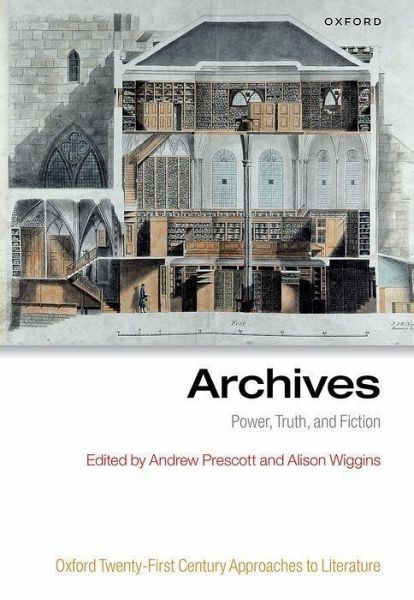
Chapter 23 is published open access under a CC BY-NC-ND 4.0 license and is free to read or download from Oxford Academic. Archives have never been more complex, expansive, or ubiquitous. Gargantuan in scale and conception yet never sufficient or complete, the archive is on the one hand a space for empowerment and expression and on the other an instrument of constraint and repression. The way in which the archive is structured, made available, and developed plays a central role in how societies define their values and ethics. Archives: Power, Truth, and Fiction is a wide-ranging and innovative…mehr
Chapter 23 is published open access under a CC BY-NC-ND 4.0 license and is free to read or download from Oxford Academic. Archives have never been more complex, expansive, or ubiquitous. Gargantuan in scale and conception yet never sufficient or complete, the archive is on the one hand a space for empowerment and expression and on the other an instrument of constraint and repression. The way in which the archive is structured, made available, and developed plays a central role in how societies define their values and ethics. Archives: Power, Truth, and Fiction is a wide-ranging and innovative volume which highlights the vibrancy and urgency of the field by bringing together contributors from many different disciplines and backgrounds, including archivists, historians, literary scholars, digital researchers, and creative practitioners. The archive of the twenty-first century is a fluid and multi-vocal space that challenges at every point the hegemonic and positivistic assumptions which shaped traditional ideas of the archive. The massive growth of digital archives further complicates the picture. Archives: Power, Truth, and Fiction is designed to help the reader draw threads through the rapidly changing and shifting multiverse of archives. The interdisciplinary and international contributors use a wide range of examples, from the Middle Ages to the Windrush scandal, to unsettle preconceptions, encourage debate, and draw out issues generated by the perpetual motion of the archive.
Andrew Prescott is Professor of Digital Humanities in the School of Critical Studies, University of Glasgow. He trained as a medieval historian and was a Curator in the Department of Manuscripts of the British Library between 1979 and 2000, where he was the principal curatorial contact for Kevin Kiernan's Electronic Beowulf. Professor Prescott was Theme Leader Fellow for the AHRC strategic theme of Digital Transformations 2012-2019. He has also worked in libraries, archives, and digital humanities units at the University of Sheffield, King's College London, and the University of Wales Lampeter. Alison Wiggins is Reader in English Language and Manuscripts in the School of Critical Studies, University of Glasgow. She has led and collaborated on a range of archive-based digital projects, at the AHRC Centre for Editing Lives and Letters between 2002 and 2006, and then at Glasgow as PI for The Letters of Bess of Hardwick (AHRC 2009-12), as Leadership Fellow for Archives and Writing Lives (AHRC 2017-19), and currently as part of the research team analyzing Adam Smith's Library (Templeton Foundation 2022-24). Dr Wiggins has also developed research and engagement projects with The National Trust, Chatsworth House Archives, The National Archives, The Bodleian Library, and the National Library of Scotland.
Inhaltsangabe
* List of Illustrations * Abbreviations * Acknowledgements * Notes on Editorial Policy * Notes on Contributors * Foreword by Carolyn Steedman * Introduction by Andrew Prescott and Alison Wiggins * I. Conceptions * 1: Michelle Caswell: 'The Archive' is Not An Archives: Acknowledging the Intellectual Contribution of Archival Studies * 2: Louise Craven: Where and What are the Boundaries of the Archive? * 3: Hariz Halilovich and Anne J. Gilliland: Digitality and Reconfiguring Global Archive(s) of Forced Migration * 4: James Lowry: The Record as Command * 5: Andrew Hoskins: New Memory and The Archive * 6: Niamh Moore: Response to Conceptions * II. Frameworks * 7: Andrew Prescott: Appraisal and Original Order: The Power Structures of the Archive * 8: Anna Sexton: Archival Education and Professionalism * 9: Lisa Gitelman: Metadata * 10: Ruth Ahnert and Sebastian E. Ahnert: Networks * 11: Michael Moss and David Thomas: Authenticating and Evaluating Evidence * 12: Victoria Van Hyning and Heather Wolfe: More Content, Less Context: Rethinking Access * 13: Janet Foster: Response to Frameworks * III. Materialities * 14: Alison Wiggins: The Materiality of Written Textual Forms * 15: Simon Popple: Sound and Vision: The Audio-Visual Archive * 16: Catherine Richardson: Doors Into the Archives: Material Objects and Document Collections * 17: Jane Birkin: Archives, Art, and the Performativity of Practice * 18: Eirini Goudarouli: Digital Innovation and Archival Thinking * 19: Laura Mandell: Response to Materialities * IV. Encounters and Evolution * 20: Eric Ketelaar: The Agency of Archivers * 21: Paul Lihoma: State Power and the Shaping of Archives in Malawi * 22: Paul Strohm: Archival Impulses and the Gunpowder Plot * 23: Nadine Akkerman and Pete Langman: Accidentally on Purpose: Denying Any Responsibility for the Accidental Archive * 24: Julie A. Fisher: Response to Encounters and Evolution * V. Narrators * 25: Karina Beras and Jarrett Martin Drake: From Repositories of Failure to Archives of Abolition * 26: Rachel Douglas: Writer-Editors Making the Haitian and Caribbean Archives Talk * 27: Sylvia Federico: Finding Women in the Archives of 1381 * 28: Norma Clarke: On Family History and Archives * 29: Ruth Maclennan: An Artist Unpacks the Archives * 30: Alan Stewart: Response to Narrators * VI. Erasures and Exclusion * 31: Lae'l Hughes-Watkins: America's Scrapbook: A Reckoning in the Archives * 32: Rebecca Kahn: Irreconcilable Archives: Queer Collections and the Truth and Reconciliation Commission * 33: Rebecca Abby Whiting: Destruction and Displacement: The 2003 War and the Struggle for Iraq's Records * 34: Edwina Ashie-Nikoi, Emmanuel Adjei, and Musah Adams: Of Bonfires, Mindsets, and Policies: The Multi-Causal Matrix of Silence in Ghanaian Public Archives * 35: Kirsten Weld: Response to Erasures and Exclusion * Afterword by Verne Harris * Index
* List of Illustrations * Abbreviations * Acknowledgements * Notes on Editorial Policy * Notes on Contributors * Foreword by Carolyn Steedman * Introduction by Andrew Prescott and Alison Wiggins * I. Conceptions * 1: Michelle Caswell: 'The Archive' is Not An Archives: Acknowledging the Intellectual Contribution of Archival Studies * 2: Louise Craven: Where and What are the Boundaries of the Archive? * 3: Hariz Halilovich and Anne J. Gilliland: Digitality and Reconfiguring Global Archive(s) of Forced Migration * 4: James Lowry: The Record as Command * 5: Andrew Hoskins: New Memory and The Archive * 6: Niamh Moore: Response to Conceptions * II. Frameworks * 7: Andrew Prescott: Appraisal and Original Order: The Power Structures of the Archive * 8: Anna Sexton: Archival Education and Professionalism * 9: Lisa Gitelman: Metadata * 10: Ruth Ahnert and Sebastian E. Ahnert: Networks * 11: Michael Moss and David Thomas: Authenticating and Evaluating Evidence * 12: Victoria Van Hyning and Heather Wolfe: More Content, Less Context: Rethinking Access * 13: Janet Foster: Response to Frameworks * III. Materialities * 14: Alison Wiggins: The Materiality of Written Textual Forms * 15: Simon Popple: Sound and Vision: The Audio-Visual Archive * 16: Catherine Richardson: Doors Into the Archives: Material Objects and Document Collections * 17: Jane Birkin: Archives, Art, and the Performativity of Practice * 18: Eirini Goudarouli: Digital Innovation and Archival Thinking * 19: Laura Mandell: Response to Materialities * IV. Encounters and Evolution * 20: Eric Ketelaar: The Agency of Archivers * 21: Paul Lihoma: State Power and the Shaping of Archives in Malawi * 22: Paul Strohm: Archival Impulses and the Gunpowder Plot * 23: Nadine Akkerman and Pete Langman: Accidentally on Purpose: Denying Any Responsibility for the Accidental Archive * 24: Julie A. Fisher: Response to Encounters and Evolution * V. Narrators * 25: Karina Beras and Jarrett Martin Drake: From Repositories of Failure to Archives of Abolition * 26: Rachel Douglas: Writer-Editors Making the Haitian and Caribbean Archives Talk * 27: Sylvia Federico: Finding Women in the Archives of 1381 * 28: Norma Clarke: On Family History and Archives * 29: Ruth Maclennan: An Artist Unpacks the Archives * 30: Alan Stewart: Response to Narrators * VI. Erasures and Exclusion * 31: Lae'l Hughes-Watkins: America's Scrapbook: A Reckoning in the Archives * 32: Rebecca Kahn: Irreconcilable Archives: Queer Collections and the Truth and Reconciliation Commission * 33: Rebecca Abby Whiting: Destruction and Displacement: The 2003 War and the Struggle for Iraq's Records * 34: Edwina Ashie-Nikoi, Emmanuel Adjei, and Musah Adams: Of Bonfires, Mindsets, and Policies: The Multi-Causal Matrix of Silence in Ghanaian Public Archives * 35: Kirsten Weld: Response to Erasures and Exclusion * Afterword by Verne Harris * Index
Es gelten unsere Allgemeinen Geschäftsbedingungen: www.buecher.de/agb
Impressum
www.buecher.de ist ein Internetauftritt der buecher.de internetstores GmbH
Geschäftsführung: Monica Sawhney | Roland Kölbl | Günter Hilger
Sitz der Gesellschaft: Batheyer Straße 115 - 117, 58099 Hagen
Postanschrift: Bürgermeister-Wegele-Str. 12, 86167 Augsburg
Amtsgericht Hagen HRB 13257
Steuernummer: 321/5800/1497
USt-IdNr: DE450055826