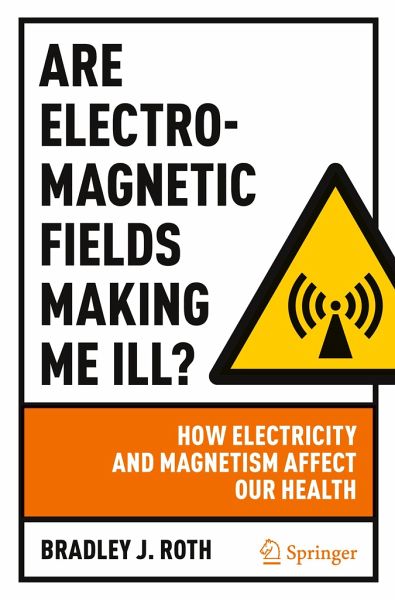
Electricity and Magnetism (E&M) underlies many lifesaving medical devices, such as magnetic resonance imaging scanners, neural stimulators, and heart pacemakers. But E&M also attracts its share of bogus health claims, such as biomagnetic therapy. How do you separate the good from the bad? Sometimes it's not easy: experiments are prone to artifacts, theories are limited by assumptions, and clinical trials can result in ambiguities. In this book, the author separates the wheat from the chaff, showing which applications of E&M are bogus and which are not. This book takes the reader on a tour…mehr
Electricity and Magnetism (E&M) underlies many lifesaving medical devices, such as magnetic resonance imaging scanners, neural stimulators, and heart pacemakers. But E&M also attracts its share of bogus health claims, such as biomagnetic therapy. How do you separate the good from the bad? Sometimes it's not easy: experiments are prone to artifacts, theories are limited by assumptions, and clinical trials can result in ambiguities. In this book, the author separates the wheat from the chaff, showing which applications of E&M are bogus and which are not. This book takes the reader on a tour through a range of fascinating phenomena, from effects that are constant in time at one extreme, such as transcranial direct current stimulation of the brain, to the millimeter-wave whole-body scanners which are familiar to frequent flyers at the other. Along the way, the author looks in depth at the dispute about power line magnetic fields and leukemia, a case study in what can go wrong when dubiousclaims inflame unjustified fears. The debate about cell phones and brain cancer still rages today, particularly for the microwave frequencies encountered with new 5G technology. Recently, the so-called Havana Syndrome has been attributed to microwave weapons, but the underlying biophysics of such weapons is unclear. For all these encounters with electricity and magnetism, the author, an eminent biophysicist, uses science and evidence to sort out fact from fantasy. This book is aimed at general readers who want to make sense of the mysterious and often controversial ways in which E&M interacts with the human body. It is also ideal for students and professionals in bioscience and health-related fields who want to learn more without getting overwhelmed by theory.
Russell K. Hobbie received a B. Physics from MIT and a PhD from Harvard University. He went to the University of Minnesota as a post-doc in 1960 and remained there for 38 years. Originally working in nuclear physics, he became interested in medical issues when he met Richard Reece, MD at a party. The two worked on computer-assisted interpretation of laboratory test results for several years. Hoping to make the pre-med physics course more interesting, Prof. Hobbie, between 1971 and 1973, audited all the courses medical students take in their first two years at the University of Minnesota. He was amazed by the amount of physics he found in these courses that had seldom been discussed in the general physics course. A number of articles he wrote for the American Journal of Physics presaged the current content recommendations for pre-med and biological physics courses. Prof. Hobbie also found a great discrepancy between the physics in papers in the biological researchliterature and the level of understanding of most biology majors or pre-med students who have taken a year of physics. It was clear that an intermediate level physics course would help these students. Prof. Hobbie developed such a course in 1973, which led to the publication of Intermediate Physics for Medicine and Biology in 1978. Prof. Hobbie is a member of the American Physical Society, the American Association of Physicists in Medicine, and the Institute of Electrical and Electronic Engineers. He is a Fellow of the American Association of Physics Teachers. Bradley J. Roth was born in Clinton, Iowa in 1960, and was raised in Morrison, Illinois. He attended the University of Kansas, majoring in Physics (BS, 1982) and Vanderbilt University (MS, 1985; PhD, 1987). In graduate school, he worked in the Living State Physics Laboratory headed by John Wikswo. In 1988, Prof. Roth joined the Biomedical Engineering and Instrumentation Program at the National Institutes of Health in Bethesda, Maryland. Prof. Roth's research at NIH centered on three themes: cardiac electrophysiology, magnetic stimulation of nerves, and analysis of the electroencephalogram. From 1995 to 1998, he was the Robert T. Lagemann Assistant Professor of Living State Physics at Vanderbilt. In 1998, he accepted his current position in the Department of Physics at Oakland University. In 2006, Prof. Roth was elected a Fellow of the American Physical Society (Division of Biological Physics). The citation reads: "For his theoretical and numerical studies of bioelectric and biomagnetic phenomena, especially for his contributions to the bidomain model of the heart."
Inhaltsangabe
Chapter 1. Introduction.- Chapter 2. Can Magnets Cure All Your Ills?.- Chapter 3. Can a 9-Volt Battery Make You Smarter?.- Chapter 4. Do Power Lines Cause Cancer?.- Chapter 5. Will Electrical Stimulation Help Your Aching Back?.- Chapter 6. Is Your Cell Phone Killing You?.- Chapter 7. Did 5G Cell Phone Radiation Cause Covid-19?.- Chapter 8. Did Cuba Attack America with Microwaves?.- Chapter 9. Is That Airport Security Scanner Dangerous?.- Chapter 10. Conclusion.
Chapter 1. Introduction.- Chapter 2. Can Magnets Cure All Your Ills?.- Chapter 3. Can a 9-Volt Battery Make You Smarter?.- Chapter 4. Do Power Lines Cause Cancer?.- Chapter 5. Will Electrical Stimulation Help Your Aching Back?.- Chapter 6. Is Your Cell Phone Killing You?.- Chapter 7. Did 5G Cell Phone Radiation Cause Covid-19?.- Chapter 8. Did Cuba Attack America with Microwaves?.- Chapter 9. Is That Airport Security Scanner Dangerous?.- Chapter 10. Conclusion.
Rezensionen
"This book is an essential reference that would be a great addition to every skeptic's bookshelf. It summarizes the evidence about the health effects of electromagnetism and provides ammunition for debunking pseudoscientific rumors. It's short, inexpensive, well-written, and full of interesting facts. I was particularly intrigued to learn that an electric eel has its own Twitter account." (Harriet Hall, Science-Based Medicine, sciencebasedmedicine.org, June 14, 2022)
Es gelten unsere Allgemeinen Geschäftsbedingungen: www.buecher.de/agb
Impressum
www.buecher.de ist ein Internetauftritt der buecher.de internetstores GmbH
Geschäftsführung: Monica Sawhney | Roland Kölbl | Günter Hilger
Sitz der Gesellschaft: Batheyer Straße 115 - 117, 58099 Hagen
Postanschrift: Bürgermeister-Wegele-Str. 12, 86167 Augsburg
Amtsgericht Hagen HRB 13257
Steuernummer: 321/5800/1497
USt-IdNr: DE450055826