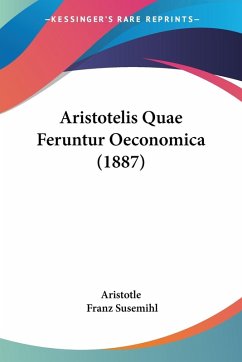
Aristotelis Quae Feruntur Oeconomica is a book written by the Greek philosopher Aristotle and published in 1887. The book is a collection of his writings on economics, which were originally compiled by his followers after his death. The text covers a wide range of topics related to household management, including the role of women in the household, the importance of education, and the proper use of resources. The book is divided into three sections, each of which focuses on a different aspect of household management. The first section discusses the importance of a well-run household and the…mehr
Aristotelis Quae Feruntur Oeconomica is a book written by the Greek philosopher Aristotle and published in 1887. The book is a collection of his writings on economics, which were originally compiled by his followers after his death. The text covers a wide range of topics related to household management, including the role of women in the household, the importance of education, and the proper use of resources. The book is divided into three sections, each of which focuses on a different aspect of household management. The first section discusses the importance of a well-run household and the role of the head of the household in managing it. The second section focuses on the proper use of resources, including money, food, and other goods. The third section explores the role of women in the household and their contributions to its success. Overall, Aristotelis Quae Feruntur Oeconomica is a valuable resource for anyone interested in the history of economics and household management.This scarce antiquarian book is a facsimile reprint of the old original and may contain some imperfections such as library marks and notations. Because we believe this work is culturally important, we have made it available as part of our commitment for protecting, preserving, and promoting the world's literature in affordable, high quality, modern editions, that are true to their original work.
Aristotle (384 - 322 bce) Born in Stagira, in Greece, in 384 bce, Aristotle was a Classical Greek philosopher who wrote on multiple subjects, including and not limited to psychology, politics, ethics, economics, biology, music, theatre, government, and logic. Once in a hierarchy of famous philosophers, he was Plato's student, who was in turn a student of Socrates. Aristotle turned out to be one of the finest scholars of his time and his thoughts and treatises have had a profound effect on scholars ever since. His influence led him to be enlisted by the then king of Macedonia, Philip II, to tutor his son, Alexander, who would go on to become one of the greatest kings and conquerors of all time. Although not all of Aristotle's philosophies and doctrines have survived criticism down the centuries, it must be said that he was a trailblazer in his own right. A polymath who could hold a conversation or debate on any topic, Aristotle's influence is such that his ways of thinking are still implemented in one form or the other to this day. He has been depicted in multiple artworks across the millennia, and is without a doubt one of the cornerstones of philosophy as a discipline.
Es gelten unsere Allgemeinen Geschäftsbedingungen: www.buecher.de/agb
Impressum
www.buecher.de ist ein Internetauftritt der buecher.de internetstores GmbH
Geschäftsführung: Monica Sawhney | Roland Kölbl | Günter Hilger
Sitz der Gesellschaft: Batheyer Straße 115 - 117, 58099 Hagen
Postanschrift: Bürgermeister-Wegele-Str. 12, 86167 Augsburg
Amtsgericht Hagen HRB 13257
Steuernummer: 321/5800/1497
USt-IdNr: DE450055826