
Andere Kunden interessierten sich auch für
 (Case Laminate Hardcover with Jacket)") The History of the Franks (Royal Collector's Edition) (Case Laminate Hardcover with Jacket)37,99 €
The History of the Franks (Royal Collector's Edition) (Case Laminate Hardcover with Jacket)37,99 € Warum zitieren frühchristliche Autoren pagane Texte?114,95 €
 Activity and Participation in Late Antique and Early Christian Thought163,99 €
") Early Christian Doctrine (1899)22,99 €
Early Christian Doctrine (1899)22,99 € Cultures at the Susquehanna Confluence39,99 €
 The Making of the Platonic Corpus124,00 €
 Broken Idols of the English Reformation159,99 €
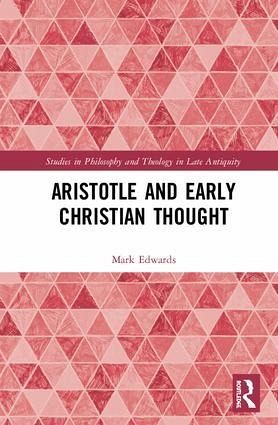
"Scholars of early Christian theology owe a debt of gratitude to Edwards for shining a light on the traces of Aristotle's philosophical legacy in late antique Christianity. Of the book's many achievements, the most welcome may be its simultaneous affirmation of the power of the Christian perspective and dismantling of the unqualified assertion that Platonism was the sole source of pagan philosophy upon which early Christians drew. In this way, Edwards' study joins a contiguous body of scholarship exploring how early Christians also adapted Stoicism."
-Alexander H. Pierce, Reading Religion
"Bonino's book constitutes a major accomplishment. It is no doubt the most important and comprehensive commentary on Aquinas's treatment of the divine attributes written in quite some time. Anyone interested in medieval philosophy and theology generally, in the study of Aquinas specifically, or in the viability of Thomism as a living tradition of thought will profit greatly from reading this book."
-Thomas Joseph White, O.P, The Thomist
-Alexander H. Pierce, Reading Religion
"Bonino's book constitutes a major accomplishment. It is no doubt the most important and comprehensive commentary on Aquinas's treatment of the divine attributes written in quite some time. Anyone interested in medieval philosophy and theology generally, in the study of Aquinas specifically, or in the viability of Thomism as a living tradition of thought will profit greatly from reading this book."
-Thomas Joseph White, O.P, The Thomist
"Aristotle has exerted a good deal of influence on early Christian thinkers, as has been recognized for some time now. This is the first book-length study on the subject and indeed a profound one." - Bryn Mawr Classical Review
"Discussing the philosophical sources of ancient Christian thought, most of us are usually content with the dictum that its development in terms of philosophical arguments was governed by Platonism. As a welcome antidote to such simplification, [Edwards] sets out to show that Peripatetic thinking, especially the interpretative tradition of the Categories, also exerted deep influence on major figures of early Christianity." - The Classical Review
"Discussing the philosophical sources of ancient Christian thought, most of us are usually content with the dictum that its development in terms of philosophical arguments was governed by Platonism. As a welcome antidote to such simplification, [Edwards] sets out to show that Peripatetic thinking, especially the interpretative tradition of the Categories, also exerted deep influence on major figures of early Christianity." - The Classical Review