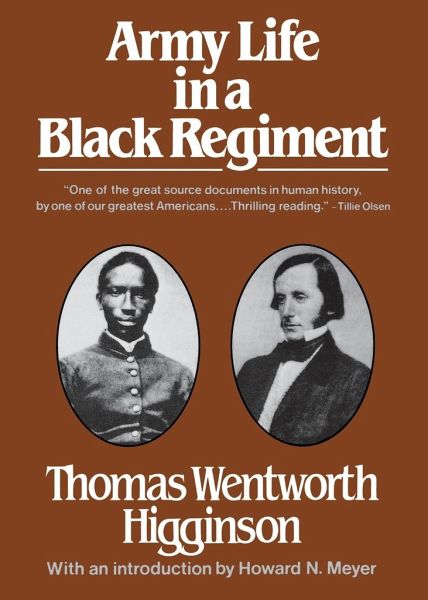
In 1862 military necessity enabled Secretary of War Edwin M. Stanton to pry from a hesitant President Lincoln the authority to enlist black troops in the Union army. The pioneer regiment of ex-slaves was to secure the beachhead tenously held at Beaufort, off the South Carolina coast. Within a year, Lincoln was to hail the enlistment of black soldiers, which he had earlier resisted as "revolutionary," as the "heaviest blow yet dealt the rebellion." The abolition of slavery, unthinkable in 1861, was to be inevitable by 1863. The commanding officer chosen for the First South Carolina Volunteers…mehr
In 1862 military necessity enabled Secretary of War Edwin M. Stanton to pry from a hesitant President Lincoln the authority to enlist black troops in the Union army. The pioneer regiment of ex-slaves was to secure the beachhead tenously held at Beaufort, off the South Carolina coast. Within a year, Lincoln was to hail the enlistment of black soldiers, which he had earlier resisted as "revolutionary," as the "heaviest blow yet dealt the rebellion." The abolition of slavery, unthinkable in 1861, was to be inevitable by 1863. The commanding officer chosen for the First South Carolina Volunteers was Thomas Wentworth Higginson, a militant human rights activist, writer and lecturer, and former Unitarian minister. "In all the land," writes the historian Ray Allen Billington, they "could have found no one better for this assignment." Higginson was an excellent strategist and administrator who combined firmness with warmth and charm. Closely watched in the nation's press by both friends and foes of the undertaking, he soon shaped a first-class regiment. Army Life in a Black Regiment is Colonel Higginson's stirring account of his two years at Camp Saxton, recording the immediate effect of a decision that proved crucial to our survival as a nation and that ultimately shaped constitutional history. It is both a literary masterpiece and a unique historical document.
Thomas Wentworth Higginson was an American Unitarian minister, author, abolitionist, and soldier, born on December 22, 1823, in Cambridge, Massachusetts. He was deeply involved in the American Abolitionist movement during the 1840s and 1850s, aligning himself with disunion and militant abolitionism, advocating for the end of slavery in the United States. Higginson's commitment to social justice extended to his role as a minister, where he emphasized progressive views on religion and social reform. In addition to his abolitionist work, he served as a colonel in the Union Army during the American Civil War, leading the first African American regiment in the war. His literary contributions include various works of fiction, essays, and letters, reflecting his intellectual and moral concerns of the time. He also wrote on women's rights and was a supporter of the women's suffrage movement, advocating for women's education and intellectual development. Higginson was married twice, first to Mary Elizabeth Channing, and later to Mary Potter Thacher. He passed away on May 9, 1911, in his hometown of Cambridge, Massachusetts.
Es gelten unsere Allgemeinen Geschäftsbedingungen: www.buecher.de/agb
Impressum
www.buecher.de ist ein Internetauftritt der buecher.de internetstores GmbH
Geschäftsführung: Monica Sawhney | Roland Kölbl | Günter Hilger
Sitz der Gesellschaft: Batheyer Straße 115 - 117, 58099 Hagen
Postanschrift: Bürgermeister-Wegele-Str. 12, 86167 Augsburg
Amtsgericht Hagen HRB 13257
Steuernummer: 321/5800/1497
USt-IdNr: DE450055826