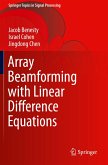
This book studies the link between differential beamforming and differential equations which in turn enables the study of fundamental theory and methods of beamforming from a different perspective, leading to new insights into the problem and new methods to solve the problem. The book first presents a brief overview of the problems and methods for beamforming and some performance measures popularly used either to evaluate beamformers or to derive optimal beamformers. Then, first-order, second-order, and general high-order linear difference equations are discussed, based on which the authors…mehr
This book studies the link between differential beamforming and differential equations which in turn enables the study of fundamental theory and methods of beamforming from a different perspective, leading to new insights into the problem and new methods to solve the problem. The book first presents a brief overview of the problems and methods for beamforming and some performance measures popularly used either to evaluate beamformers or to derive optimal beamformers. Then, first-order, second-order, and general high-order linear difference equations are discussed, based on which the authors show how to formulate the beamforming problem and derive different beamforming methods, including fixed and adaptive ones. Furthermore, the authors show how to apply the theory of difference equations to the general problem of speech enhancement, and deduce a number of noise reduction filters, including the maximum SNR filter, the Wiener filter, the MVDR filter, etc. Also covered in the book are thedifference equations and differential beamforming from the spectral graph perspective.
Presents basic concepts, fundamental principles, and methods for beamforming from the perspective of linear difference equations;Provides formulation and methods of conventional beamforming, and first-order, second-order, and general high-order linear difference equations for beamforming;Includes the applications of linear difference equations to the problem of noise reduction;Explains beamforming based on difference equations with graphs.
Jacob Benesty received a master's degree in microwaves from Pierre & Marie Curie University, France, in 1987, and a Ph.D. degree in control and signal processing from Paris-Saclay University, France, in April 1991. During his Ph.D. (from Nov. 1989 to Apr. 1991), he worked on adaptive filters and fast algorithms at the Centre National d'Etudes des Telecommunications (CNET), Paris, France. From January 1994 to July 1995, he worked at Telecom Paris University on multichannel adaptive filters and acoustic echo cancellation. From October 1995 to May 2003, he was first a consultant and then a Member of the Technical Staff at Bell Laboratories, Murray Hill, NJ, USA. In May 2003, he joined the University of Quebec, INRS-EMT, in Montreal, Quebec, Canada, as a professor. He is also an adjunct professor with Aalborg University, Denmark, and a guest professor with Northwestern Polytechnical University, Xi'an, China. His research interests are in signal processing, acoustic signal processing, and multimedia communications. He is the inventor of many important technologies. In particular, he was the lead researcher at Bell Labs who conceived and designed the world-first real-time hands-free full-duplex stereophonic teleconferencing system. Also, he conceived and designed the world-first PC-based multi-party hands-free full-duplex stereo conferencing system over IP networks. He is the editor of the book series Springer Topics in Signal Processing. He was the general chair and technical chair of many international conferences and a member of several IEEE technical committees. Four of his journal papers were awarded by the IEEE Signal Processing Society, in 2010 he received the Gheorghe Cartianu Award from the Romanian Academy, and in 2023 he received an Honorary Doctorate (Doctor Technices Honoris Causa) from Aalborg University, Denmark, for his distinguished efforts in audio and acoustic signal processing. He has co-authored and co-edited/co-authored numerous books in the areaof acoustic signal processing. Gongping Huang received his bachelor's degree in Electronics and Information Engineering and his Ph.D. degree in Information and Communication Engineering from Northwestern Polytechnical University (NPU) in Xian, China, in 2012 and 2019, respectively. Between 2015 and 2017, he worked as a visiting researcher at University of Quebec, INRS-EMT, Montreal, Quebec, Canada. Following this, he worked as a postdoctoral research fellow at the Technion-Israel Institute of Technology in Haifa, Israel, from 2019 to 2021. He was a Humboldt Research Fellow at the University of Erlangen-Nuremberg in Germany, supported by the Alexander von Humboldt Foundation. He is now a professor at Wuhan University. His research interests include microphone arrays, acoustic signal processing, and speech enhancement. Dr. Huang received the Humboldt Research Fellowship (2021), the Andrew and Erna Finci Viterbi Post-Doctoral Fellowship award (2019), the Best Ph.D. Thesis Award from the Chinese Institute of Electronics (2021), and the Best Ph.D. Thesis Award of Shanxi Province (2021). He is currently serving as an Associate Editor for the Circuits Systems and Signal Processing Journal and a Consulting Associate Editors for the IEEE Open Journal of Signal Processing. He also serves as an active reviewer for more than 30 scientific journals and international conferences. Jingdong Chen received the Ph.D. degree in pattern recognition and intelligence control from the Chinese Academy of Sciences in 1998. From 1998 to 1999, he was with ATR Interpreting Telecommunications Research Laboratories, Kyoto, Japan, where he conducted research on speech synthesis, speech analysis, as well as objective measurements for evaluating speech synthesis. He then joined the Griffith University, Brisbane, Australia, where he engaged in research on robust speech recognition and signal processing. From 2000 to 2001, he worked at ATR Spoken Language Translation Research Laboratories
Inhaltsangabe
Introduction.- A Brief Overview of Conventional Beamforming.- Beamforming with First-Order Linear Difference Equations.- Beamforming with Second-Order Linear Difference.- Beamforming with Higher-Order Linear Difference Equations.- Application to Speech Enhancement.- A Spectral Graph Perspective.- Conclusion.
Introduction.- A Brief Overview of Conventional Beamforming.- Beamforming with First-Order Linear Difference Equations.- Beamforming with Second-Order Linear Difference.- Beamforming with Higher-Order Linear Difference Equations.- Application to Speech Enhancement.- A Spectral Graph Perspective.- Conclusion.
Es gelten unsere Allgemeinen Geschäftsbedingungen: www.buecher.de/agb
Impressum
www.buecher.de ist ein Internetauftritt der buecher.de internetstores GmbH
Geschäftsführung: Monica Sawhney | Roland Kölbl | Günter Hilger
Sitz der Gesellschaft: Batheyer Straße 115 - 117, 58099 Hagen
Postanschrift: Bürgermeister-Wegele-Str. 12, 86167 Augsburg
Amtsgericht Hagen HRB 13257
Steuernummer: 321/5800/1497
USt-IdNr: DE450055826