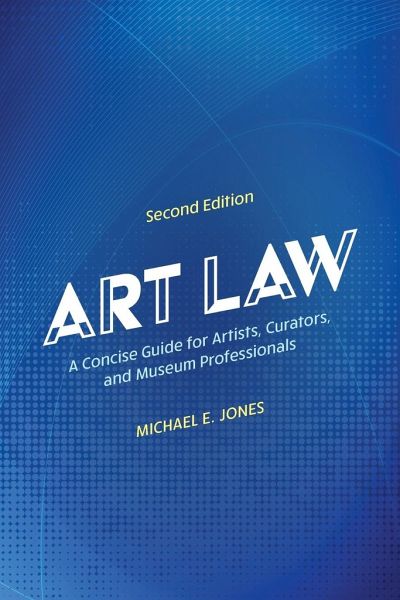
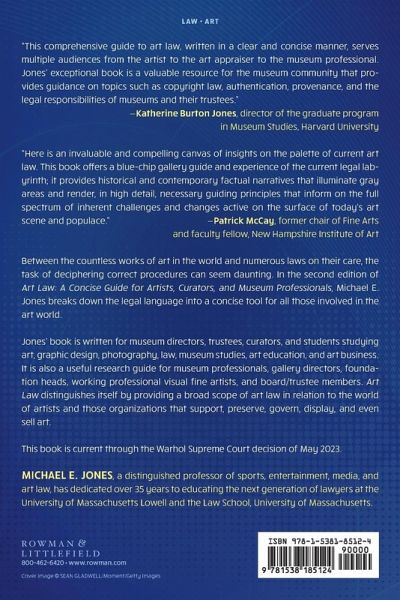
In Art Law: A Concise Guide for Artists, Curators, and Museum Professionals, Michael E. Jones breaks down the legal language into a concise tool for all those involved in the art world.
In Art Law: A Concise Guide for Artists, Curators, and Museum Professionals, Michael E. Jones breaks down the legal language into a concise tool for all those involved in the art world.
Michael E. Jones, Professor Emeritus at the University of Massachusetts Lowell, has spent decades at the intersection of ethics, technology, law and the humanities, helping students and professionals alike explore a world increasingly shaped by rapid digital transformation. For more than forty years, he has taught university courses that probe the ethical boundaries of emerging technologies, governance rules, and intellectual property and how these forces are reshaping our understanding of creativity, law, sports, and the arts. He has authored nine foundational books about sports law, entertainment law, and art law and has advised Olympic athletes, museums, and creative professionals at every level from PBS TV stars to street artists. But just as critically, he has pushed audiences to ask hard questions about fairness, authorship, and the human consequences of technological progress. His latest book, soon to be published by Bloomsbury later this year, What Art Is Now: Creativity in the Age of AI, tackles one of the most urgent: What happens to human creativity when machines can mimic or even replace it? Michael earned his undergraduate degree in Economics from Denison University, followed by an MBA from The Wharton School at the University of Pennsylvania. He went on to receive his law degree from the University of Miami and pursued further graduate degree studies in law and art at Harvard University. He studied fine art at the Art Students League and the New Hampshire Institute of Art, co-edited with his wife, Christine, a book on legendary photo-journalist Rowland Scherman, co-produced with Christine a film documentary on esteemed painter Nancy Ellen Craig, and has served on boards from Provincetown to academia to the Olympics.
Inhaltsangabe
List of Figures Preface Acknowledgments Ch 1. What is Art Law Ch 2. Artistic Freedom Censorship and Defamation Ch 3. Copyrights and AI Law Ch 4. Privacy Data Protection Right of Publicity and Trademarks Ch 5. Accessibility in the Arts: Race Gender and Ethnicity Ch 6. Acquisitions: Good Title Theft Forgery and Authentication Ch 7. Who Owns the Past: Ethical and Legal Challenges Ch 8. Museum Law Ch 9. Art Artists Critics and the Commerce of Creativity Ch 10. The Future of Art: NFTS Climate Digital and AI Art About the Author
List of Figures Preface Acknowledgments Ch 1. What is Art Law Ch 2. Artistic Freedom Censorship and Defamation Ch 3. Copyrights and AI Law Ch 4. Privacy Data Protection Right of Publicity and Trademarks Ch 5. Accessibility in the Arts: Race Gender and Ethnicity Ch 6. Acquisitions: Good Title Theft Forgery and Authentication Ch 7. Who Owns the Past: Ethical and Legal Challenges Ch 8. Museum Law Ch 9. Art Artists Critics and the Commerce of Creativity Ch 10. The Future of Art: NFTS Climate Digital and AI Art About the Author
Es gelten unsere Allgemeinen Geschäftsbedingungen: www.buecher.de/agb
Impressum
www.buecher.de ist ein Internetauftritt der buecher.de internetstores GmbH
Geschäftsführung: Monica Sawhney | Roland Kölbl | Günter Hilger
Sitz der Gesellschaft: Batheyer Straße 115 - 117, 58099 Hagen
Postanschrift: Bürgermeister-Wegele-Str. 12, 86167 Augsburg
Amtsgericht Hagen HRB 13257
Steuernummer: 321/5800/1497
USt-IdNr: DE450055826