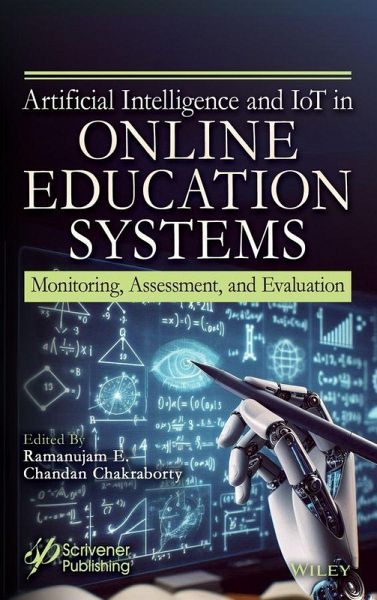
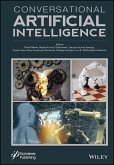
Design the future of digital education with this essential book that provides a comprehensive guide to leveraging AI and IoT to create dynamic, inclusive virtual learning environments and effectively implement advanced online proctoring solutions. The rapid development of online learning environments and virtual classrooms, coupled with the need for scalable, personalized education systems, has positioned AI as a key enabler of modern education. The advent of these technologies promises to reshape how we deliver, monitor, assess, and evaluate online learning. This book explores these critical…mehr
Design the future of digital education with this essential book that provides a comprehensive guide to leveraging AI and IoT to create dynamic, inclusive virtual learning environments and effectively implement advanced online proctoring solutions. The rapid development of online learning environments and virtual classrooms, coupled with the need for scalable, personalized education systems, has positioned AI as a key enabler of modern education. The advent of these technologies promises to reshape how we deliver, monitor, assess, and evaluate online learning. This book explores these critical intersections of technology and education, emphasizing the potential of AI and IoT not only to optimize outcomes but also to create more dynamic, responsive, and inclusive virtual learning environments. Focusing on problems that can be solved through computer vision, video and audio streaming, class imbalance data, audio-to-text processes, multi-modal and bi-modal aspects, hand-written strokes, text similarity, biomedical ethics, and advancements in machine and deep learning algorithms, this book comprehensively explores the effectiveness of these technologies in online proctoring. This essential guide will equip educators, technologists, administrators, and policymakers with the knowledge and perspective necessary to leverage these technologies effectively. Readers will find the book: * Explores various AI tools and techniques adopted for online proctoring examination systems; * Covers critical analytical aspects of AI-assisted systems; * Describes a variety of experiments leading to uni- and multi-modal systems and IoT-based architecture using computer vision, machine learning, and deep learning algorithms; * Discusses the quality assurance and psychological aspects to preserve ethics during examinations. Audience Educational researchers and policymakers, as well as computer scientists working in AI, machine learning, data science, deep learning, computer vision, and statistics.
Ramanujam E., PhD is an Assistant Professor in the Department of Computer Science and Engineering at the National Institute of Technology Silchar, Assam, India. He has contributed significantly to human activity recognition, especially online education and examinations, spam detection, and feature engineering across various domains. His areas of expertise include artificial intelligence, machine learning, deep learning, and ambient intelligence. Chandan Chakraborty, PhD is a Professor in the Department of Computer Science and Engineering at the National Institute of Technical Teachers' Training and Research, Kolkata, West Bengal, India. He has more than 100 peer-reviewed publications in top journals and holds several patents. He specializes in artificial intelligence, machine learning, deep learning, and biomedical engineering.
Inhaltsangabe
Preface xix Part 1: Introduction to AI Tools for Online Proctoring 1 1 AI Literacy and Online Proctoring: Educational Perspectives and Strategies 3 Prihana Vasishta, Gitanjaly Chhabra and Noosha Mehdian 1.1 Introduction 4 1.2 AI in Education - Theoretical Framework 6 1.3 AI-Assisted Educational Practices 8 1.4 Strengthening Teacher Preparation for AI Literacy in Higher Education Curricula 19 1.5 Conclusion and Implications 21 2 Next-Generation Online Education Integrating AI and IoT for Superior Management and Evaluation 27 Aniket Kumar, Rajesh Kumar, Akshay Kumar, Prashant D. Yelpale and Aman Thakur 2.1 Introduction 28 2.2 AI and IoT in Online Education Systems 31 2.3 Functional Structure of IoT System 41 2.4 Emerging Technologies in the Online Education System 45 2.5 Challenges of AI and IoT in Online Education System 54 2.6 The Future Vision of AI and IoT in Online Education Systems 562.7 Conclusion 58 Part 2: Ethics of Using AI Tools in Education 63 3 Ethical Integrity in Educational Contexts 65 C. Santhiya, Ravi Prasath S., Suriya Navaneetha Krishnan K. and Kannappan R. 3.1 Introduction 66 3.2 Types and Methods of Fake Credentials 67 3.3 Consequences of Fake Credentials 72 3.4 Challenges in Detecting and Verifying Fake Credentials 84 3.5 Role of Technology in Facilitating and Combating Fake Credentials 86 3.6 Impact on Organizational Reputation and Public Trust 90 3.7 Multi-Layered Approach to Tackling the Problem 91 3.8 Innovative Solutions and Technologies 94 3.9 Promoting Awareness and Education 96 3.10 Future Trends and Strategies 99 3.11 Conclusion 99 4 Psychological and Ethical Aspects of Using Intelligent Systems in Online Proctoring 103 Mukesh Chaware and Sreejith Alathur 4.1 Introduction 104 4.2 The Advent of AI in Online Proctoring 112 4.2.1 The Need for AI in Online Proctoring 112 4.3 The Prevailing Situation 116 4.4 Psychological Aspects 119 4.5 Ethical Aspects 124 4.6 Discussion and Recommendations 127 4.6.1 Strategies for Ethically Implementing AI in Online Proctoring 127 4.7 Conclusion 128 Part 3: State-of-the-Art AI Tools and Techniques for Online Proctoring 137 5 A Comprehensive Review of Deep Learning Models on Detecting Student Emotions in Online Education 139 Thangavel Murugan, A.M. Abirami and P. Karthikeyan 5.1 Introduction 140 5.2 Understanding Student Emotions 142 5.3 Overview of Deep Learning 143 5.4 Literature Review 144 5.5 Challenges in Detecting Student Emotions 153 5.6 Future Directions and Recommendations 158 5.7 Conclusion 159 6 Deep Learning Models for Monitoring Student's Emotion During the Class: A Comprehensive Survey 165 Vamshi Krishna B., N. Padmavathy and Ajeet Kumar 6.1 Introduction 166 6.2 Literature Survey 168 6.3 Research Background 178 6.4 Prediction Models for Tracking and Monitoring Students 193 6.5 Conclusion 197 7 Comparative Analysis of Head Pose Estimation and Eye Gaze Tracking with Machine Learning Classifiers for Proctored Online Examination 203 Rajarajeswari P., Shivagangatharani B. and Karthikeyan Jothikumar 7.1 Introduction 204 7.2 Benchmark Datasets for Head Pose and Eye Gaze Tracking 207 7.3 Apparatus for Estimating Head Pose and Tracking Eye Gaze 214 7.4 Models for Head Pose Estimation and Eye Gaze Tracking 217 7.5 Comparison of Models for Head Pose Estimation and Eye Gaze Tracking 224 7.6 Conclusion 226 8 Uni- and Multi-Modal Aspects in the Online Proctoring System: Survey 231 Diana Moses and Dainty M. 8.1 Introduction 232 8.2 AI-Based Online Proctoring System 240 8.3 Existing AI-Based Online Proctoring Frameworks 249 8.4 Challenges in AI-Based Online Proctoring Frameworks 253 8.5 Future Scope of AI-Based Proctoring Frameworks 256 8.6 Conclusion 259 9 Advancing Academic Integrity: AI and IoT in Enhancing Monitoring for Online Examination Systems 265 J. Shanthalakshmi Revathy and J. Mangaiyarkkarasi 9.1 Introduction 266 9.2 Predictive Analysis of Student Performance 267 9.3 Authentication of Students 271 9.4 Supervision of Examination 272 9.5 Challenges in Monitoring 279 9.6 Conclusion 283 10 Optimizing Academic Excellence: Leveraging Advanced AI Tools for Assessment and Evaluation in Modern Online Examination Systems 287 Manikandakumar M., Karthikeyan P., Senthamarai Kannan K., Arul V. and Vigneshwaran T. 10.1 Introduction 288 10.2 Role of AI in Online Examination Systems 289 10.3 Advanced AI Tools for Assessment 293 10.4 Implementing AI Tools in Online Examination Systems 308 10.5 Future Trends 310 10.6 Conclusion 311 Part 4: Case Studies: AI and IoT in Education, Online Proctoring 315 11 Evaluation of Web Design Deficiency and Anxiety Constructs, with Computer¿Based Test: Use Case in India 317 Juby Thomas, Ashique Ali K.A., Vishnu Achutha Menon, Sateesh Kumar T.K. and Lijo P. Thomas 11.1 Introduction 318 11.2 Review of Literature 319 11.3 Methodology 325 11.4 Results 328 11.5 Discussions 335 11.6 Conclusion 338 12 AI for Learners' Emotions - A Perspective Approach of Analysis During Online Assessments 343 S.J. Sheeba Sharon, R. Mary Sophia Chitra and C. Santhiya 12.1 Introduction 344 12.2 Literature Survey 346 12.3 Role of Emotions in Learning 349 12.4 Challenges in Online Assessments 350 12.5 The Rise of AI in Education 351 12.6 AI Tools for Monitoring Learner Emotions 351 12.7 Methodology 353 12.8 Advantages of Using AI Tools 356 12.9 Possible Implementational Risks 357 12.10 Demerits and Future Scope 358 12.11 Conclusion 359 13 Implementing Personalized Adaptive Online Assessments through Deep Learning 365 Fawad Naseer, Noreen Sattar, Akhtar Rasool, Kamel Jebreen and Usman Khalid 13.1 Introduction 366 13.2 Literature Review 368 13.3 Methodology 370 13.4 Case Studies 378 13.5 Results and Discussion 384 13.6 Conclusion 395 14 Generative Artificial Intelligence for Online Education Systems 399 Munmi Dutta and Vinay Kumar Goyal 14.1 Introduction 400 14.2 The Types of GAI Models 401 14.3 Working of GAI 401 14.4 Use Cases of GAI 406 14.5 The Limitations of GAI 407 14.6 Adaptive Learning Platforms 408 14.7 GAI and Adaptive Learning Intersection 409 14.8 Implications for Educators and Learners 412 14.9 GAI Effect on Workforce 412 14.10 GAI Has Already Transformed Education 413 14.11 Effect on the Participation and Performance of Learners 414 14.12 The Education Sector's Challenges with GAI 415 14.13 Policymakers and Educators Need to Reconsider the Current Educational Paradigm 418 14.14 Access and Equity Comes First 418 14.15 United Nations Educational, Scientific and Cultural Organization's (UNESCO's) Policy for Reshaping Education by Using GAI 419 14.16 Conclusion 420 15 Level of Academic Misconduct During Online Unproctored Examination with Perception of Engineering Students in India 423 S. Sasikala, G. Vidyasree, C. Selvan and R. Ragunath 15.1 Introduction 424 15.2 Literature Review 425 15.3 Research Methodology 428 15.4 Conclusion 439 16 Student Activity Monitoring Using Hybrid Deep Learning Technique During Online Examinations 443 Devi Naveen, Akshitha Katkeri, Manikantha K., A.K. Sreeja and Satish Kumar V. 16.1 Introduction 444 16.2 Related Works 447 16.3 Methodology - The Theoretical Foundation of the Proposed Model 451 16.4 Experimental Results and Discussion 456 16.5 Conclusion and Future Work 460 17 Multicue Facial Emotion Expression Using Lightweight Deep Learning Models 465 S. Hemaswathi, P. Rajkumar, N. Mohan Prabhu and R. Dhivya 17.1 Introduction 466 17.2 Related Works 469 17.3 Materials and Method 472 17.4 Experimental Result Analysis 478 17.5 Conclusion 482 Part 5: Challenges and Future Scope of AI in Online Proctoring 485 18 Machine-Learning-Based Online Assessment of Students' Academic Performance in Moodle Learning Management System 487 Reshma V.K., Nisha A.K., Radhika K. Manjusha, Divya P. and Sundaraselvan S. 18.1 Introduction 488 18.2 Literature Review 491 18.3 Research Methodology 493 18.4 Results and Discussion 496 18.5 Conclusion 509 18.6 Future Research 510 19 Issues and Challenges of Using Artificial Intelligence Proctoring Tools 515 V. Senthil 19.1 Introduction 515 19.2 Literature Review 517 19.3 Issues and Challenges of Using AI Proctoring Tools 522 19.4 Case Study 524 19.5 Conclusion 527 References 529 Index 533
Preface xix Part 1: Introduction to AI Tools for Online Proctoring 1 1 AI Literacy and Online Proctoring: Educational Perspectives and Strategies 3 Prihana Vasishta, Gitanjaly Chhabra and Noosha Mehdian 1.1 Introduction 4 1.2 AI in Education - Theoretical Framework 6 1.3 AI-Assisted Educational Practices 8 1.4 Strengthening Teacher Preparation for AI Literacy in Higher Education Curricula 19 1.5 Conclusion and Implications 21 2 Next-Generation Online Education Integrating AI and IoT for Superior Management and Evaluation 27 Aniket Kumar, Rajesh Kumar, Akshay Kumar, Prashant D. Yelpale and Aman Thakur 2.1 Introduction 28 2.2 AI and IoT in Online Education Systems 31 2.3 Functional Structure of IoT System 41 2.4 Emerging Technologies in the Online Education System 45 2.5 Challenges of AI and IoT in Online Education System 54 2.6 The Future Vision of AI and IoT in Online Education Systems 562.7 Conclusion 58 Part 2: Ethics of Using AI Tools in Education 63 3 Ethical Integrity in Educational Contexts 65 C. Santhiya, Ravi Prasath S., Suriya Navaneetha Krishnan K. and Kannappan R. 3.1 Introduction 66 3.2 Types and Methods of Fake Credentials 67 3.3 Consequences of Fake Credentials 72 3.4 Challenges in Detecting and Verifying Fake Credentials 84 3.5 Role of Technology in Facilitating and Combating Fake Credentials 86 3.6 Impact on Organizational Reputation and Public Trust 90 3.7 Multi-Layered Approach to Tackling the Problem 91 3.8 Innovative Solutions and Technologies 94 3.9 Promoting Awareness and Education 96 3.10 Future Trends and Strategies 99 3.11 Conclusion 99 4 Psychological and Ethical Aspects of Using Intelligent Systems in Online Proctoring 103 Mukesh Chaware and Sreejith Alathur 4.1 Introduction 104 4.2 The Advent of AI in Online Proctoring 112 4.2.1 The Need for AI in Online Proctoring 112 4.3 The Prevailing Situation 116 4.4 Psychological Aspects 119 4.5 Ethical Aspects 124 4.6 Discussion and Recommendations 127 4.6.1 Strategies for Ethically Implementing AI in Online Proctoring 127 4.7 Conclusion 128 Part 3: State-of-the-Art AI Tools and Techniques for Online Proctoring 137 5 A Comprehensive Review of Deep Learning Models on Detecting Student Emotions in Online Education 139 Thangavel Murugan, A.M. Abirami and P. Karthikeyan 5.1 Introduction 140 5.2 Understanding Student Emotions 142 5.3 Overview of Deep Learning 143 5.4 Literature Review 144 5.5 Challenges in Detecting Student Emotions 153 5.6 Future Directions and Recommendations 158 5.7 Conclusion 159 6 Deep Learning Models for Monitoring Student's Emotion During the Class: A Comprehensive Survey 165 Vamshi Krishna B., N. Padmavathy and Ajeet Kumar 6.1 Introduction 166 6.2 Literature Survey 168 6.3 Research Background 178 6.4 Prediction Models for Tracking and Monitoring Students 193 6.5 Conclusion 197 7 Comparative Analysis of Head Pose Estimation and Eye Gaze Tracking with Machine Learning Classifiers for Proctored Online Examination 203 Rajarajeswari P., Shivagangatharani B. and Karthikeyan Jothikumar 7.1 Introduction 204 7.2 Benchmark Datasets for Head Pose and Eye Gaze Tracking 207 7.3 Apparatus for Estimating Head Pose and Tracking Eye Gaze 214 7.4 Models for Head Pose Estimation and Eye Gaze Tracking 217 7.5 Comparison of Models for Head Pose Estimation and Eye Gaze Tracking 224 7.6 Conclusion 226 8 Uni- and Multi-Modal Aspects in the Online Proctoring System: Survey 231 Diana Moses and Dainty M. 8.1 Introduction 232 8.2 AI-Based Online Proctoring System 240 8.3 Existing AI-Based Online Proctoring Frameworks 249 8.4 Challenges in AI-Based Online Proctoring Frameworks 253 8.5 Future Scope of AI-Based Proctoring Frameworks 256 8.6 Conclusion 259 9 Advancing Academic Integrity: AI and IoT in Enhancing Monitoring for Online Examination Systems 265 J. Shanthalakshmi Revathy and J. Mangaiyarkkarasi 9.1 Introduction 266 9.2 Predictive Analysis of Student Performance 267 9.3 Authentication of Students 271 9.4 Supervision of Examination 272 9.5 Challenges in Monitoring 279 9.6 Conclusion 283 10 Optimizing Academic Excellence: Leveraging Advanced AI Tools for Assessment and Evaluation in Modern Online Examination Systems 287 Manikandakumar M., Karthikeyan P., Senthamarai Kannan K., Arul V. and Vigneshwaran T. 10.1 Introduction 288 10.2 Role of AI in Online Examination Systems 289 10.3 Advanced AI Tools for Assessment 293 10.4 Implementing AI Tools in Online Examination Systems 308 10.5 Future Trends 310 10.6 Conclusion 311 Part 4: Case Studies: AI and IoT in Education, Online Proctoring 315 11 Evaluation of Web Design Deficiency and Anxiety Constructs, with Computer¿Based Test: Use Case in India 317 Juby Thomas, Ashique Ali K.A., Vishnu Achutha Menon, Sateesh Kumar T.K. and Lijo P. Thomas 11.1 Introduction 318 11.2 Review of Literature 319 11.3 Methodology 325 11.4 Results 328 11.5 Discussions 335 11.6 Conclusion 338 12 AI for Learners' Emotions - A Perspective Approach of Analysis During Online Assessments 343 S.J. Sheeba Sharon, R. Mary Sophia Chitra and C. Santhiya 12.1 Introduction 344 12.2 Literature Survey 346 12.3 Role of Emotions in Learning 349 12.4 Challenges in Online Assessments 350 12.5 The Rise of AI in Education 351 12.6 AI Tools for Monitoring Learner Emotions 351 12.7 Methodology 353 12.8 Advantages of Using AI Tools 356 12.9 Possible Implementational Risks 357 12.10 Demerits and Future Scope 358 12.11 Conclusion 359 13 Implementing Personalized Adaptive Online Assessments through Deep Learning 365 Fawad Naseer, Noreen Sattar, Akhtar Rasool, Kamel Jebreen and Usman Khalid 13.1 Introduction 366 13.2 Literature Review 368 13.3 Methodology 370 13.4 Case Studies 378 13.5 Results and Discussion 384 13.6 Conclusion 395 14 Generative Artificial Intelligence for Online Education Systems 399 Munmi Dutta and Vinay Kumar Goyal 14.1 Introduction 400 14.2 The Types of GAI Models 401 14.3 Working of GAI 401 14.4 Use Cases of GAI 406 14.5 The Limitations of GAI 407 14.6 Adaptive Learning Platforms 408 14.7 GAI and Adaptive Learning Intersection 409 14.8 Implications for Educators and Learners 412 14.9 GAI Effect on Workforce 412 14.10 GAI Has Already Transformed Education 413 14.11 Effect on the Participation and Performance of Learners 414 14.12 The Education Sector's Challenges with GAI 415 14.13 Policymakers and Educators Need to Reconsider the Current Educational Paradigm 418 14.14 Access and Equity Comes First 418 14.15 United Nations Educational, Scientific and Cultural Organization's (UNESCO's) Policy for Reshaping Education by Using GAI 419 14.16 Conclusion 420 15 Level of Academic Misconduct During Online Unproctored Examination with Perception of Engineering Students in India 423 S. Sasikala, G. Vidyasree, C. Selvan and R. Ragunath 15.1 Introduction 424 15.2 Literature Review 425 15.3 Research Methodology 428 15.4 Conclusion 439 16 Student Activity Monitoring Using Hybrid Deep Learning Technique During Online Examinations 443 Devi Naveen, Akshitha Katkeri, Manikantha K., A.K. Sreeja and Satish Kumar V. 16.1 Introduction 444 16.2 Related Works 447 16.3 Methodology - The Theoretical Foundation of the Proposed Model 451 16.4 Experimental Results and Discussion 456 16.5 Conclusion and Future Work 460 17 Multicue Facial Emotion Expression Using Lightweight Deep Learning Models 465 S. Hemaswathi, P. Rajkumar, N. Mohan Prabhu and R. Dhivya 17.1 Introduction 466 17.2 Related Works 469 17.3 Materials and Method 472 17.4 Experimental Result Analysis 478 17.5 Conclusion 482 Part 5: Challenges and Future Scope of AI in Online Proctoring 485 18 Machine-Learning-Based Online Assessment of Students' Academic Performance in Moodle Learning Management System 487 Reshma V.K., Nisha A.K., Radhika K. Manjusha, Divya P. and Sundaraselvan S. 18.1 Introduction 488 18.2 Literature Review 491 18.3 Research Methodology 493 18.4 Results and Discussion 496 18.5 Conclusion 509 18.6 Future Research 510 19 Issues and Challenges of Using Artificial Intelligence Proctoring Tools 515 V. Senthil 19.1 Introduction 515 19.2 Literature Review 517 19.3 Issues and Challenges of Using AI Proctoring Tools 522 19.4 Case Study 524 19.5 Conclusion 527 References 529 Index 533
Es gelten unsere Allgemeinen Geschäftsbedingungen: www.buecher.de/agb
Impressum
www.buecher.de ist ein Internetauftritt der buecher.de internetstores GmbH
Geschäftsführung: Monica Sawhney | Roland Kölbl | Günter Hilger
Sitz der Gesellschaft: Batheyer Straße 115 - 117, 58099 Hagen
Postanschrift: Bürgermeister-Wegele-Str. 12, 86167 Augsburg
Amtsgericht Hagen HRB 13257
Steuernummer: 321/5800/1497
USt-IdNr: DE450055826