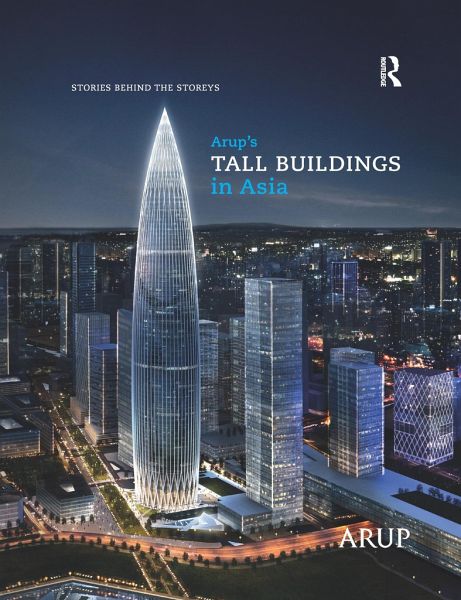
Through a series of detailed case studies from East Asia, Arup, one of the global leaders in tall building design, presents the latest developments in the field to inspire more innovative and sustainable ideas in tall building design and engineering. This book exhibits the key design aspects of tall buildings in 20 case studies, from China, Singapore, Hong Kong, Vietnam and Japan. Chapters cover design and construction, safety concerns, sustainability strategies, BIM and optimisation solutions, and include contributions from the actual project engineers. The projects chosen are not the tallest…mehr
Through a series of detailed case studies from East Asia, Arup, one of the global leaders in tall building design, presents the latest developments in the field to inspire more innovative and sustainable ideas in tall building design and engineering. This book exhibits the key design aspects of tall buildings in 20 case studies, from China, Singapore, Hong Kong, Vietnam and Japan. Chapters cover design and construction, safety concerns, sustainability strategies, BIM and optimisation solutions, and include contributions from the actual project engineers. The projects chosen are not the tallest buildings, but all of them have been selected for their significant engineering insights and values. Arup's engineers explain the design principles, and how they overcame various design constraints and challenges, while exceeding their clients' expectations. Unique examples include: the design and application of a hybrid outrigger system in the Raffles City Chongqing project the challenges encountered in the construction of the CCTV Headquarters, Beijing as well as Tianjin's Goldin Finance 117 Tower, Ho Chi Minh City's Vincom Landmark 81, the China Resources Headquarters, Ping An IFC, Tokyo's Nicolas G Hayek Center and the Shanghai World Financial Centre. These varied and complex cases studies draw on multi-disciplinary design and engineering challenges which make this book essential reading for architects, structural engineers, project managers and researchers of high-rise buildings. The book also provides a usual reference and link between practitioners in the industry, academia and engineering students.
Goman Wai-Ming Ho is an Arup Fellow. He has extensive experience in multi-disciplinary and mega scale and tall building projects especially in East Asia Region. He is currently the global leader of Tall Building Skills Network. He joined Arup in 1992 after completing his PhD at Hong Kong Polytechnic University. His has been involved in projects across the East Asia Region including: Hong Kong, Japan, Korea, Mainland China, Myanmar, the Philippines, Taiwan and Vietnam. He is a registered Chartered Engineer in the UK, Registered Professional Engineer in Hong Kong and First Class Registered Structural Engineer in the People's Republic of China.
Inhaltsangabe
About ARUP ix Preface: overview of the book and Arup's building design philosophy x goman wai-ming ho, arup fellow, tall buildings skill leader Foreword xii michael kwok, east asia region chairman, arup Foreword xiii prof. you-lin xu , dean of faculty of construction and environment, the hong kong polytechnic university CHAPTER 1: AMBITIOUSLY TALL 1 Tall buildings are viewed as a symbol of a city's socio-economic power and the source of pride of its people; they are becoming increasingly tall and peculiar in shape. How can we realise height? 1a Raffles City Chongqing, Chongqing, China 3 A patented hybrid outrigger system to achieve 9.4 slenderness ratio in two 350m tall buildings. Also a 280m long seismically isolated glass-clad conservatory floating 265m above the ground. 1b Tianjin Goldin Finance 117 Tower, Tianjin, China 13 597m tall building in high seismicity region, supported by four steel mega columns, perimeter cross-bracing and belt trusses. 1c The Masterpiece (K11), Hong Kong 21 Vertical pre-stressing with belt truss and outrigger to realise a reinforced concrete building with an aspect ratio of 12. CHAPTER 2: Facilitating construction 29 Tall buildings, especially those in iconic shapes, often suffer from high risks in construction safety and costs. As designers and engineers, what are we doing to facilitate construction, ensure safety and reduce construction time and cost? 2a CCTV Headquarters, Beijing, China 31 Joining two 75m long cantilever steelwork from two inclined towers at 162m above ground; wind, temperature, stress built in the two inclined towers all matter. 2b Vincom Landmark 81, Ho Chi Minh City, Vietnam 39 Tallest building in Vietnam upon completion. Difficult ground conditions, large scale of the project and fast-paced programme all pose challenges to the pile design and construction. 2c Tianjin Goldin Finance 117 Tower, Tianjin, China 47 Soft soil and deep stiff strata resulted in a foundation system with 941 100m long 1m diameter friction piles. 2d Tianjin Chow Tai Fook Finance Center, Tianjin, China 55 The curvatures along this 530m tall building yield more than 20,000 unique irregular façade panels; Arup rationalised them to just over a thousand. CHAPTER 3: All in one, vertically integrated 61 Today, tall buildings are often cities within a city, embracing all major functions of a city - office, hotel, retail, residential and so on. But how can we make the best use of space and make all the services function well together, vertically? 3a Changsha International Finance Square, Changsha, China 63 Effective vertical transportation strategy to achieve high handling capacity with minimum space. 3b Guangzhou International Finance Centre, Guangzhou, China 71 Mixed-use tower has different MEP requirements at different building zones. Optimisation is crucial to ensure maximum rentable area. CHAPTER 4: Safe and comfortable 79 Many people are afraid of getting trapped in a tall building during extreme events such as fires, earthquakes and super typhoons. Are our tall buildings designed safe enough? 4a China Zun (Z15), Beijing, China 81 Structural fire engineering explains the possible interaction between different structural members during a fire, allowing us to go beyond the prescriptive design codes. 4b Nicolas G. Hayek Center, Tokyo, Japan 89 An innovative "self-mass damper" system which transfers the floor slabs to mass dampers to ensure no collapse in a one-in-a-1000-year earthquake in Tokyo. 4c Shanghai World Financial Centre, Shanghai, China 97 The first Chinese lift-assisted evacuation strategy, reducing the evacuation time by almost 40% in this 101-storey building. 4d China Resources Headquarters, Shenzhen, China 105 Apart from ensuring the tall building is safe in typhoons and earthquakes, we also adopted a motion simulator to help the client determine the comfort criteria. CHAPTER 5: Green building 113 Tall buildings are a major source of carbon emissions in cities due to energy consumption in their heating, cooling and ventilation systems. They also have adverse effects on the microclimate. How can we minimise their environmental impact and unleash their potential environmental advantages? 5a China Resources Building, Hong Kong 115 Strategies to make a 25-year-old building save 27% water and 8% energy consumption. 5b Ping An International Finance Centre, Shenzhen, China 123 Specific challenges in making a 599m super-tall building "green" and Arup's solutions. 5c Hysan Place, Hong Kong 131 A LEED-CS Platinum project that not only benefits the building owner and users, but also the community. How? CHAPTER 6: Design in the digital age 139 Digital tools are influencing how buildings are designed. They save time and give confidence to designers to move away from conventional buildings towards unusual forms; they are also revolutionising the construction process by integrating the way different disciplines work. 6a M+, Hong Kong 141 Implementing BIM from the very beginning of the design for better design coordination and quicker design calculation. 6b China Zun (Z15), Beijing, China 151 Parametric design has enabled automatic design processes and optimised structural solutions. CHAPTER 7: Total Design 159 An integrated approach is particularly important in tall buildings, where many skills are needed to make the complex web of systems function effectively for the vertical cities. Collaboration is often the most powerful design tool to bring optimum solutions. 7a Canton Tower, Guangzhou, China 161 An integrated effort by Arup's structural and building services engineers, specialists in fire, seismic and wind, and lighting designers has realised the most elegant TV tower in the world. 7b Marina Bay Sands, Singapore 173 This mega project took four years to design and construct; without the multi-disciplinary and global Arup team, this would have been impossible. Index 185
About ARUP ix Preface: overview of the book and Arup's building design philosophy x goman wai-ming ho, arup fellow, tall buildings skill leader Foreword xii michael kwok, east asia region chairman, arup Foreword xiii prof. you-lin xu , dean of faculty of construction and environment, the hong kong polytechnic university CHAPTER 1: AMBITIOUSLY TALL 1 Tall buildings are viewed as a symbol of a city's socio-economic power and the source of pride of its people; they are becoming increasingly tall and peculiar in shape. How can we realise height? 1a Raffles City Chongqing, Chongqing, China 3 A patented hybrid outrigger system to achieve 9.4 slenderness ratio in two 350m tall buildings. Also a 280m long seismically isolated glass-clad conservatory floating 265m above the ground. 1b Tianjin Goldin Finance 117 Tower, Tianjin, China 13 597m tall building in high seismicity region, supported by four steel mega columns, perimeter cross-bracing and belt trusses. 1c The Masterpiece (K11), Hong Kong 21 Vertical pre-stressing with belt truss and outrigger to realise a reinforced concrete building with an aspect ratio of 12. CHAPTER 2: Facilitating construction 29 Tall buildings, especially those in iconic shapes, often suffer from high risks in construction safety and costs. As designers and engineers, what are we doing to facilitate construction, ensure safety and reduce construction time and cost? 2a CCTV Headquarters, Beijing, China 31 Joining two 75m long cantilever steelwork from two inclined towers at 162m above ground; wind, temperature, stress built in the two inclined towers all matter. 2b Vincom Landmark 81, Ho Chi Minh City, Vietnam 39 Tallest building in Vietnam upon completion. Difficult ground conditions, large scale of the project and fast-paced programme all pose challenges to the pile design and construction. 2c Tianjin Goldin Finance 117 Tower, Tianjin, China 47 Soft soil and deep stiff strata resulted in a foundation system with 941 100m long 1m diameter friction piles. 2d Tianjin Chow Tai Fook Finance Center, Tianjin, China 55 The curvatures along this 530m tall building yield more than 20,000 unique irregular façade panels; Arup rationalised them to just over a thousand. CHAPTER 3: All in one, vertically integrated 61 Today, tall buildings are often cities within a city, embracing all major functions of a city - office, hotel, retail, residential and so on. But how can we make the best use of space and make all the services function well together, vertically? 3a Changsha International Finance Square, Changsha, China 63 Effective vertical transportation strategy to achieve high handling capacity with minimum space. 3b Guangzhou International Finance Centre, Guangzhou, China 71 Mixed-use tower has different MEP requirements at different building zones. Optimisation is crucial to ensure maximum rentable area. CHAPTER 4: Safe and comfortable 79 Many people are afraid of getting trapped in a tall building during extreme events such as fires, earthquakes and super typhoons. Are our tall buildings designed safe enough? 4a China Zun (Z15), Beijing, China 81 Structural fire engineering explains the possible interaction between different structural members during a fire, allowing us to go beyond the prescriptive design codes. 4b Nicolas G. Hayek Center, Tokyo, Japan 89 An innovative "self-mass damper" system which transfers the floor slabs to mass dampers to ensure no collapse in a one-in-a-1000-year earthquake in Tokyo. 4c Shanghai World Financial Centre, Shanghai, China 97 The first Chinese lift-assisted evacuation strategy, reducing the evacuation time by almost 40% in this 101-storey building. 4d China Resources Headquarters, Shenzhen, China 105 Apart from ensuring the tall building is safe in typhoons and earthquakes, we also adopted a motion simulator to help the client determine the comfort criteria. CHAPTER 5: Green building 113 Tall buildings are a major source of carbon emissions in cities due to energy consumption in their heating, cooling and ventilation systems. They also have adverse effects on the microclimate. How can we minimise their environmental impact and unleash their potential environmental advantages? 5a China Resources Building, Hong Kong 115 Strategies to make a 25-year-old building save 27% water and 8% energy consumption. 5b Ping An International Finance Centre, Shenzhen, China 123 Specific challenges in making a 599m super-tall building "green" and Arup's solutions. 5c Hysan Place, Hong Kong 131 A LEED-CS Platinum project that not only benefits the building owner and users, but also the community. How? CHAPTER 6: Design in the digital age 139 Digital tools are influencing how buildings are designed. They save time and give confidence to designers to move away from conventional buildings towards unusual forms; they are also revolutionising the construction process by integrating the way different disciplines work. 6a M+, Hong Kong 141 Implementing BIM from the very beginning of the design for better design coordination and quicker design calculation. 6b China Zun (Z15), Beijing, China 151 Parametric design has enabled automatic design processes and optimised structural solutions. CHAPTER 7: Total Design 159 An integrated approach is particularly important in tall buildings, where many skills are needed to make the complex web of systems function effectively for the vertical cities. Collaboration is often the most powerful design tool to bring optimum solutions. 7a Canton Tower, Guangzhou, China 161 An integrated effort by Arup's structural and building services engineers, specialists in fire, seismic and wind, and lighting designers has realised the most elegant TV tower in the world. 7b Marina Bay Sands, Singapore 173 This mega project took four years to design and construct; without the multi-disciplinary and global Arup team, this would have been impossible. Index 185
Es gelten unsere Allgemeinen Geschäftsbedingungen: www.buecher.de/agb
Impressum
www.buecher.de ist ein Internetauftritt der buecher.de internetstores GmbH
Geschäftsführung: Monica Sawhney | Roland Kölbl | Günter Hilger
Sitz der Gesellschaft: Batheyer Straße 115 - 117, 58099 Hagen
Postanschrift: Bürgermeister-Wegele-Str. 12, 86167 Augsburg
Amtsgericht Hagen HRB 13257
Steuernummer: 321/5800/1497
USt-IdNr: DE450055826