
Andere Kunden interessierten sich auch für
 Some Principles of Maritime Strategy44,99 €
 India's Naval Strategy and Asian Security69,99 €
 India's Naval Strategy and Asian Security177,99 €
 US Naval Strategy and National Security186,99 €
 Toward a New Maritime Strategy36,99 €
 A Brief Guide to Maritime Strategy33,99 €
 The Pacific War18,99 €



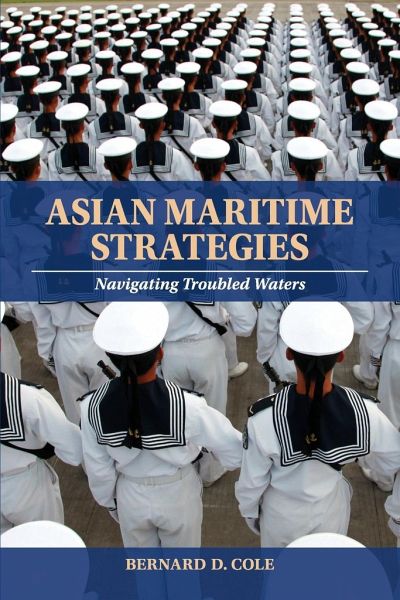
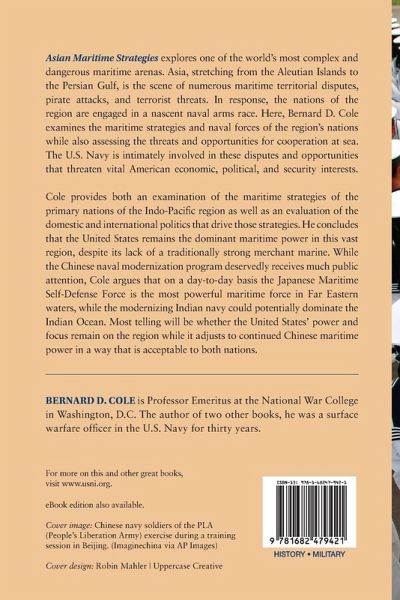
Asian Maritime Strategies explores one of the world’s most complex and dangerous maritime arenas. Asia, stretching from the Aleutian Islands to the Persian Gulf, is the scene of numerous maritime territorial disputes, pirate attacks, and terrorist threats. In response, the nations of the region are engaged in a nascent naval arms race. In this new work, Bernard Cole, author of the acclaimed The Great Wall At Sea, examines the maritime strategies and naval forces of the region’s nations while also assessing the threats and opportunities for cooperation at sea. The U.S. Navy is intimately involved in these disputes and opportunities, which threaten vital American economic, political, and security interests. The most useful geographical designation for maritime Asia is the "Indo-Pacific," and Cole provides both an examination of the maritime strategies of the primary nations of the Indo-Pacific region as well as an evaluation of the domestic and international politics that drive those strategies. The United States, Japan, China, India, Canada, Russia, North Korea, South Korea, the Philippines, Brunei, Indonesia, Vietnam, Singapore, Malaysia, Myanmar, Pakistan, Iran, and the smaller Indian Ocean and Persian Gulf states are all surveyed and analyzed, with the first four countries receiving the most attention due to their large, modern navies and distant strategic reach. The author concludes that the United States remains the dominant maritime power in this huge region, despite its lack of a traditionally strong merchant marine. While the Chinese naval modernization program deservedly receives a good deal of public attention, Cole argues that on a day-to-day basis the Japanese Maritime Self-Defense Force, as its navy is named, is the most powerful maritime force in Far Eastern waters, while the modernizing Indian navy potentially dominates the Indian Ocean. Most telling will be whether the United States’ power and focus remain on the region while it adjusts to continued Chinese maritime power in a way that is acceptable to both nations. No other current or recent work provides such a complete description of the Indo-Pacific region’s navies and maritime strategies, while analyzing the current and future impact of those forces.