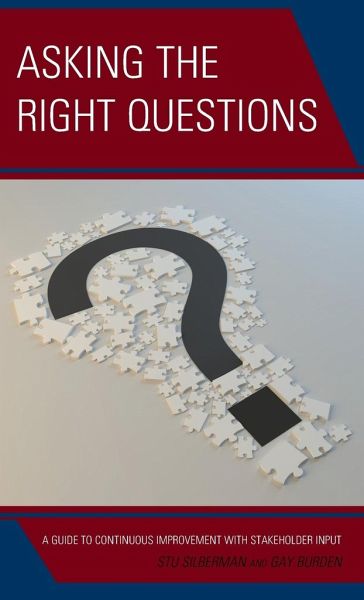
Stu Silberman, Gay Burden
Asking the Right Questions
A Guide to Continuous Improvement with Stakeholder Input
Stu Silberman, Gay Burden
Asking the Right Questions
A Guide to Continuous Improvement with Stakeholder Input
- Gebundenes Buch
- Merkliste
- Auf die Merkliste
- Bewerten Bewerten
- Teilen
- Produkt teilen
- Produkterinnerung
- Produkterinnerung
This four-question model is an inquiry-based approach to leadership that gets to the heart of an organization's DNA.
Andere Kunden interessierten sich auch für
Stu SilbermanAsking the Right Questions24,99 €
Jane C. FlinnFun Facts to Engage Students28,99 €
Gerard GiordanoCommon Sense Questions about School Administration38,99 €
Gerard GiordanoCommon Sense Questions About Learners41,99 €
Gerard GiordanoCommon Sense Questions About Learners77,99 €
Gerard GiordanoCommon Sense Questions about Tests50,99 €
Gerard GiordanoCommon Sense Questions about Tests92,99 €-
-
-
This four-question model is an inquiry-based approach to leadership that gets to the heart of an organization's DNA.
Produktdetails
- Produktdetails
- Verlag: Rowman & Littlefield Publishers
- Seitenzahl: 96
- Erscheinungstermin: 31. Dezember 2019
- Englisch
- Abmessung: 222mm x 145mm x 9mm
- Gewicht: 263g
- ISBN-13: 9781475852578
- ISBN-10: 1475852576
- Artikelnr.: 56738007
- Herstellerkennzeichnung
- Libri GmbH
- Europaallee 1
- 36244 Bad Hersfeld
- gpsr@libri.de
- Verlag: Rowman & Littlefield Publishers
- Seitenzahl: 96
- Erscheinungstermin: 31. Dezember 2019
- Englisch
- Abmessung: 222mm x 145mm x 9mm
- Gewicht: 263g
- ISBN-13: 9781475852578
- ISBN-10: 1475852576
- Artikelnr.: 56738007
- Herstellerkennzeichnung
- Libri GmbH
- Europaallee 1
- 36244 Bad Hersfeld
- gpsr@libri.de
Stu Silberman has been a teacher, principal, superintendent and the executive director of the Prichard Committee for Academic Excellence. Stu was Kentucky's superintendent of the year three times and a final four national superintendent of the year.
Table of Contents
Foreward
Preface and Acknowledgments
Introduction
Chapter 1: Four-Question Model Overview
Modeling Connected Leadership
About the Authors
Determining Your Schools DNA
The Four-Question Model
Collective Efficacy
Stakeholder Focus Group Meetings
Sample Groups
Analyzing and Sharing the Results
To Sum Up
Reflective Questions/Activities
Chapter 2: What is working--things you do not want to change?
What's Working and How do we Know it's Working?
District Leadership Modeling
What's Your Leadership Style?
To Sum Up
Reflective Questions/Activities
Chapter 3: What needs to be changed to make this a better place for kids?
Christmas Trees and Kitchen Sinks
Student Voice
Weeding the Garden
College and Career Readiness
Creating Buy-in on the Front-end
To Sum Up
Reflective Questions/Activities
Chapter 4: What needs to be changed to make this a better place for adults?
Human Side of Change
Top-Down and Grassroots Effort
Symbolism
Recognizing the Super Stars
Dealing with Naysayers
The Abilene Paradox
To Sum Up
Reflective Questions/Activities
Chapter 5: What can I do, as your leader, to do a better job?
A Learning Leader is Vulnerable
Visioning and Establishing Purpose
A Clear Communication Plan
Celebrate Victories
Collective Capacity
A Practitioner's Story
Clearly Document the Process
To Sum Up
Reflective Questions/Activities
Appendix A: Debriefing Strategy: Think-a-Thon
References
About the Author
Foreward
Preface and Acknowledgments
Introduction
Chapter 1: Four-Question Model Overview
Modeling Connected Leadership
About the Authors
Determining Your Schools DNA
The Four-Question Model
Collective Efficacy
Stakeholder Focus Group Meetings
Sample Groups
Analyzing and Sharing the Results
To Sum Up
Reflective Questions/Activities
Chapter 2: What is working--things you do not want to change?
What's Working and How do we Know it's Working?
District Leadership Modeling
What's Your Leadership Style?
To Sum Up
Reflective Questions/Activities
Chapter 3: What needs to be changed to make this a better place for kids?
Christmas Trees and Kitchen Sinks
Student Voice
Weeding the Garden
College and Career Readiness
Creating Buy-in on the Front-end
To Sum Up
Reflective Questions/Activities
Chapter 4: What needs to be changed to make this a better place for adults?
Human Side of Change
Top-Down and Grassroots Effort
Symbolism
Recognizing the Super Stars
Dealing with Naysayers
The Abilene Paradox
To Sum Up
Reflective Questions/Activities
Chapter 5: What can I do, as your leader, to do a better job?
A Learning Leader is Vulnerable
Visioning and Establishing Purpose
A Clear Communication Plan
Celebrate Victories
Collective Capacity
A Practitioner's Story
Clearly Document the Process
To Sum Up
Reflective Questions/Activities
Appendix A: Debriefing Strategy: Think-a-Thon
References
About the Author
Table of Contents
Foreward
Preface and Acknowledgments
Introduction
Chapter 1: Four-Question Model Overview
Modeling Connected Leadership
About the Authors
Determining Your Schools DNA
The Four-Question Model
Collective Efficacy
Stakeholder Focus Group Meetings
Sample Groups
Analyzing and Sharing the Results
To Sum Up
Reflective Questions/Activities
Chapter 2: What is working--things you do not want to change?
What's Working and How do we Know it's Working?
District Leadership Modeling
What's Your Leadership Style?
To Sum Up
Reflective Questions/Activities
Chapter 3: What needs to be changed to make this a better place for kids?
Christmas Trees and Kitchen Sinks
Student Voice
Weeding the Garden
College and Career Readiness
Creating Buy-in on the Front-end
To Sum Up
Reflective Questions/Activities
Chapter 4: What needs to be changed to make this a better place for adults?
Human Side of Change
Top-Down and Grassroots Effort
Symbolism
Recognizing the Super Stars
Dealing with Naysayers
The Abilene Paradox
To Sum Up
Reflective Questions/Activities
Chapter 5: What can I do, as your leader, to do a better job?
A Learning Leader is Vulnerable
Visioning and Establishing Purpose
A Clear Communication Plan
Celebrate Victories
Collective Capacity
A Practitioner's Story
Clearly Document the Process
To Sum Up
Reflective Questions/Activities
Appendix A: Debriefing Strategy: Think-a-Thon
References
About the Author
Foreward
Preface and Acknowledgments
Introduction
Chapter 1: Four-Question Model Overview
Modeling Connected Leadership
About the Authors
Determining Your Schools DNA
The Four-Question Model
Collective Efficacy
Stakeholder Focus Group Meetings
Sample Groups
Analyzing and Sharing the Results
To Sum Up
Reflective Questions/Activities
Chapter 2: What is working--things you do not want to change?
What's Working and How do we Know it's Working?
District Leadership Modeling
What's Your Leadership Style?
To Sum Up
Reflective Questions/Activities
Chapter 3: What needs to be changed to make this a better place for kids?
Christmas Trees and Kitchen Sinks
Student Voice
Weeding the Garden
College and Career Readiness
Creating Buy-in on the Front-end
To Sum Up
Reflective Questions/Activities
Chapter 4: What needs to be changed to make this a better place for adults?
Human Side of Change
Top-Down and Grassroots Effort
Symbolism
Recognizing the Super Stars
Dealing with Naysayers
The Abilene Paradox
To Sum Up
Reflective Questions/Activities
Chapter 5: What can I do, as your leader, to do a better job?
A Learning Leader is Vulnerable
Visioning and Establishing Purpose
A Clear Communication Plan
Celebrate Victories
Collective Capacity
A Practitioner's Story
Clearly Document the Process
To Sum Up
Reflective Questions/Activities
Appendix A: Debriefing Strategy: Think-a-Thon
References
About the Author