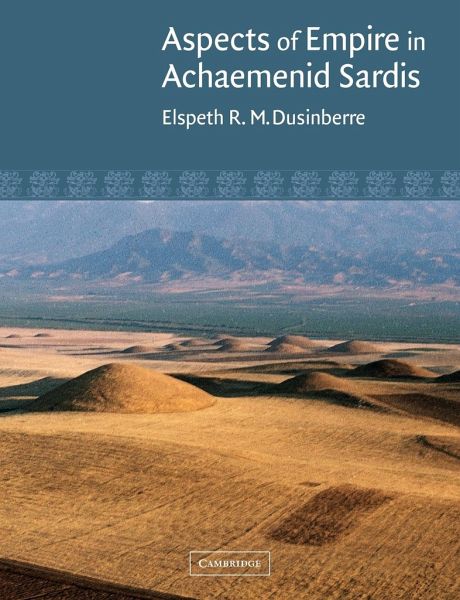
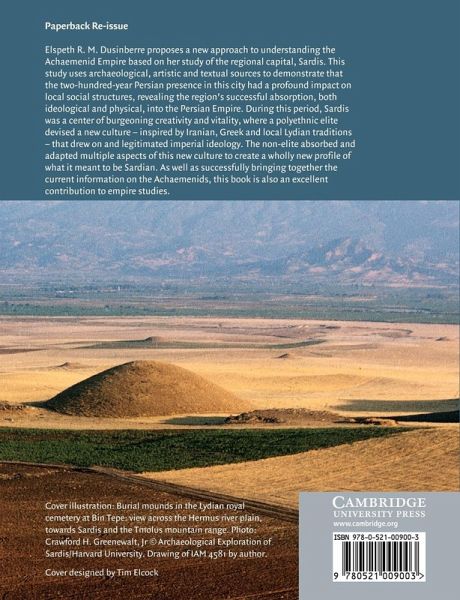
Elspeth R. M. Dusinberre proposes a fresh approach to understanding the Achaemenid Empire based on her study of the regional capital, Sardis. This study uses archaeological, artistic and textual sources to demonstrate that the two-hundred-year Persian presence in this city had a profound impact on local social structures, revealing the region's successful absorption, both ideological and physical, into the Persian Empire. During this period, Sardis was a centre of burgeoning creativity and vitality, where a polyethnic elite devised a fresh culture - inspired by Iranian, Greek and local Lydian…mehr
Elspeth R. M. Dusinberre proposes a fresh approach to understanding the Achaemenid Empire based on her study of the regional capital, Sardis. This study uses archaeological, artistic and textual sources to demonstrate that the two-hundred-year Persian presence in this city had a profound impact on local social structures, revealing the region's successful absorption, both ideological and physical, into the Persian Empire. During this period, Sardis was a centre of burgeoning creativity and vitality, where a polyethnic elite devised a fresh culture - inspired by Iranian, Greek and local Lydian traditions - that drew on and legitimated imperial ideology. The non-elite absorbed and adapted multiple aspects of this culture to create a wholly different profile of what it meant to be Sardian. As well as successfully bringing together information on the Achaemenids, this book is also an excellent contribution to empire studies.
Elspeth R. M. Dusinberre (PhD, Michigan, 1997) is interested in cultural interactions in Anatolia, particularly in the ways in which the Achaemenid Empire affected local social structures and in the give-and-take between Achaemenid and other cultures. Aspects of Empire in Achaemenid Sardis (her first book) examines such issues from the vantage of the Lydian capital, while her third book, Empire, Authority, and Autonomy in Achaemenid Anatolia (Cambridge University Press, 2013) considers all of Anatolia. Her second book is a diachronic excavation monograph, Gordion Seals and Sealings: Individuals and Society (2005). She is currently studying the seal impressions on the Aramaic tablets of the Persepolis Fortification Archive (dating ca.500 BCE), and the cremation burials from Gordion. She has worked at Sardis, Gordion, and Kerkenes Dag in Turkey, as well as at sites elsewhere in the eastern Mediterranean. Professor Dusinberre teaches primarily Greek and Near Eastern archaeology. She has been awarded six University of Colorado teaching awards, the Chancellor's Faculty Recognition Award, and the Faculty Graduate Advisor Award.
Inhaltsangabe
List of figures Preface List of abbreviations 1. Sardis in the Achaemenid empire 2. Textual sources and the effects of empire 3. The urban structure of Achaemenid Sardis: monuments and meaning 4. The urban structure of Achaemenid Sardis: sculpture and society 5. Inscriptions: Sardians in their own words 6. Mortuary evidence: dead and living societies 7. Personal signifiers: Sealstones 8. Achaemenid bowls: ceramic assemblages and the non-elite 9. Conclusion: Imperialism and Achaemenid Sardis Appendices References Index.
List of figures Preface List of abbreviations 1. Sardis in the Achaemenid empire 2. Textual sources and the effects of empire 3. The urban structure of Achaemenid Sardis: monuments and meaning 4. The urban structure of Achaemenid Sardis: sculpture and society 5. Inscriptions: Sardians in their own words 6. Mortuary evidence: dead and living societies 7. Personal signifiers: Sealstones 8. Achaemenid bowls: ceramic assemblages and the non-elite 9. Conclusion: Imperialism and Achaemenid Sardis Appendices References Index.
Es gelten unsere Allgemeinen Geschäftsbedingungen: www.buecher.de/agb
Impressum
www.buecher.de ist ein Internetauftritt der buecher.de internetstores GmbH
Geschäftsführung: Monica Sawhney | Roland Kölbl | Günter Hilger
Sitz der Gesellschaft: Batheyer Straße 115 - 117, 58099 Hagen
Postanschrift: Bürgermeister-Wegele-Str. 12, 86167 Augsburg
Amtsgericht Hagen HRB 13257
Steuernummer: 321/5800/1497
USt-IdNr: DE450055826