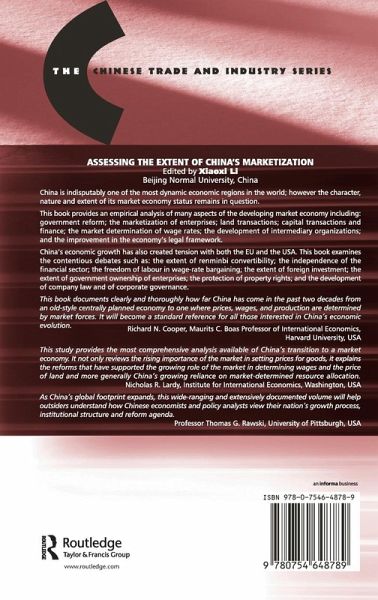
This book outlines the development process of China's market economy, analyzes the efforts made and the results obtained by China when striving for a resolution to the non-market economy issue. In doing so, it expounds the researchers' views on this important issue.
This book outlines the development process of China's market economy, analyzes the efforts made and the results obtained by China when striving for a resolution to the non-market economy issue. In doing so, it expounds the researchers' views on this important issue.
Xiaoxi Li is Director and Professor of the Institute of Economic and Resources Management with Beijing Normal University, China and an Invited Professor with Peking University and the Graduate School of the Chinese Academy of Social Sciences (CASS). Li has been well known as one of major advocators of China's market-oriented reforms in the 1980s as well as an authority on assessing the extent of China's marketization during recent years.
Inhaltsangabe
Introduction Part 1 New Progress in Market Economy in 2002 and 2003 Chapter 1 Reform of Government Administrative System Chapter 2 Marketization of Enterprises Chapter 3 Labor Flow and Market Determination of Wage Rates Chapter 4 Market-determined Capital Transaction Chapter 5 Market-oriented Land Transaction Chapter 6 Marketization of Trade Chapter 7 Scale of Intermediary Organizations and Their Market-oriented Operations Chapter 8 Marketization of Money and Finance Chapter 9 Improvement in China's Market Economy Legal Framework Chapter 10 Evaluation of the Degree of China's Market Economy Development in 2002-2003 Part 2 The Development of China's Market Ecomony by Western Standards Chapter 11 The Free Convertibility of Renminbi Chapter 12 Independence of the Financial Sector Chapter 13 Freedom of the Employee in Bargaining with the Employer for Wage Rates Chapter 14 Extent of Admission of Foreign Investment Chapter 15 Extent of Government Ownership or Control of the Means of Production and Enterprises Chapter 16 Extent of Government Control over the Output, Price and Sales Decisions of Enterprises and over the Allocation of Resources Chapter 17 The Protection of Property Rights and the Bankruptcy Law Chapter 18 Implementation of Laws and Regulations Relating to Investment and Taxation Chapter 19 Company Law and Corporate Governance Chapter 20 Laws on Enterprise Accounting and Auditing Standards and their Enforcement Chapter 21 The Use and Disposal of State-owned Enterprises' Assets Chapter 22 Analysing Corruption, Trade Ties, and Other Factors
Introduction Part 1 New Progress in Market Economy in 2002 and 2003 Chapter 1 Reform of Government Administrative System Chapter 2 Marketization of Enterprises Chapter 3 Labor Flow and Market Determination of Wage Rates Chapter 4 Market-determined Capital Transaction Chapter 5 Market-oriented Land Transaction Chapter 6 Marketization of Trade Chapter 7 Scale of Intermediary Organizations and Their Market-oriented Operations Chapter 8 Marketization of Money and Finance Chapter 9 Improvement in China's Market Economy Legal Framework Chapter 10 Evaluation of the Degree of China's Market Economy Development in 2002-2003 Part 2 The Development of China's Market Ecomony by Western Standards Chapter 11 The Free Convertibility of Renminbi Chapter 12 Independence of the Financial Sector Chapter 13 Freedom of the Employee in Bargaining with the Employer for Wage Rates Chapter 14 Extent of Admission of Foreign Investment Chapter 15 Extent of Government Ownership or Control of the Means of Production and Enterprises Chapter 16 Extent of Government Control over the Output, Price and Sales Decisions of Enterprises and over the Allocation of Resources Chapter 17 The Protection of Property Rights and the Bankruptcy Law Chapter 18 Implementation of Laws and Regulations Relating to Investment and Taxation Chapter 19 Company Law and Corporate Governance Chapter 20 Laws on Enterprise Accounting and Auditing Standards and their Enforcement Chapter 21 The Use and Disposal of State-owned Enterprises' Assets Chapter 22 Analysing Corruption, Trade Ties, and Other Factors
Es gelten unsere Allgemeinen Geschäftsbedingungen: www.buecher.de/agb
Impressum
www.buecher.de ist ein Internetauftritt der buecher.de internetstores GmbH
Geschäftsführung: Monica Sawhney | Roland Kölbl | Günter Hilger
Sitz der Gesellschaft: Batheyer Straße 115 - 117, 58099 Hagen
Postanschrift: Bürgermeister-Wegele-Str. 12, 86167 Augsburg
Amtsgericht Hagen HRB 13257
Steuernummer: 321/5800/1497
USt-IdNr: DE450055826