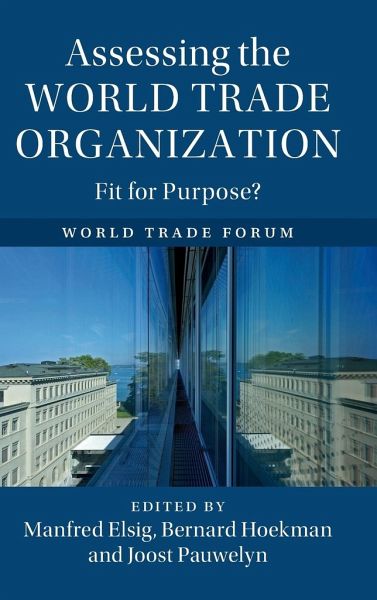
Assessing the World Trade Organization
Herausgeber: Elsig, Manfred; Pauwelyn, Joost; Hoekman, Bernard
Assessing the World Trade Organization
Herausgeber: Elsig, Manfred; Pauwelyn, Joost; Hoekman, Bernard
- Gebundenes Buch
- Merkliste
- Auf die Merkliste
- Bewerten Bewerten
- Teilen
- Produkt teilen
- Produkterinnerung
- Produkterinnerung
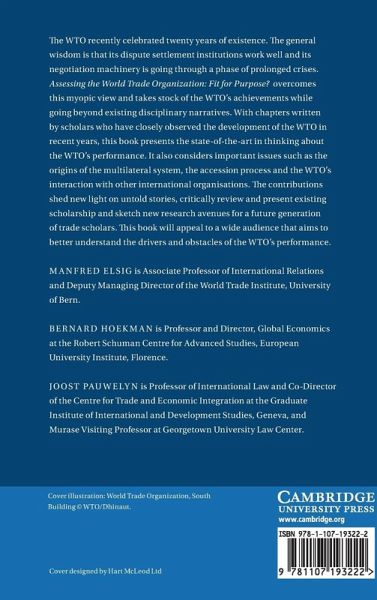
This book challenges our understanding of the true role and impact of the World Trade Organization.
Andere Kunden interessierten sich auch für
Michael A. Long (Oklahoma State University)Applying Benford's Law for Assessing the Validity of Social Science Data29,99 €
Cyril J. WeirResearch and Practice in Assessing Academic Reading: The Case of Ielts86,99 €
Peter Stopher (University of Sydney)Collecting, Managing, and Assessing Data Using Sample Surveys64,99 €
Craig S. Wells (Amherst University of Massachusetts)Assessing Measurement Invariance for Applied Research40,99 €
James Bacchus (University of Central Florida)The Willing World41,99 €
Simon A. B. Schropp (G Graduate Institute of International StudiesTrade Policy Flexibility and Enforcement in the Wto49,99 €
Adrian Evans (Victoria Monash University)Assessing Lawyers' Ethics107,99 €-
-
-
This book challenges our understanding of the true role and impact of the World Trade Organization.
Produktdetails
- Produktdetails
- Verlag: Cambridge University Press
- Seitenzahl: 468
- Erscheinungstermin: 31. März 2017
- Englisch
- Abmessung: 235mm x 157mm x 30mm
- Gewicht: 808g
- ISBN-13: 9781107193222
- ISBN-10: 1107193222
- Artikelnr.: 47722329
- Herstellerkennzeichnung
- Libri GmbH
- Europaallee 1
- 36244 Bad Hersfeld
- gpsr@libri.de
- Verlag: Cambridge University Press
- Seitenzahl: 468
- Erscheinungstermin: 31. März 2017
- Englisch
- Abmessung: 235mm x 157mm x 30mm
- Gewicht: 808g
- ISBN-13: 9781107193222
- ISBN-10: 1107193222
- Artikelnr.: 47722329
- Herstellerkennzeichnung
- Libri GmbH
- Europaallee 1
- 36244 Bad Hersfeld
- gpsr@libri.de
Part I. Introduction and Setting the Stage: 1. Introduction Manfred Elsig,
Bernard Hoekman and Joost Pauwelyn; 2. Thinking about the performance of
the World Trade Organization: a discussion across disciplines Manfred
Elsig, Bernard Hoekman and Joost Pauwelyn; Part II. New Insight from the
Early Times: 3. The GATT's starting point: tariff levels circa 1947 Chad P.
Bown and Douglas A. Irwin; 4. Negotiating in the early GATT: norms, rules
and the US tariff schedule Judith Goldstein and Robert Gulotty; Part III.
General Trends and Patterns in WTO Dispute Settlement: 5. Dispute
settlement in the WTO: from a deliberately designed to a spontaneously
grown order Frieder Rössler; 6. About the melting of icebergs: political
and economic determinants of dispute initiation and resolution in the WTO
Dirk de Bièvre, Arlo Poletti and Aydin Yildirim; 7. The WTO dispute
settlement system: consolidating success and confronting new challenges
Giorgio Sacerdoti; 8. Does trade comply? The economic effect(iveness) of
the WTO dispute settlement process Soo Yeon Kim and Tobias Hofmann; Part
IV. Zooming in on Specific Debates: 9. Twenty years of third party
participation at the WTO: what have we learned? Krzysztof J. Pelc; 10. Mind
the gap: navigating between the WTO agreement and its accession protocols
Julia Qin; 11. The age of innocence - the evolution of the case-law of the
WTO dispute settlement: subsidies as a case-study Luca Rubini; 12. The
presence of the World Trade Organization within preferential trade
agreements Todd Allee and Manfred Elsig; 13. The WTO and regional trading
agreements: is it all over for multilateralism? L. Alan Winters; 14.
Performance and international organisations' borders: the case of the World
Trade Organization Cèdric Dupont and Manfred Elsig; 15. The GATT/WTO system
and national trade policies: which comes first? Joseph Michael Finger.
Bernard Hoekman and Joost Pauwelyn; 2. Thinking about the performance of
the World Trade Organization: a discussion across disciplines Manfred
Elsig, Bernard Hoekman and Joost Pauwelyn; Part II. New Insight from the
Early Times: 3. The GATT's starting point: tariff levels circa 1947 Chad P.
Bown and Douglas A. Irwin; 4. Negotiating in the early GATT: norms, rules
and the US tariff schedule Judith Goldstein and Robert Gulotty; Part III.
General Trends and Patterns in WTO Dispute Settlement: 5. Dispute
settlement in the WTO: from a deliberately designed to a spontaneously
grown order Frieder Rössler; 6. About the melting of icebergs: political
and economic determinants of dispute initiation and resolution in the WTO
Dirk de Bièvre, Arlo Poletti and Aydin Yildirim; 7. The WTO dispute
settlement system: consolidating success and confronting new challenges
Giorgio Sacerdoti; 8. Does trade comply? The economic effect(iveness) of
the WTO dispute settlement process Soo Yeon Kim and Tobias Hofmann; Part
IV. Zooming in on Specific Debates: 9. Twenty years of third party
participation at the WTO: what have we learned? Krzysztof J. Pelc; 10. Mind
the gap: navigating between the WTO agreement and its accession protocols
Julia Qin; 11. The age of innocence - the evolution of the case-law of the
WTO dispute settlement: subsidies as a case-study Luca Rubini; 12. The
presence of the World Trade Organization within preferential trade
agreements Todd Allee and Manfred Elsig; 13. The WTO and regional trading
agreements: is it all over for multilateralism? L. Alan Winters; 14.
Performance and international organisations' borders: the case of the World
Trade Organization Cèdric Dupont and Manfred Elsig; 15. The GATT/WTO system
and national trade policies: which comes first? Joseph Michael Finger.
Part I. Introduction and Setting the Stage: 1. Introduction Manfred Elsig,
Bernard Hoekman and Joost Pauwelyn; 2. Thinking about the performance of
the World Trade Organization: a discussion across disciplines Manfred
Elsig, Bernard Hoekman and Joost Pauwelyn; Part II. New Insight from the
Early Times: 3. The GATT's starting point: tariff levels circa 1947 Chad P.
Bown and Douglas A. Irwin; 4. Negotiating in the early GATT: norms, rules
and the US tariff schedule Judith Goldstein and Robert Gulotty; Part III.
General Trends and Patterns in WTO Dispute Settlement: 5. Dispute
settlement in the WTO: from a deliberately designed to a spontaneously
grown order Frieder Rössler; 6. About the melting of icebergs: political
and economic determinants of dispute initiation and resolution in the WTO
Dirk de Bièvre, Arlo Poletti and Aydin Yildirim; 7. The WTO dispute
settlement system: consolidating success and confronting new challenges
Giorgio Sacerdoti; 8. Does trade comply? The economic effect(iveness) of
the WTO dispute settlement process Soo Yeon Kim and Tobias Hofmann; Part
IV. Zooming in on Specific Debates: 9. Twenty years of third party
participation at the WTO: what have we learned? Krzysztof J. Pelc; 10. Mind
the gap: navigating between the WTO agreement and its accession protocols
Julia Qin; 11. The age of innocence - the evolution of the case-law of the
WTO dispute settlement: subsidies as a case-study Luca Rubini; 12. The
presence of the World Trade Organization within preferential trade
agreements Todd Allee and Manfred Elsig; 13. The WTO and regional trading
agreements: is it all over for multilateralism? L. Alan Winters; 14.
Performance and international organisations' borders: the case of the World
Trade Organization Cèdric Dupont and Manfred Elsig; 15. The GATT/WTO system
and national trade policies: which comes first? Joseph Michael Finger.
Bernard Hoekman and Joost Pauwelyn; 2. Thinking about the performance of
the World Trade Organization: a discussion across disciplines Manfred
Elsig, Bernard Hoekman and Joost Pauwelyn; Part II. New Insight from the
Early Times: 3. The GATT's starting point: tariff levels circa 1947 Chad P.
Bown and Douglas A. Irwin; 4. Negotiating in the early GATT: norms, rules
and the US tariff schedule Judith Goldstein and Robert Gulotty; Part III.
General Trends and Patterns in WTO Dispute Settlement: 5. Dispute
settlement in the WTO: from a deliberately designed to a spontaneously
grown order Frieder Rössler; 6. About the melting of icebergs: political
and economic determinants of dispute initiation and resolution in the WTO
Dirk de Bièvre, Arlo Poletti and Aydin Yildirim; 7. The WTO dispute
settlement system: consolidating success and confronting new challenges
Giorgio Sacerdoti; 8. Does trade comply? The economic effect(iveness) of
the WTO dispute settlement process Soo Yeon Kim and Tobias Hofmann; Part
IV. Zooming in on Specific Debates: 9. Twenty years of third party
participation at the WTO: what have we learned? Krzysztof J. Pelc; 10. Mind
the gap: navigating between the WTO agreement and its accession protocols
Julia Qin; 11. The age of innocence - the evolution of the case-law of the
WTO dispute settlement: subsidies as a case-study Luca Rubini; 12. The
presence of the World Trade Organization within preferential trade
agreements Todd Allee and Manfred Elsig; 13. The WTO and regional trading
agreements: is it all over for multilateralism? L. Alan Winters; 14.
Performance and international organisations' borders: the case of the World
Trade Organization Cèdric Dupont and Manfred Elsig; 15. The GATT/WTO system
and national trade policies: which comes first? Joseph Michael Finger.