Andere Kunden interessierten sich auch für
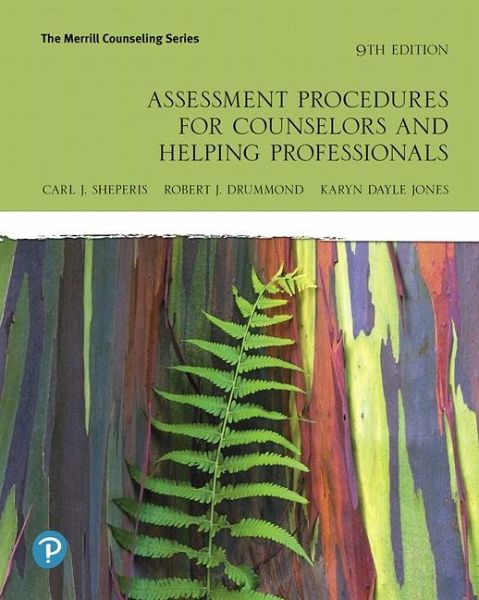
Assessment Procedures for Counselors and Helping Professionals
Produktdetails
- Verlag: Pearson Education; Pearson
- 9. Aufl. 2024.
- Seitenzahl: 464
- Erscheinungstermin: 10. Februar 2024
- Englisch
- Abmessung: 235mm x 195mm x 25mm
- Gewicht: 856g
- ISBN-13: 9780135186022
- ISBN-10: 0135186021
- Artikelnr.: 65509200
- Pearson
- St.-Martin-Straße 82
- 81541 München
- salesde@pearson.com
- Verlag: Pearson Education; Pearson
- 9. Aufl. 2024.
- Seitenzahl: 464
- Erscheinungstermin: 10. Februar 2024
- Englisch
- Abmessung: 235mm x 195mm x 25mm
- Gewicht: 856g
- ISBN-13: 9780135186022
- ISBN-10: 0135186021
- Artikelnr.: 65509200
- Pearson
- St.-Martin-Straße 82
- 81541 München
- salesde@pearson.com
About our authorsDr. Carl J. Sheperis serves as Dean of the College of Education and Human Development at Texas A&M University, San Antonio. Dr. Sheperis has served as President and CEO of the National Board for Certified Counselors (NBCC) and Affiliates. He is a past president of the Association for Assessment and Research in Counseling and Associate Editor for Quantitative Research for the Journal of Counseling and Development. He has worked with the American Counseling Association as the Chair of the Research and Knowledge Committee, and has served as the Editor of the Journal of Counseling Research and Practice. In addition to this textbook, Dr. Sheperis is an author of Research in Counseling: Quantitative, Qualitative, and Mixed Methods; Clinical Mental Health Counseling: Fundamentals of Applied Practice; Diagnosing and Treating Children and Adolescents; and The Peace Train. He is also published in various textbooks, academic journals and reference volumes.Dr. Robert J. Drummond passed away on March 14, 2005. He was a retired professor and counselor educator at the University of North Florida for 20 years. He was foremost in the field of assessment, and he specialized in educational and psychological testing, career development, models for evaluation, educational research, and personality theory and measurement. Dr. Drummond wrote the 1st Edition of this text in 1988. Now in its 9th Edition, the book remains a popular assessment textbook in counseling.Dr. Karyn Dayle Jones is an associate professor in counselor education at the University of Central Florida. She has over 20 years of experience in the counseling profession and has been a counselor educator for over 15 years. Jones is coauthor of Introduction to the Profession of Counseling, has authored or coauthored several book chapters and reference publications, and has made numerous professional presentations. Her primary areas of research are assessment and diagnosis. She is the past president of the Association for Humanistic Counseling, a division of the American Counseling Association. Jones is a Florida Licensed Mental Health Counselor and a National Certified Counselor, and she has worked as a counselor in mental health agencies, schools and private practice.
PART ONE: THE PRINCIPLES OF ASSESSMENT
1. Introduction to Assessment
2. Ethical and Legal Issues in Assessment
3. Assessment Issues with Diverse Populations
4. Methods and Sources of Assessment Information
PART TWO: FOUNDATIONS OF ASSESSMENT
1. Statistical Concepts
2. Understanding Assessment Scores
3. Reliability/Precision
4. Validity
5. Selecting, Administering, Scoring, and Interpreting Assessment Results
PART THREE: TYPES OF ASSESSMENT
6. Assessment of Intelligence and General Ability
7. Assessment of Achievement
8. Assessment of Aptitude
9. Career and Employment Assessment
10. Personality Assessment
11. Clinical Assessment
12. Assessment in Education
13. Communicating Assessment Results
Appendices
14. Standards for Multicultural Assessment Fourth Revision, 2012
15. Responsibilities of Users of Standardized Tests (RUST; 3rd Ed.)
PART ONE: THE PRINCIPLES OF ASSESSMENT
1. Introduction to Assessment
2. Ethical and Legal Issues in Assessment
3. Assessment Issues with Diverse Populations
4. Methods and Sources of Assessment Information
PART TWO: FOUNDATIONS OF ASSESSMENT
1. Statistical Concepts
2. Understanding Assessment Scores
3. Reliability/Precision
4. Validity
5. Selecting, Administering, Scoring, and Interpreting Assessment Results
PART THREE: TYPES OF ASSESSMENT
6. Assessment of Intelligence and General Ability
7. Assessment of Achievement
8. Assessment of Aptitude
9. Career and Employment Assessment
10. Personality Assessment
11. Clinical Assessment
12. Assessment in Education
13. Communicating Assessment Results
Appendices
14. Standards for Multicultural Assessment Fourth Revision, 2012
15. Responsibilities of Users of Standardized Tests (RUST; 3rd Ed.)