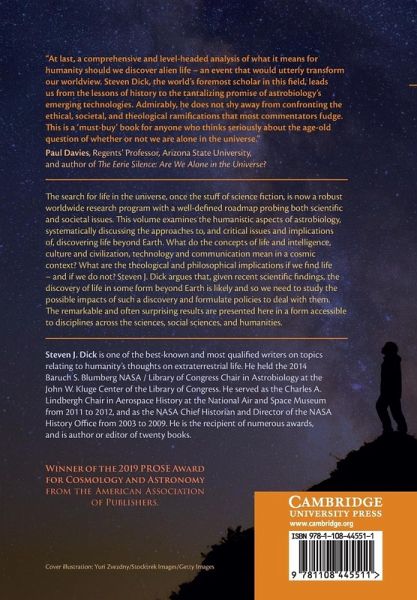
Steven J. Dick is one of the best known and most qualified writers on topics relating to humanity's thoughts on extraterrestrial life. He held the 2014 Baruch S. Blumberg NASA/Library of Congress Chair in Astrobiology at the John W. Kluge Center of the Library of Congress. In 2013 he testified before Congress on the subject of astrobiology. He served as the Charles A. Lindbergh Chair in Aerospace History at the National Air and Space Museum from 2011-2012, and as the NASA Chief Historian and Director of the NASA History Office from 2003-2009. He is the recipient of numerous awards, including the NASA Exceptional Service Medal and the Navy Meritorious Civilian Service Medal, and is author or editor of 20 books, including The Biological Universe (Cambridge, 2008). He was awarded the 2006 LeRoy E. Doggett Prize for Historical Astronomy of the American Astronomical Society. In 2009 the International Astronomical Union designated minor planet 6544 Stevendick in his honor.
Inhaltsangabe
Introduction. When biospheres collide Part I. Approaches: 1. History 2. Discovery 3. Analogy Part II. Critical Issues: 4. Can we transcend anthropocentrism? 5. Is human knowledge universal? 6. How can we envision impact? Part III. Impact!: 7. Astroculture: transforming our worldviews 8. Astroethics: interacting with alien life 9. Astropolicy: preparing for discovery 10. Summary and conclusions: at home in the biological (or postbiological) universe Bibliography Index.
Introduction. When biospheres collide Part I. Approaches: 1. History 2. Discovery 3. Analogy Part II. Critical Issues: 4. Can we transcend anthropocentrism? 5. Is human knowledge universal? 6. How can we envision impact? Part III. Impact!: 7. Astroculture: transforming our worldviews 8. Astroethics: interacting with alien life 9. Astropolicy: preparing for discovery 10. Summary and conclusions: at home in the biological (or postbiological) universe Bibliography Index.
Es gelten unsere Allgemeinen Geschäftsbedingungen: www.buecher.de/agb
Impressum
www.buecher.de ist ein Internetauftritt der buecher.de internetstores GmbH
Geschäftsführung: Monica Sawhney | Roland Kölbl | Günter Hilger
Sitz der Gesellschaft: Batheyer Straße 115 - 117, 58099 Hagen
Postanschrift: Bürgermeister-Wegele-Str. 12, 86167 Augsburg
Amtsgericht Hagen HRB 13257
Steuernummer: 321/5800/1497
USt-IdNr: DE450055826