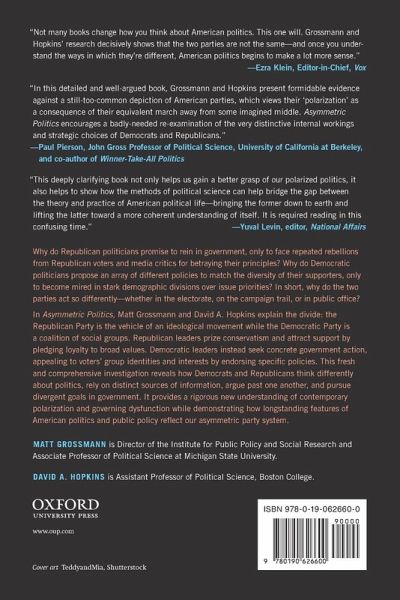
The Republican Party is the vehicle of an ideological movement whereas the Democratic Party is a coalition of social groups with concrete policy concerns. Democrats prefer a more moderate party leadership that makes compromises, whereas Republicans favor a more conservative party leadership that sticks to principles.
The Republican Party is the vehicle of an ideological movement whereas the Democratic Party is a coalition of social groups with concrete policy concerns. Democrats prefer a more moderate party leadership that makes compromises, whereas Republicans favor a more conservative party leadership that sticks to principles.
Matt Grossman is Associate Professor of Political Science, Michigan State University. David A. Hopkins is Assistant Professor of Political Science, Boston College.
Inhaltsangabe
Table of Contents Introduction: Two Different Kinds of Parties Chapter 1: How Democrats and Republicans Think About Politics Chapter 2: An Ideological Movement vs. A Social Group Coalition Chapter 3: The Not-So-Great Debate Chapter 4: Campaigning in Poetry and Prose Chapter 5: Policymaking in Red and Blue Conclusion: American Politics Out of Balance References
Table of Contents Introduction: Two Different Kinds of Parties Chapter 1: How Democrats and Republicans Think About Politics Chapter 2: An Ideological Movement vs. A Social Group Coalition Chapter 3: The Not-So-Great Debate Chapter 4: Campaigning in Poetry and Prose Chapter 5: Policymaking in Red and Blue Conclusion: American Politics Out of Balance References
Es gelten unsere Allgemeinen Geschäftsbedingungen: www.buecher.de/agb
Impressum
www.buecher.de ist ein Internetauftritt der buecher.de internetstores GmbH
Geschäftsführung: Monica Sawhney | Roland Kölbl | Günter Hilger
Sitz der Gesellschaft: Batheyer Straße 115 - 117, 58099 Hagen
Postanschrift: Bürgermeister-Wegele-Str. 12, 86167 Augsburg
Amtsgericht Hagen HRB 13257
Steuernummer: 321/5800/1497
USt-IdNr: DE450055826