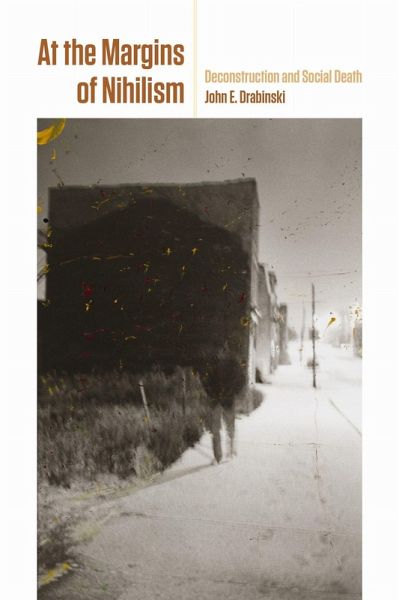
The multi-century event of enslavement and colonialism changed the cultural and political imagination of the Atlantic world. We still live and work in the horizon of that event. It was an event that placed a violent Manichean structure of antiblackness at the foundation of our shared world. What kinds of life are possible in nihilistic, antiblack worlds of social death? Is it possible to imagine life outside the reach of those worlds? What decolonial methods help us understand that form of life in relation to expressive cultures of resistance and refusal? At the Margins of Nihilism develops a…mehr
The multi-century event of enslavement and colonialism changed the cultural and political imagination of the Atlantic world. We still live and work in the horizon of that event. It was an event that placed a violent Manichean structure of antiblackness at the foundation of our shared world. What kinds of life are possible in nihilistic, antiblack worlds of social death? Is it possible to imagine life outside the reach of those worlds? What decolonial methods help us understand that form of life in relation to expressive cultures of resistance and refusal? At the Margins of Nihilism develops a theoretical frame through a comparative reading of Jacques Derrida and Orlando Patterson. Reading between deconstruction and social death, Drabinski describes a notion of life as interstitial, situated outside the play of life and death in systems of antiblackness. This notion of life has broad epistemological, existential, and ontological implications. Drawing from a diverse set of sources including Zora Neale Hurston, Ralph Ellison, Gloria Anzaldúa, and others, At the Margins of Nihilism shows how the nihilisms of Richard Wright, Frantz Fanon, James Baldwin, and contemporary afropessimism operate as a closed system. Each system is opened by vernacular forms of life and practices of refusal. Those forms and practices speak to the power and significance of life that persists across centuries of antiblack culture, social life, and political hegemony.
John E. Drabinski is Professor of African American and Africana Studies and English at the University of Maryland. He is author of So Unimaginable a Price: Baldwin and the Black Atlantic (2025), Atlantic Theory: On the Vicissitudes of Relation (2025), Glissant and the Middle Passage: Philosophy, Beginning, Abyss (2019), Theorizing Glissant: Sites and Citations (2015), Levinas and the Postcolonial: Race, Nation, Other (2011), Godard Between Identity and Difference (2008), and Sensibility and Singularity: The Problem of Phenomenology in Levinas (2001).
Inhaltsangabe
Prologue: Sembène, Teno, and the Work of the Outside 1 Introduction: Whithering the Decolonial 19 1 Social Death as a Kind of Deconstruction 38 2 Racial Formation and the Remainder in Baldwin’s Nonfiction 70 3 Nihilism and the Refusal of Refusal in Wright and Fanon 102 4 The Lower Frequencies after Afropessimism 134 Postscript Notes 168 Acknowledgments 179 Notes 181 Index 189
Prologue: Sembène, Teno, and the Work of the Outside 1 Introduction: Whithering the Decolonial 19 1 Social Death as a Kind of Deconstruction 38 2 Racial Formation and the Remainder in Baldwin’s Nonfiction 70 3 Nihilism and the Refusal of Refusal in Wright and Fanon 102 4 The Lower Frequencies after Afropessimism 134 Postscript Notes 168 Acknowledgments 179 Notes 181 Index 189
Es gelten unsere Allgemeinen Geschäftsbedingungen: www.buecher.de/agb
Impressum
www.buecher.de ist ein Internetauftritt der buecher.de internetstores GmbH
Geschäftsführung: Monica Sawhney | Roland Kölbl | Günter Hilger
Sitz der Gesellschaft: Batheyer Straße 115 - 117, 58099 Hagen
Postanschrift: Bürgermeister-Wegele-Str. 12, 86167 Augsburg
Amtsgericht Hagen HRB 13257
Steuernummer: 321/5800/1497
USt-IdNr: DE450055826