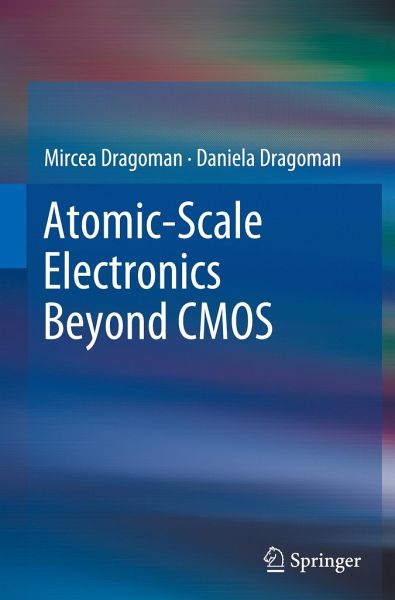
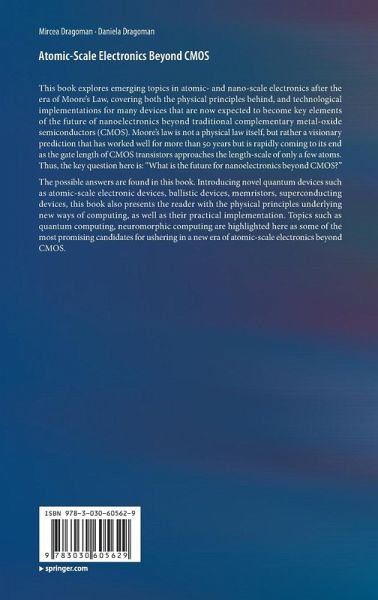
This book explores emerging topics in atomic- and nano-scale electronics after the era of Moore's Law, covering both the physical principles behind, and technological implementations for many devices that are now expected to become key elements of the future of nanoelectronics beyond traditional complementary metal-oxide semiconductors (CMOS). Moore's law is not a physical law itself, but rather a visionary prediction that has worked well for more than 50 years but is rapidly coming to its end as the gate length of CMOS transistors approaches the length-scale of only a few atoms. Thus, the key…mehr
This book explores emerging topics in atomic- and nano-scale electronics after the era of Moore's Law, covering both the physical principles behind, and technological implementations for many devices that are now expected to become key elements of the future of nanoelectronics beyond traditional complementary metal-oxide semiconductors (CMOS). Moore's law is not a physical law itself, but rather a visionary prediction that has worked well for more than 50 years but is rapidly coming to its end as the gate length of CMOS transistors approaches the length-scale of only a few atoms. Thus, the key question here is: "What is the future for nanoelectronics beyond CMOS?"
The possible answers are found in this book. Introducing novel quantum devices such as atomic-scale electronic devices, ballistic devices, memristors, superconducting devices, this book also presents the reader with the physical principles underlying new ways of computing, as well as their practical implementation. Topics such as quantum computing, neuromorphic computing are highlighted here as some of the most promising candidates for ushering in a new era of atomic-scale electronics beyond CMOS.
Mircea Dragoman is a senior researcher I at the National Research Institute in Microtechnology since 1996. In the period 1992-1994 he was the recipient of the Humboldt Fellowship award and he has followed postdoctoral studies at Duisburg University, Germany. He was invited professor at: CNR-Istituto di Electtronica dello Stato Solido-Roma (1993-1996), Univ. Saint-Etienne, France (1997), Univ. Mannheim (1998-1999, 2001-2002), Univ. Frankfurt (2003), and Univ. Darmstadt (2004). He was invited professor at CNRS LAAS in the period 2005-2006 and 2008-2010. He has published 205 scientific papers (114 in international journals and 91 communications at various national and international conferences). The papers are dedicated to the following areas: nanoelectronics, microwaves, MEMS, and optoelectronics. He is co-author of 5 books in prestigious international publishing houses. Daniela Dragoman is a Professor at the Physics Faculty of the University of Bucharest. In the period 1998-1999 and 2001-2002 she was the recipient of the Humboldt Fellowship award and followed postdoctoral studies at the Mannheim University, Germany. She was invited professor at Univ. Saint-Etienne, France (1997 and 2000), and at CNRS LAAS, Toulouse in 2008, 2009 and 2010. She is co-author of 5 monographs at prestigious international publishing houses and author or co-author of 152 scientific papers in ISI-ranked international journals and 41 communications at national and international conferences. Her research areas of interest include: nanostructures and nanodevices, quantum-classical correspondence and the foundations of quantum mechanics.
Inhaltsangabe
Materials at atomic scale.- Atomic electronics -electronics based on atoms.- Nanoelectronic devices beyond Moore's law: Quantum devices with low power and high gain ( tunnelling devices, phase change devices, quantum dots for memory applications, ballistic devices , spintronic devices and superconducting devices).- Quantum computing (theory and implementation of quantum gates and computers).- Neuromorphic computing -artificial synapses and neurons based on atomically thin materials.- Optical computing.- Perspectives-main concepts that could be implemented by industry in the next 10 years.
Materials at atomic scale.- Atomic electronics -electronics based on atoms.- Nanoelectronic devices beyond Moore's law: Quantum devices with low power and high gain ( tunnelling devices, phase change devices, quantum dots for memory applications, ballistic devices , spintronic devices and superconducting devices).- Quantum computing (theory and implementation of quantum gates and computers).- Neuromorphic computing -artificial synapses and neurons based on atomically thin materials.- Optical computing.- Perspectives-main concepts that could be implemented by industry in the next 10 years.
Es gelten unsere Allgemeinen Geschäftsbedingungen: www.buecher.de/agb
Impressum
www.buecher.de ist ein Internetauftritt der buecher.de internetstores GmbH
Geschäftsführung: Monica Sawhney | Roland Kölbl | Günter Hilger
Sitz der Gesellschaft: Batheyer Straße 115 - 117, 58099 Hagen
Postanschrift: Bürgermeister-Wegele-Str. 12, 86167 Augsburg
Amtsgericht Hagen HRB 13257
Steuernummer: 321/5800/1497
USt-IdNr: DE450055826