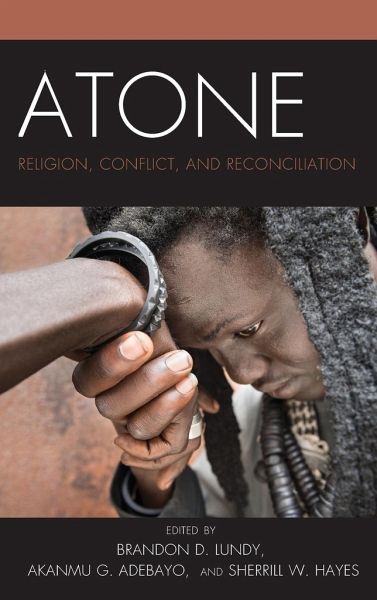
This volume engages the unseen impacts of religion-linked conflicts and successful peacebuilding around the world. The authors address the paradoxes of the role of religion in global conflicts to reveal the connections among religion, conflict, and peace.
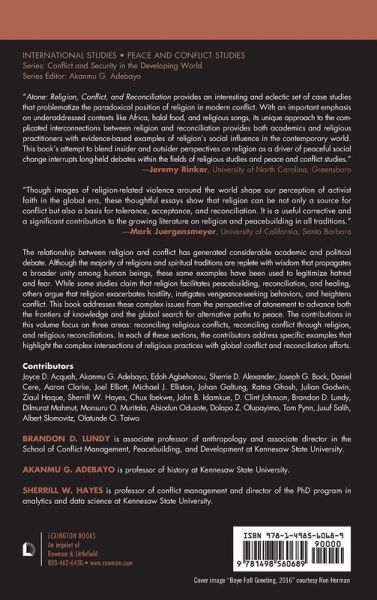
This volume engages the unseen impacts of religion-linked conflicts and successful peacebuilding around the world. The authors address the paradoxes of the role of religion in global conflicts to reveal the connections among religion, conflict, and peace.
Brandon D. Lundy is associate professor of anthropology and associate director in the School of Conflict Management, Peacebuilding and Development at Kennesaw State University. Akanmu G. Adebayo is professor of history at Kennesaw State University. Sherrill W. Hayes is professor and associate director of the School of Conflict Management, Peacebuilding, and Development at Kennesaw State University.
Inhaltsangabe
Tables Preface and Acknowledgments, by Brandon D. Lundy, Akanmu G. Adebayo, and Sherrill W. Hayes Introduction: Examining the Paradoxical Role of Religion in Conflict and Reconciliation, by Brandon D. Lundy, Ziaul Haque, Akanmu G. Adebayo, Sherrill W. Hayes, and Aaron Clarke Part I: Reconciling Religious Conflicts Chapter 1: Sources of the Radical Self: Extremism, Modernity, and Religion, by Daniel Cere Chapter 2: Education, Religion, and Religious Extremism, by Ratna Ghosh Chapter 3: Revisiting Muslim Identity and Islamophobia in the Contemporary World, by Dilmurat Mahmut Chapter 4: The Limits of Law in Resolving Religious Conflicts: Perspectives from Nigeria and Beyond, by Abiodun Odusote Chapter 5: Transnational Insurgency and Counterinsurgency around the Lake Chad Basin: Rethinking Boko Haram, by Olatunde O. Taiwo Chapter 6: Land Use and Religious Movements: Entangled Spaces and Impending Conflict along Lagos-Ibadan Expressway, Nigeria, by Monsuru O. Muritala Part II: Reconciling Conflict through Religion Chapter 7: Islamic Approach to Abrahamic Traditions, by Jusuf Salih Chapter 8: How Mysticism Can Point the Way to Tolerance: Recognizing a Common Ground of Non-conceptual Experience in Meister Eckhart and Zen, by D. Clint Johnson Chapter 9: Reconciliation: Examining the Charleston AME Tragedy Victims' Forgiveness of Dylann Roof, by Chux Ibekwe Chapter 10: Truth, Justice, and Reconciliation Commission in Togo: A Useful Tool for Regime Maintenance or for Healing the Wounds of the Past for Peaceful Democratic Alternations? by Edoh Agbehonou Chapter 11: Faith-Based Organizations and Refugee Women: A Case Study of the Assistance Provided by Faith-Based and Other Organization to Liberian Women Refugees in Ghana, by Joyce D. Acquah Chapter 12: Religious Songs in Conflict Situation: An Interrogation of Selected Yorùbá Coded Church Songs, by Dolapo Z. Olupayimo Chapter 13: Halal in Context: A Reconciliation of Muslim Foodways and Animal Welfare in Islam, by Sherrie D. Alexander Chapter 14: Testing the Co-Religionist Hypothesis in Sri Lanka, by Joel Elliott and Joseph G. Bock Chapter 15: The Role of the Catholic Church in Managing Interstate Conflict: An Examination of the Intervention of Pope Francis in Cuba-U.S. Relations, by John B. Idamkue Part III: Religious Reconciliations Chapter 16: A Pope, a Patriarch, a Spiritual Revolution, by Johan Galtung Chapter 17: Searching for Shalom, by Albert Slomovitz Chapter 18: Framing Conflict and Reconciliation in the Context of Zen Buddhism, by Michael J. Elliston Chapter 19: Soka Nichiren Buddhism, by Julian Godwin Chapter 20: Religious Resources for Reconciliation, by Tom Pynn
Tables Preface and Acknowledgments, by Brandon D. Lundy, Akanmu G. Adebayo, and Sherrill W. Hayes Introduction: Examining the Paradoxical Role of Religion in Conflict and Reconciliation, by Brandon D. Lundy, Ziaul Haque, Akanmu G. Adebayo, Sherrill W. Hayes, and Aaron Clarke Part I: Reconciling Religious Conflicts Chapter 1: Sources of the Radical Self: Extremism, Modernity, and Religion, by Daniel Cere Chapter 2: Education, Religion, and Religious Extremism, by Ratna Ghosh Chapter 3: Revisiting Muslim Identity and Islamophobia in the Contemporary World, by Dilmurat Mahmut Chapter 4: The Limits of Law in Resolving Religious Conflicts: Perspectives from Nigeria and Beyond, by Abiodun Odusote Chapter 5: Transnational Insurgency and Counterinsurgency around the Lake Chad Basin: Rethinking Boko Haram, by Olatunde O. Taiwo Chapter 6: Land Use and Religious Movements: Entangled Spaces and Impending Conflict along Lagos-Ibadan Expressway, Nigeria, by Monsuru O. Muritala Part II: Reconciling Conflict through Religion Chapter 7: Islamic Approach to Abrahamic Traditions, by Jusuf Salih Chapter 8: How Mysticism Can Point the Way to Tolerance: Recognizing a Common Ground of Non-conceptual Experience in Meister Eckhart and Zen, by D. Clint Johnson Chapter 9: Reconciliation: Examining the Charleston AME Tragedy Victims' Forgiveness of Dylann Roof, by Chux Ibekwe Chapter 10: Truth, Justice, and Reconciliation Commission in Togo: A Useful Tool for Regime Maintenance or for Healing the Wounds of the Past for Peaceful Democratic Alternations? by Edoh Agbehonou Chapter 11: Faith-Based Organizations and Refugee Women: A Case Study of the Assistance Provided by Faith-Based and Other Organization to Liberian Women Refugees in Ghana, by Joyce D. Acquah Chapter 12: Religious Songs in Conflict Situation: An Interrogation of Selected Yorùbá Coded Church Songs, by Dolapo Z. Olupayimo Chapter 13: Halal in Context: A Reconciliation of Muslim Foodways and Animal Welfare in Islam, by Sherrie D. Alexander Chapter 14: Testing the Co-Religionist Hypothesis in Sri Lanka, by Joel Elliott and Joseph G. Bock Chapter 15: The Role of the Catholic Church in Managing Interstate Conflict: An Examination of the Intervention of Pope Francis in Cuba-U.S. Relations, by John B. Idamkue Part III: Religious Reconciliations Chapter 16: A Pope, a Patriarch, a Spiritual Revolution, by Johan Galtung Chapter 17: Searching for Shalom, by Albert Slomovitz Chapter 18: Framing Conflict and Reconciliation in the Context of Zen Buddhism, by Michael J. Elliston Chapter 19: Soka Nichiren Buddhism, by Julian Godwin Chapter 20: Religious Resources for Reconciliation, by Tom Pynn
Es gelten unsere Allgemeinen Geschäftsbedingungen: www.buecher.de/agb
Impressum
www.buecher.de ist ein Internetauftritt der buecher.de internetstores GmbH
Geschäftsführung: Monica Sawhney | Roland Kölbl | Günter Hilger
Sitz der Gesellschaft: Batheyer Straße 115 - 117, 58099 Hagen
Postanschrift: Bürgermeister-Wegele-Str. 12, 86167 Augsburg
Amtsgericht Hagen HRB 13257
Steuernummer: 321/5800/1497
USt-IdNr: DE450055826