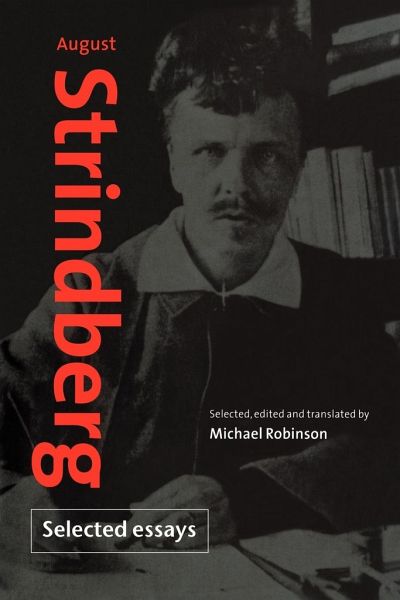
This is a fully edited translation of a series of essays by the great Swedish dramatist August Strindberg. The essays, edited and translated by Michael Robinson, have been selected for the light they shed, both directly and indirectly, on Strindberg's contribution to the European theatre, firstly in such masterpieces of psychological realism as The Father and Miss Julie, and subsequently in those works, including A Dream Play and The Ghost Sonata, with which he largely established a basis for theatrical modernism. Together with the accompanying notes and commentary, these essays on psychology,…mehr
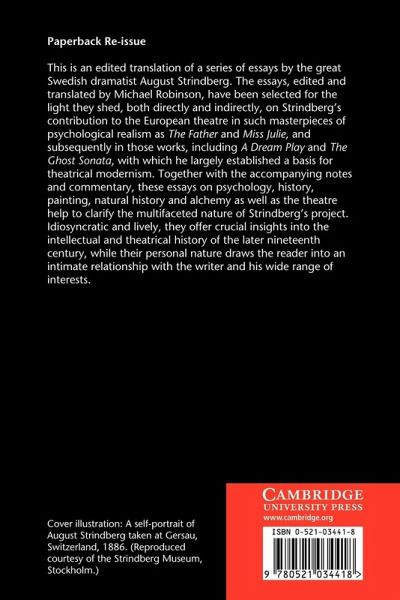
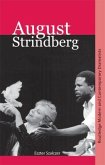
This is a fully edited translation of a series of essays by the great Swedish dramatist August Strindberg. The essays, edited and translated by Michael Robinson, have been selected for the light they shed, both directly and indirectly, on Strindberg's contribution to the European theatre, firstly in such masterpieces of psychological realism as The Father and Miss Julie, and subsequently in those works, including A Dream Play and The Ghost Sonata, with which he largely established a basis for theatrical modernism. Together with the accompanying notes and commentary, these essays on psychology, history, painting, natural history and alchemy as well as the theatre, help to clarify the multifaceted nature of Strindberg's project. Idiosyncratic and lively, they offer crucial insights into the intellectual history of the late nineteenth century, while their personal nature draws the reader into an intimate relationship with the writer and his wide range of interests.
August Strindberg (1849-1912) was a Swedish playwright, novelist, poet, essayist, and painter, considered one of the most influential figures in Scandinavian literature and modern drama. His works are characterized by their exploration of psychological complexity, naturalism, and symbolism, often challenging conventional norms and exploring existential themes. Born in Stockholm, Sweden, Strindberg began his career as a journalist and writer, initially gaining recognition for his early novels and short stories. However, it was his contributions to drama that solidified his reputation. Strindberg's plays, such as "Miss Julie" (1888), "The Father" (1887), and "A Dream Play" (1902), are renowned for their intense psychological realism and innovative narrative techniques. He is credited with pioneering techniques in modernist theater and influencing playwrights and directors worldwide. Beyond drama, Strindberg's literary output includes novels, essays, poetry, and autobiographical works. His novels, like "The Red Room" (1879) and "The People of Hemsö" (1887), reflect his interest in naturalism and social criticism, often depicting the struggles of individuals against societal constraints. Strindberg's writing also reflects his tumultuous personal life and evolving philosophical outlook, which ranged from skepticism and naturalism to mysticism and expressionism. His exploration of themes such as identity, madness, gender roles, and the human condition continues to resonate with readers and scholars alike. In addition to his literary pursuits, Strindberg was a prolific painter and photographer, exploring symbolism and expressionism in visual art. His multifaceted creativity and intellectual curiosity have left a lasting legacy, making him a central figure in the development of modern literature and theater. August Strindberg's works continue to be studied and performed worldwide, celebrated for their profound insight into the complexities of human relationships and the existential dilemmas of modern life.
Inhaltsangabe
Notes on the text Introduction Part I. From Vivisections (1887): 1. 'The battle of the brains' 2. 'Nemesis Divina' 3. 'Mysticism - for now' 4. 'Soul murder (Apropos Rosmersholm)' 'On modern drama and modern theatre' (1889) Part II. From Vivisections II (1894): 5. 'I' 6. 'The making of Aspasia' 7. 'Nemesis Divina (cont.)' 8. 'The new arts! or the role of chance in artistic creation' 9. 'Whence we have come' 10. 'Character a role?' 'Césarine' (1894) 'Deranged sensations' (1894) 'In the cemetery' (1896) Part III. From Jardin des Plantes (1896): 11. 'Introduction' 12. 'The death's head moth' 13. 'Indigo and the line of copper' 14. 'To the heckler' 'On the action of light in photography' (1896) 'A glance into space' (1896) 'Edvard Munch's exhibition' (1896) 'The synthesis of gold' (1896) 'Contemporary gold-making' (1896) 'The sunflower' (1896) 'The mysticism of world history' (1903) 'August Strindberg on himself' (1909) Notes and commentary Index.
Notes on the text Introduction Part I. From Vivisections (1887): 1. 'The battle of the brains' 2. 'Nemesis Divina' 3. 'Mysticism - for now' 4. 'Soul murder (Apropos Rosmersholm)' 'On modern drama and modern theatre' (1889) Part II. From Vivisections II (1894): 5. 'I' 6. 'The making of Aspasia' 7. 'Nemesis Divina (cont.)' 8. 'The new arts! or the role of chance in artistic creation' 9. 'Whence we have come' 10. 'Character a role?' 'Césarine' (1894) 'Deranged sensations' (1894) 'In the cemetery' (1896) Part III. From Jardin des Plantes (1896): 11. 'Introduction' 12. 'The death's head moth' 13. 'Indigo and the line of copper' 14. 'To the heckler' 'On the action of light in photography' (1896) 'A glance into space' (1896) 'Edvard Munch's exhibition' (1896) 'The synthesis of gold' (1896) 'Contemporary gold-making' (1896) 'The sunflower' (1896) 'The mysticism of world history' (1903) 'August Strindberg on himself' (1909) Notes and commentary Index.
Es gelten unsere Allgemeinen Geschäftsbedingungen: www.buecher.de/agb
Impressum
www.buecher.de ist ein Internetauftritt der buecher.de internetstores GmbH
Geschäftsführung: Monica Sawhney | Roland Kölbl | Günter Hilger
Sitz der Gesellschaft: Batheyer Straße 115 - 117, 58099 Hagen
Postanschrift: Bürgermeister-Wegele-Str. 12, 86167 Augsburg
Amtsgericht Hagen HRB 13257
Steuernummer: 321/5800/1497
USt-IdNr: DE450055826