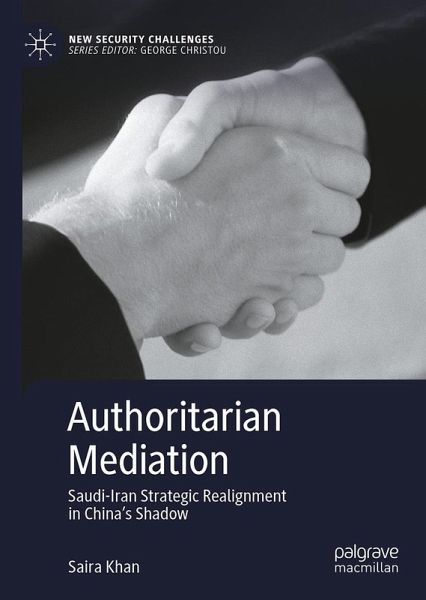
This book investigates the groundbreaking diplomatic breakthrough between Saudi Arabia and Iran, mediated by China in March 2023 a striking departure from the traditional Western-dominated diplomatic processes that have long shaped the Middle East. This pivotal moment reflects a complex interplay of strategic calculations, domestic pressures, and shifting geopolitical realities, with far-reaching implications for regional and global power dynamics. The analysis unpacks the reasons why Saudi Arabia a key regional actor chose China, rather than a Western power, to mediate its rapprochement with…mehr
This book investigates the groundbreaking diplomatic breakthrough between Saudi Arabia and Iran, mediated by China in March 2023 a striking departure from the traditional Western-dominated diplomatic processes that have long shaped the Middle East. This pivotal moment reflects a complex interplay of strategic calculations, domestic pressures, and shifting geopolitical realities, with far-reaching implications for regional and global power dynamics. The analysis unpacks the reasons why Saudi Arabia a key regional actor chose China, rather than a Western power, to mediate its rapprochement with Iran, an enduring rival. It investigates Riyadh s strategic priorities, recalibration of foreign policy, and the broader context of its regional ambitions. Simultaneously, the book explores Iran s motivations for embracing a China-brokered deal, examining how domestic economic challenges, regime stability, and diplomatic isolation influenced its decision to pursue a thaw in relations with Saudi Arabia. By situating this diplomatic realignment within the broader decline of Western influence in the Middle East, the book highlights how new patterns of engagement are emerging ones that often bypass traditional Western channels in favor of authoritarian-led mediation. In doing so, it offers insight into the circumstances under which authoritarian states prefer third-party mediation by fellow authoritarian regimes and when such arrangements produce the most durable outcomes. Ultimately, the book offers a novel perspective on the evolving nature of diplomacy in a multipolar world, where emerging powers like China are reshaping the geopolitical landscape through pragmatic, interest-based engagement.
Artikelnr. des Verlages: 89533766, 978-3-032-01387-3
Seitenzahl: 282
Erscheinungstermin: 3. Januar 2026
Englisch
Abmessung: 216mm x 153mm x 21mm
Gewicht: 506g
ISBN-13: 9783032013873
ISBN-10: 3032013879
Artikelnr.: 74787725
Herstellerkennzeichnung
Springer-Verlag GmbH
Tiergartenstr. 17
69121 Heidelberg
ProductSafety@springernature.com
Autorenporträt
Saira Khan is an expert in international affairs with over two decades of experience teaching International Relations across Canada, Europe, West Asia, the U.S., and South Asia. She specializes in conflict dynamics, crisis management, war, and nuclear proliferation, with regional expertise in South Asia, the Middle East, and Southeast Asia. Her work bridges academic research and policy relevance, offering insights into traditional and emerging threats.Khan is the author of The Iran Nuclear Deal (2024), Iran and Nuclear Weapons (2009, 2011), Nuclear Weapons and Conflict Transformation (2008, 2010), and Nuclear Proliferation Dynamics in Protracted Conflict Regions (2002).
Inhaltsangabe
Chapter 1: Introduction: The Diplomatic Breakthrough and Its Global Significance.- Chapter 2: Historical Context and Evolution of the Saudi-Iran Rivalry and Cooperation Efforts.- Chapter 3: China s Strategic Interests and Role as a Mediator.- Chapter 4: Drivers Behind Rapprochement with Rivals.- Chapter 5: Dynamics of Authoritarian Mediation.- Chapter 6: Saudi Arabia s Perspectives.- Chapter 7: Iran s Calculations.- Chapter 8: Geopolitical Implications, Regional Power Dynamics, and the New Cold War.- Chapter 9: Future Prospects and Challenges.- Chapter 10: Conclusion.
Chapter 1: Introduction: The Diplomatic Breakthrough and Its Global Significance.- Chapter 2: Historical Context and Evolution of the Saudi-Iran Rivalry and Cooperation Efforts.- Chapter 3: China s Strategic Interests and Role as a Mediator.- Chapter 4: Drivers Behind Rapprochement with Rivals.- Chapter 5: Dynamics of Authoritarian Mediation.- Chapter 6: Saudi Arabia s Perspectives.- Chapter 7: Iran s Calculations.- Chapter 8: Geopolitical Implications, Regional Power Dynamics, and the New Cold War.- Chapter 9: Future Prospects and Challenges.- Chapter 10: Conclusion.
Es gelten unsere Allgemeinen Geschäftsbedingungen: www.buecher.de/agb
Impressum
www.buecher.de ist ein Internetauftritt der buecher.de internetstores GmbH
Geschäftsführung: Monica Sawhney | Roland Kölbl | Günter Hilger
Sitz der Gesellschaft: Batheyer Straße 115 - 117, 58099 Hagen
Postanschrift: Bürgermeister-Wegele-Str. 12, 86167 Augsburg
Amtsgericht Hagen HRB 13257
Steuernummer: 321/5800/1497
USt-IdNr: DE450055826