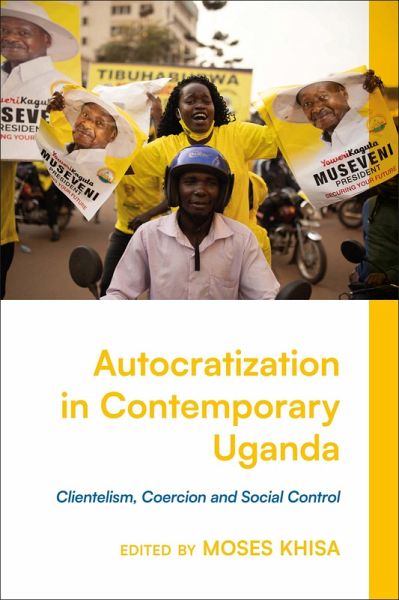
Autocratization in Contemporary Ugandaanalyses two interrelated outcomes: autocratisation, manifest in the deepening of personalist rule or Musevenism, and the regime resilience that has made Museveni one of Africa's current-longest surviving rulers. How has this feat been possible, and what has been the trajectory of Museveni's increasingly autocratic rule? Surveying that trajectory since 1986, the book takes as its primary focus the years since 2005; bringing to the fore the 'autocratic turn', placing it within a broader comparative lens, and enriching it with comparative references to cases…mehr
Autocratization in Contemporary Ugandaanalyses two interrelated outcomes: autocratisation, manifest in the deepening of personalist rule or Musevenism, and the regime resilience that has made Museveni one of Africa's current-longest surviving rulers. How has this feat been possible, and what has been the trajectory of Museveni's increasingly autocratic rule? Surveying that trajectory since 1986, the book takes as its primary focus the years since 2005; bringing to the fore the 'autocratic turn', placing it within a broader comparative lens, and enriching it with comparative references to cases outside of Uganda. While positing the notion of 'autocratic adaptability' as a defining hallmark of Museveni's rule, the book examines the factors and forces that have made that adaptability possible, analysing the dynamics around three keys themes: institutions, resources, and coalitions. Through empirical research, each chapter seeks to demonstrate how either one or two of these three variables have functioned in propelling autocratization and assuring regime resilience - producing theoretical and and comparative implications that reach beyond Uganda.
Moses Khisa is Associate Professor of Political Science and Africana Studies, North Carolina State University, USA.
Inhaltsangabe
PREFACE ACKNOWLEDGEMENTS INTRODUCTION: Theory and Trajectory of Autocratization in Contemporary Uganda Moses Khisa, North Carolina State University, USA Part I: CLIENTELISM AND RESOURCES Chapter 1: Political Clientelism and Museveni's Authoritarianism Nelson Kasfir, Dartmouth College, USA Chapter 2: "The one and only Revolutionary President": Heritage, Memory and the Personalisation of NRM Rule Jonathan Fisher, University of Birmingham, UK, and Stephanie Cawood, University of the Free State, South Africa Chapter 3: Museveni and Government-Foreign Business Relations in the Electricity Sector Roger Tangri and Andrew M. Mwenda Part II: CO-OPTATION, COERCION & SOCIAL CONTROL Chapter 4: State Co-optation of Feminism: Unpacking the Paradoxes of Political Representation Tabitha Mulyampiti, Makerere University, Uganda Chapter 5: Obstructing Civil Society: State Backlash, Co-optation and Coping Mechanisms Mesharch W. Katusiimeh, Kabale University, Uganda Chapter 6: Uncertainty, Militarism and the Politics of Regime Survival Sabastian Rwengabo, Centre for Basic Research, Uganda Chapter 7: The Military as an Instrument of Regime Survival Gerald Bareebe, York University, Canada Chapter 8: Institutionalized Arbitrariness as Autocratic Adaptability Rebecca Tapscott, University of York, UK Part III: INSTITUTIONS AND COALITION POLITICS Chapter 9: Between Change and Continuity in the Ruling Coalition Moses Khisa, North Carolina State University, USA Chapter 10: Autocratization by Elections Anders Sjögren, Uppsala University, Sweden Chapter 11: From Movement to Multiparty: The State and the Role of Political Parties Frederick Golooba-Mutebi, Uganda Martyrs University, Uganda, and Mesharch W. Katusiimeh, Kabale University, Uganda CONCLUSION: Uganda at Political Crossroads? Moses Khisa, North Carolina State University, USA, and Sabastiano Rwengabo, Centre for Basic Research, Uganda Index
Es gelten unsere Allgemeinen Geschäftsbedingungen: www.buecher.de/agb
Impressum
www.buecher.de ist ein Internetauftritt der buecher.de internetstores GmbH
Geschäftsführung: Monica Sawhney | Roland Kölbl | Günter Hilger
Sitz der Gesellschaft: Batheyer Straße 115 - 117, 58099 Hagen
Postanschrift: Bürgermeister-Wegele-Str. 12, 86167 Augsburg
Amtsgericht Hagen HRB 13257
Steuernummer: 321/5800/1497
USt-IdNr: DE450055826