
Andere Kunden interessierten sich auch für
 Automated Human Resource Systems27,99 €
 Automated Verification of Dynamic Access Control Policies45,99 €
 Experiments in Automated Generation of Games39,99 €
 Automated system of educational process management36,99 €
 How To Develop Automated Teller Machine System32,99 €
 Automated System for Land Administration36,99 €
 Automated Brain Lesion Detection and Segmentation Using MR Images55,99 €





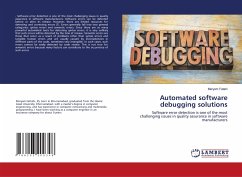
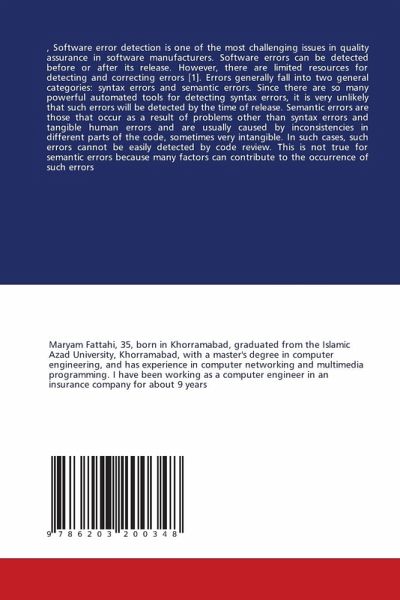
, Software error detection is one of the most challenging issues in quality assurance in software manufacturers. Software errors can be detected before or after its release. However, there are limited resources for detecting and correcting errors [1]. Errors generally fall into two general categories: syntax errors and semantic errors. Since there are so many powerful automated tools for detecting syntax errors, it is very unlikely that such errors will be detected by the time of release. Semantic errors are those that occur as a result of problems other than syntax errors and tangible human errors and are usually caused by inconsistencies in different parts of the code, sometimes very intangible. In such cases, such errors cannot be easily detected by code review. This is not true for semantic errors because many factors can contribute to the occurrence of such errors