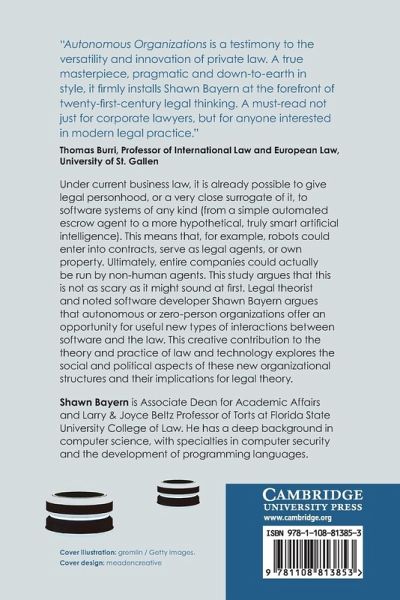
Written by a legal theorist with a background in computer technology, this book shows how existing law in the US can enable software to gain the capabilities of "legal persons." Bayern argues that this capability is not as scary as it appears and that it has several potential positive benefits.
Shawn Bayern is Associate Dean for Academic Affairs and Larry & Joyce Beltz Professor of Torts at Florida State University College of Law. He has a deep background in computer science, with specialties in computer security and the development of programming languages.
Inhaltsangabe
1. Why Autonomous Organizations? 2. The Legal Role of Algorithms 3. In the Company of Robots: The Creation of Autonomous Organizations 4. The Legal Viability of Autonomous Organizations 5. The Advantages of Autonomous Organizations 6. The Limitations and Legal Implications of Autonomous Organizations Conclusion.
Es gelten unsere Allgemeinen Geschäftsbedingungen: www.buecher.de/agb
Impressum
www.buecher.de ist ein Internetauftritt der buecher.de internetstores GmbH
Geschäftsführung: Monica Sawhney | Roland Kölbl | Günter Hilger
Sitz der Gesellschaft: Batheyer Straße 115 - 117, 58099 Hagen
Postanschrift: Bürgermeister-Wegele-Str. 12, 86167 Augsburg
Amtsgericht Hagen HRB 13257
Steuernummer: 321/5800/1497
USt-IdNr: DE450055826