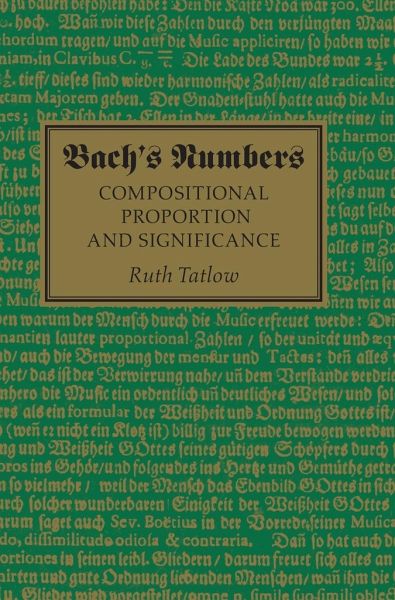
In eighteenth-century Germany the universal harmony of God's creation and the perfection of its proportions still held philosophical, moral and devotional significance. Reproducing proportions close to the unity (1:1) across compositions could render them beautiful, perfect and even eternal. Using the principles of her groundbreaking theory of proportional parallelism and the latest source study research, Ruth Tatlow reveals how Bach used the number of bars to create numerical perfection across his published collections, and explains why he did so. The first part of the book illustrates the…mehr
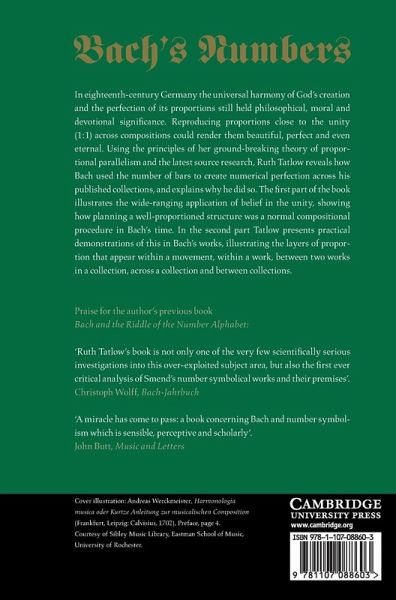
In eighteenth-century Germany the universal harmony of God's creation and the perfection of its proportions still held philosophical, moral and devotional significance. Reproducing proportions close to the unity (1:1) across compositions could render them beautiful, perfect and even eternal. Using the principles of her groundbreaking theory of proportional parallelism and the latest source study research, Ruth Tatlow reveals how Bach used the number of bars to create numerical perfection across his published collections, and explains why he did so. The first part of the book illustrates the wide-ranging application of belief in the unity, showing how planning a well-proportioned structure was a normal compositional procedure in Bach's time. In the second part Tatlow presents practical demonstrations of this in Bach's works, illustrating the layers of proportion that appear within a movement, a work, between two works in a collection, across a collection and between collections.
British-Swedish musicologist Ruth Tatlow is a widely published independent scholar and editor with a research base in Stockholm, Sweden, and a performance background as a prize-winning clarinettist (as Ruth Ballard). Her examination of compositional theory and practice in the works of J. S. Bach began with her doctoral thesis Lusus musicus vel poëticus (King's College, London University, 1987) and produced ground-breaking results reflected in her publications that include two classic monographs, Bach and the Riddle of the Number Alphabet (Cambridge, 1991) and Bach's Numbers: Compositional Proportion and Significance (Cambridge, 2015), the latter awarded Choice 'Outstanding Academic Title 2016'. Her current research interests include tracing the origins and transmission of proportional parallelism 1650-1850, and the theory and practice of emblematic techniques in early eighteenth century music collections. She co-founded Bach Network in 2004 and its journal Understanding Bach in 2006. She currently serves as chair of the Bach Network Council and is a member of the Editorial Board of the American Bach Society. https://orcid.org/0000-0003-3367-9921
Inhaltsangabe
Part I. Foundations: 1. Bach's numbers 2. Symmetry, proportion and parallels 3. Unity, proportions and universal harmony in Bach's world 4. Bars, compositional planning and proportional parallelism Part II. Demonstrations: 5. Three collections for strings 6. Four in two collections for keyboard 7. Two further collections for keyboard 8. Two small late collections 9. Two large late collections 10. Collections of concertos 11. Collections of organ works 12. Great passions and cantatas 13. Festive cut-and-paste projects: masses and oratorios 14. Lost blueprints Appendix 1. Chronological index of musical doctrine.
Es gelten unsere Allgemeinen Geschäftsbedingungen: www.buecher.de/agb
Impressum
www.buecher.de ist ein Internetauftritt der buecher.de internetstores GmbH
Geschäftsführung: Monica Sawhney | Roland Kölbl | Günter Hilger
Sitz der Gesellschaft: Batheyer Straße 115 - 117, 58099 Hagen
Postanschrift: Bürgermeister-Wegele-Str. 12, 86167 Augsburg
Amtsgericht Hagen HRB 13257
Steuernummer: 321/5800/1497
USt-IdNr: DE450055826