
Andere Kunden interessierten sich auch für
 Back to the University's Future113,99 €
 To Judge and To Justify98,99 €
 The Governing-Evaluation-Knowledge Nexus38,99 €
 The Governing-Evaluation-Knowledge Nexus38,99 €
 Academic Integrity in the Social Sciences113,99 €
 Ethics and the Scholarship of Teaching and Learning83,99 €
 The Future of Higher Education in the Middle East and Africa68,99 €







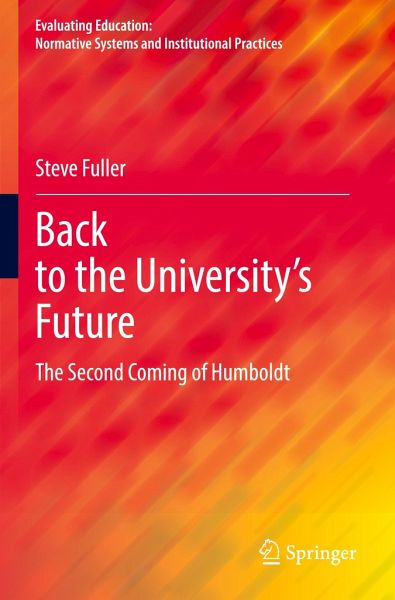
This volume addresses the central question facing the future of higher education around the world, whether and why universities need to exist at all. This book accepts the question's premise: It is not clear that the university is any longer needed as an institution -- that is, unless its defenders recover what had made the university the revolutionary institution that over the past two centuries has not only defined the shape of modern systematic inquiry but also the distinctiveness of the societies that have housed them. In short, what is required is a reanimation of the spirit of Wilhelm von Humboldt for our times; hence the book's title and subtitle. Humboldt was responsible for relaunching the university as the vanguard institution of 'Enlightenment' to which we continue to pay lip service - and sometimes not much more than that. Admittedly, the task of relaunching Humboldt today is made difficult because many of the concrete achievements associated with the Humboldtian university - not least academic disciplines and nation-states - are increasingly seen as problematic if not obsolete. However, the global reach of the Humboldtian vision in its 19th century and 20th century heyday offers hope that it may be recovered in the 21st century. The book focuses on the performative character of the academic vocation, what Humboldt memorably characterized as the 'unity of research and teaching' in the same person, a role model for students and society at large. The book's seven chapters develop this theme in a historically and philosophically nuanced way in terms of the Humboldtian vision of knowledge, sense of free expression and critical judgement, and commitment to translation and publicity.
Back to the University s Future: The Second Coming of Humboldt provides excellent insight into the history of ideas that shaped modern university education. Fuller concludes the book with a powerful message about the importance of university education as a public good . (Ioannis Rigkos Zitthen, Amalie Rigkos Zitthen, Postdigital Science and Education, Vol. 7 (2), 2025)