
Andere Kunden interessierten sich auch für
 The Economics of Foreign Exchange and Global Finance98,99 €
 Managing Human Capital during the Covid-19 Pandemic113,99 €
 Studies in International Economics and Finance129,99 €
 European Monetary Union39,99 €
 Studies in International Economics and Finance130,99 €
 European Monetary Integration39,99 €
 Theoretical and Policy-Oriented Aspects of the External Debt Economics77,99 €



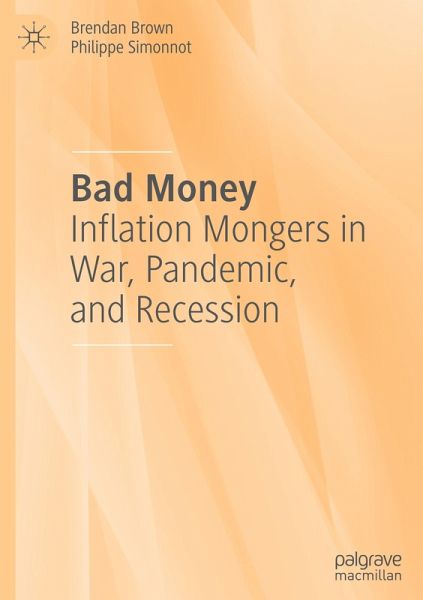
This book argues that the blame for the Great Pandemic Inflation in the US and Europe lies with serious flaws in the actual monetary regime. Money is literally out of control with no solid anchor. In consequence further great inflations lie ahead, whether the proximate cause is another massive supply shock (for example war, trade conflict, resource famine) or fiscal explosion or simply malfunctioning of the corrupted monetary system.
The book draws on monetary principles applied in the laboratory of history including wars, great recessions, and US wave elections to make its key points. The choice of monetary principles is eclectic, including insights from Austrian School and previous works of the authors. The historical examples stretch from the 1890s to the present day. The authors do not shy away from use of counterfactual analysis, including how the shocks from the pandemic or Russia-Ukraine War would have played out under a sound money regime.
Questions posed include how a flawed monetary regime has encountered so little political push-back. The answer includes an identification of the sub-groups in the US or global economy who gain from a flawed monetary regime and their wielding of power to protect the status quo. Crucially the book describes how asset inflation, one of the main symptoms of monetary disorder, has weakened opposition to the regime, though ultimately fanning populism due to decades of malinvestment.
This book should have wide appeal to academics in monetary economics, international finance, international relations and history, especially those with a passion for the use of history as laboratory. More generally the book should fascinate a wide range of thinkers close to or in the thick of the global financial markets.
The book draws on monetary principles applied in the laboratory of history including wars, great recessions, and US wave elections to make its key points. The choice of monetary principles is eclectic, including insights from Austrian School and previous works of the authors. The historical examples stretch from the 1890s to the present day. The authors do not shy away from use of counterfactual analysis, including how the shocks from the pandemic or Russia-Ukraine War would have played out under a sound money regime.
Questions posed include how a flawed monetary regime has encountered so little political push-back. The answer includes an identification of the sub-groups in the US or global economy who gain from a flawed monetary regime and their wielding of power to protect the status quo. Crucially the book describes how asset inflation, one of the main symptoms of monetary disorder, has weakened opposition to the regime, though ultimately fanning populism due to decades of malinvestment.
This book should have wide appeal to academics in monetary economics, international finance, international relations and history, especially those with a passion for the use of history as laboratory. More generally the book should fascinate a wide range of thinkers close to or in the thick of the global financial markets.
The logic of Mr. Brown s argument should be widely understood. If prices don t fall sometimes you can t have stable prices. That is what the inflation-mongers want precisely to prevent. They wish to reinflate any periodic tendency of prices to fall. (Alex J Pollock, The New York Sun, nysun.com, November 13, 2025)