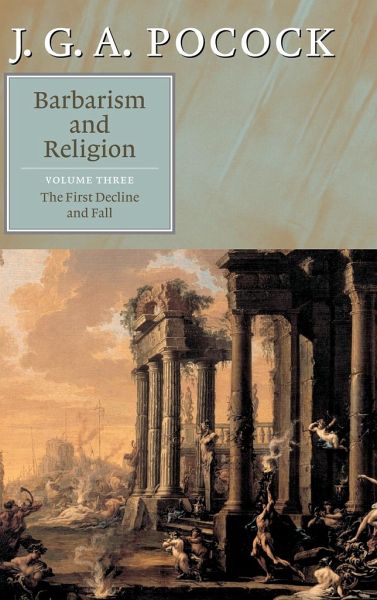

'Barbarism and Religion' - Edward Gibbon's own phrase - is the title of a sequence of works by John Pocock designed to situate Gibbon, and his Decline and Fall of the Roman Empire, in a series of contexts in the history of eighteenth-century Europe. This is a major intervention from one of the world's leading historians, challenging the notion of any one 'Enlightenment' and positing instead a plurality of enlightenments, of which the English was one. The first two volumes of Barbarism and Religion were warmly and widely reviewed, and won the Jacques Barzun Prize in Cultural History of the…mehr
'Barbarism and Religion' - Edward Gibbon's own phrase - is the title of a sequence of works by John Pocock designed to situate Gibbon, and his Decline and Fall of the Roman Empire, in a series of contexts in the history of eighteenth-century Europe. This is a major intervention from one of the world's leading historians, challenging the notion of any one 'Enlightenment' and positing instead a plurality of enlightenments, of which the English was one. The first two volumes of Barbarism and Religion were warmly and widely reviewed, and won the Jacques Barzun Prize in Cultural History of the American Philosophical Society. In this third volume in the sequence, The First Decline and Fall, John Pocock offers an historical introduction to the first fourteen chapters of Gibbon's great work, recounting the end of the classical civilisation Gibbon and his readers knew so much better than the worlds that followed.
J. G. A. Pocock is one of the world's leading historians of ideas, and is Harry C. Black Emeritus Professor of History at The Johns Hopkins University.
Inhaltsangabe
Introduction Prologue: 1. Gibbon's first volume: the problem of the Antonine moment Part I. The First Decline and Fall: Ancient Perceptions: 2. Alibi quam Romae: the Tacitean narrative 3. The Gracchan explanation: Appian of Alexandria and the unknown historian 4. The construction of Christian empire Part II. The Ambivalence and Survival of Christian Empire: 5. Orosius and Augustine: the formation of a Christian anti-history 6. Otto of Freising and the two cities 7. The historiography of the translatio imperii Part III. The Humanist Construction of Decline and Fall: 8. Leonardo Bruni: from translatio to declinatio 9. Flavio Biondo and the decades of decline 10. Niccolo Machiavelli and the imperial republic Part IV. Extensive Monarchy and Roman History: 11. Pedro Mexia: empire and monarchy 12. History in the western monarchies: barbarism, law and republican survivals 13. Lipsius and Harrington: the problem of arms in ancient and modern monarchy Part V. Republic and Empire: The Enlightened Narrative: 14. European Enlightenment and the Machiavellian moment 15. The French narrative: I: Boussuet and Tillemont, II: Montesquieu and Beaufort 16. The Scottish narrative: I: David Hume and Adam Smith, II: Adam Ferguson's history of the republic Part VI. Gibbon and the Structure of Decline: 17. The Antonine moment 18. The Severi and the disintegration of the principate 19. The Illyrian recovery and the new monarchy Epilogue 20. The Constantinean moment.
Es gelten unsere Allgemeinen Geschäftsbedingungen: www.buecher.de/agb
Impressum
www.buecher.de ist ein Internetauftritt der buecher.de internetstores GmbH
Geschäftsführung: Monica Sawhney | Roland Kölbl | Günter Hilger
Sitz der Gesellschaft: Batheyer Straße 115 - 117, 58099 Hagen
Postanschrift: Bürgermeister-Wegele-Str. 12, 86167 Augsburg
Amtsgericht Hagen HRB 13257
Steuernummer: 321/5800/1497
USt-IdNr: DE450055826