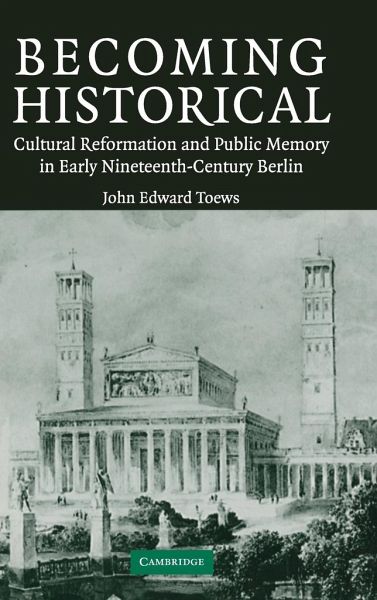
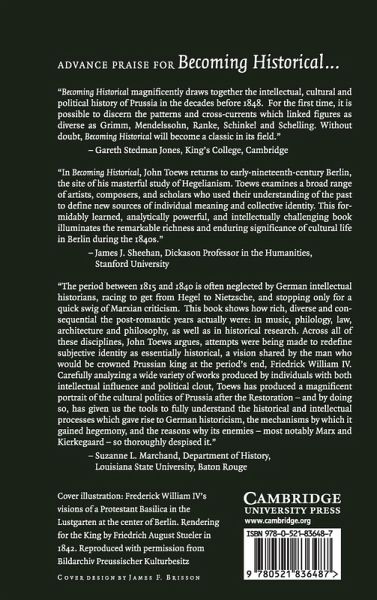
This book examines the ways in which selfhood and cultural solidarity came to be understood and lived as historical identities during the 1800s. It examines the stages and conflicts in the process of 'becoming historical' through the works of prominent Prussian artists and intellectuals (Karl Friedrich Schinkel, Felix Mendelssohn, Jacob Grimm, Friedrich Karl von Savigny, Leopold von Ranke) who attached their personal visions to the reformist agenda of the Prussian regime that took power in 1840. The historical account of the evolution of analogous and inter-related commitments to a cultural…mehr
This book examines the ways in which selfhood and cultural solidarity came to be understood and lived as historical identities during the 1800s. It examines the stages and conflicts in the process of 'becoming historical' through the works of prominent Prussian artists and intellectuals (Karl Friedrich Schinkel, Felix Mendelssohn, Jacob Grimm, Friedrich Karl von Savigny, Leopold von Ranke) who attached their personal visions to the reformist agenda of the Prussian regime that took power in 1840. The historical account of the evolution of analogous and inter-related commitments to a cultural reformation that would create communal solidarity through subjective identification with public memory is framed by the philosophical perspectives on historical selfhood provided by F. W. J. Schelling and his radical critics, Karl Marx and Søren Kierkegaard, thus drawing this story of building selves and communities in early nineteenth-century Berlin into debates about historical determined and contingently constructed identities.
John Edward Toews is Professor of History at the University of Washington. He is the author of Hegelianism: The Path Toward Dialectical Humanism, 1805-1841 (Cambridge, 1981) as well as numerous articles in scholarly journals. He also is the editor of The Communist Manifesto: By Karl Marx and Frederick Engels with Related Documents (1999).
Inhaltsangabe
List of illustrations; Preface; Acknowledgements; Philosophical prologue: historical ontology and cultural reformation: Schelling in Berlin, 1841-5; Part I. Historicism in Power: 1840 and the Historical Turn in Prussian Cultural Politics: 1. Nation, church, and the politics of historical identity: Frederick William IV's vision of cultural reformation; 2. 'Redeemed nationality': Christian Bunsen and the transformation of ethnic peoples into ethical communities under the guidance of the historical principle; Part II. Architectural and Musical Historicism: Aesthetic Education and Cultural Reformation: 3. Building historical identities in space and stone: Schinkel's search for the shape of ethical community; 4. The generation of ethical community from the spirit of music: Mendelssohn's musical constructions of historical identity; Part III. Law, Language, and History: Cultural Identity and the Self-Constituting Subject in the Historical School: 5. The tension between immanent and transcendent subjectivity in the Historical School of Law: from Savigny to Stahl; 6. The past as a foreign home: Jacob Grimm and the relation between language and historical identity; 7. Ranke and the Christian-German state: contested historical identities and the transcendent foundations of the historical subject; Antiphilosophical Epilogue: historicizing self-identity in Kierkegaard and Marx, 1841-6; Index.
Es gelten unsere Allgemeinen Geschäftsbedingungen: www.buecher.de/agb
Impressum
www.buecher.de ist ein Internetauftritt der buecher.de internetstores GmbH
Geschäftsführung: Monica Sawhney | Roland Kölbl | Günter Hilger
Sitz der Gesellschaft: Batheyer Straße 115 - 117, 58099 Hagen
Postanschrift: Bürgermeister-Wegele-Str. 12, 86167 Augsburg
Amtsgericht Hagen HRB 13257
Steuernummer: 321/5800/1497
USt-IdNr: DE450055826