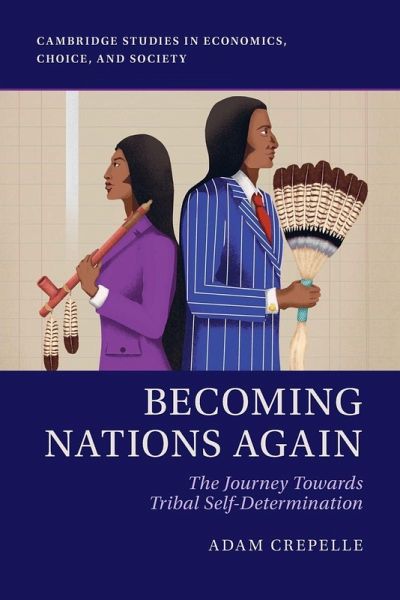
Tribes operated sovereign governments since time immemorial. Colonialism forced tribes onto reservations and stripped them of sovereign powers. Federal paternalism continues to undermine tribal self-governance; thus, tribes struggle with crime and poverty. Treating tribes as nations again is the key to improving life in Indian country.
Tribes operated sovereign governments since time immemorial. Colonialism forced tribes onto reservations and stripped them of sovereign powers. Federal paternalism continues to undermine tribal self-governance; thus, tribes struggle with crime and poverty. Treating tribes as nations again is the key to improving life in Indian country.
Produktdetails
Produktdetails
Cambridge Studies in Economics, Choice, and Society
Adam Crepelle is an Assistant Professor at Loyola University Chicago School of Law. He received the Elinor Ostrom Prize in 2023 for his co-authored article, Community Policing on American Indian Reservations. He is the coauthor of the upcoming book Reservation Capitalism: Economic Development in Indian Country Revised and Updated (2025).
Inhaltsangabe
1. Introduction Part I: 2. The original American governments 3. 'Discovering' and 'founding' America 4. Commerce and culture 5. World war and American revolution 6. Governing the United States and tribal rights 7. Indian removal and the Cherokee cases 8. Reservations and federal power 9. Allotment and assimilation 10. The Indian new deal to tribal termination 11. Tribal self-determination Part II: 12. An unfit guardian: ongoing federal paternalism 13. Excessive federal bureaucracy 14. Criminal justice crisis 15. Tribal economic development and uncertain civil jurisdiction Part III: 16. Domestic dependent no more 17. Federal recognition 18. Territorial jurisdiction 19. Tribal legal institutions 20. Tribes as nations 21. Education, ethics, and the law 22. Conclusion.
1. Introduction Part I: 2. The original American governments 3. 'Discovering' and 'founding' America 4. Commerce and culture 5. World war and American revolution 6. Governing the United States and tribal rights 7. Indian removal and the Cherokee cases 8. Reservations and federal power 9. Allotment and assimilation 10. The Indian new deal to tribal termination 11. Tribal self-determination Part II: 12. An unfit guardian: ongoing federal paternalism 13. Excessive federal bureaucracy 14. Criminal justice crisis 15. Tribal economic development and uncertain civil jurisdiction Part III: 16. Domestic dependent no more 17. Federal recognition 18. Territorial jurisdiction 19. Tribal legal institutions 20. Tribes as nations 21. Education, ethics, and the law 22. Conclusion.
Es gelten unsere Allgemeinen Geschäftsbedingungen: www.buecher.de/agb
Impressum
www.buecher.de ist ein Internetauftritt der buecher.de internetstores GmbH
Geschäftsführung: Monica Sawhney | Roland Kölbl | Günter Hilger
Sitz der Gesellschaft: Batheyer Straße 115 - 117, 58099 Hagen
Postanschrift: Bürgermeister-Wegele-Str. 12, 86167 Augsburg
Amtsgericht Hagen HRB 13257
Steuernummer: 321/5800/1497
USt-IdNr: DE450055826