"Two opposed points of view," John B. Watson wrote in 1925, "are still dominant in American psychological thinking: introspective or subjective psychology, and behaviorism or objective psychology." His statement is still true today. Reacting against traditional psychology's emphasis on feelings and introspection, and its lack of precise categories, Watson proposed a methodological approach to psychological problems that would be logical, precise, and scientific. Consciousness, he believed, was not a usable hypothesis: the proper subject of human psychology is the behavior of the human being.…mehr
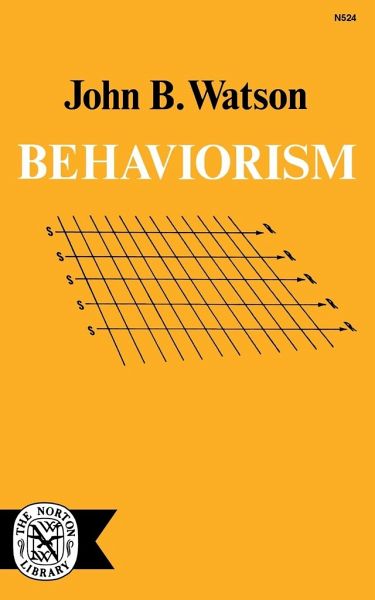
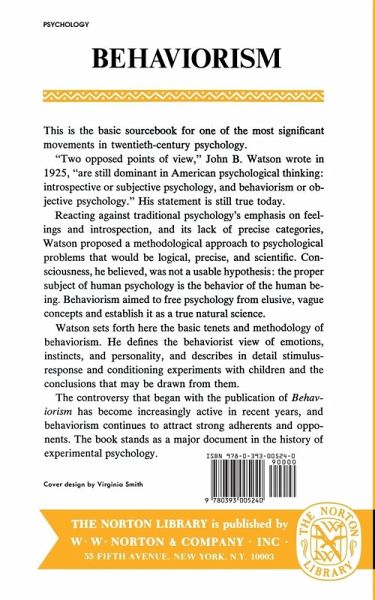
"Two opposed points of view," John B. Watson wrote in 1925, "are still dominant in American psychological thinking: introspective or subjective psychology, and behaviorism or objective psychology." His statement is still true today. Reacting against traditional psychology's emphasis on feelings and introspection, and its lack of precise categories, Watson proposed a methodological approach to psychological problems that would be logical, precise, and scientific. Consciousness, he believed, was not a usable hypothesis: the proper subject of human psychology is the behavior of the human being. Behaviorism aimed to free psychology from elusive, vague concepts and establish it as a true natural science.
John B. Watson (1878-1958) es recordado por fundar el conductismo clásico (a veces denominado watsoniano o metodológico), un enfoque que hace hincapié en el estudio de la conducta observable por encima de los estados mentales internos. Su famoso experimento del pequeño Alberto demostró que las emociones podían ser respuestas condicionadas, ilustrando cómo las conductas pueden moldearse a través de factores ambientales. Watson creía que la psicología debía centrarse en las acciones observables y rechazaba la introspección. Su trabajo influyó enormemente en campos como la educación, la publicidad y el estudio del desarrollo infantil. Más adelante, tras abandonar la vida académica, aplicó los principios conductistas al marketing y la publicidad, siendo pionero de la psicología moderna del consumidor.
Inhaltsangabe
INTRODUCTION I. WHAT IS BEHAVIORISM? II. HOW TO STUDY HUMAN BEHAVIOR Ill. THE HUMAN BODY Part 1-The structures that make behavior possible. IV. THE HUMANB ODY Part 11-The glands in everyday behavior. V. ARE THERE ANY HUMAN INSTINCTS? Part I-On the subject of talent, tendencies and the inheritance of all so-called 'mental' traits. VI. ARE THERE ANY HUMAN INSTINCTS? Part 11-What the study of the human young teaches us. VII. EMOTIONS Part I-A general survey of the field and some experimental studies. VIII. EMOTIONS Part 11-Further experiments and observations on how we acquire, shift and lose our emotional life. IX. OUR MANUAL HABITS X. TALKING AND THINKING XI. DO WE ALWAYS THINK IN WORDS XII. PERSONALITY
INTRODUCTION I. WHAT IS BEHAVIORISM? II. HOW TO STUDY HUMAN BEHAVIOR Ill. THE HUMAN BODY Part 1-The structures that make behavior possible. IV. THE HUMANB ODY Part 11-The glands in everyday behavior. V. ARE THERE ANY HUMAN INSTINCTS? Part I-On the subject of talent, tendencies and the inheritance of all so-called 'mental' traits. VI. ARE THERE ANY HUMAN INSTINCTS? Part 11-What the study of the human young teaches us. VII. EMOTIONS Part I-A general survey of the field and some experimental studies. VIII. EMOTIONS Part 11-Further experiments and observations on how we acquire, shift and lose our emotional life. IX. OUR MANUAL HABITS X. TALKING AND THINKING XI. DO WE ALWAYS THINK IN WORDS XII. PERSONALITY
Es gelten unsere Allgemeinen Geschäftsbedingungen: www.buecher.de/agb
Impressum
www.buecher.de ist ein Internetauftritt der buecher.de internetstores GmbH
Geschäftsführung: Monica Sawhney | Roland Kölbl | Günter Hilger
Sitz der Gesellschaft: Batheyer Straße 115 - 117, 58099 Hagen
Postanschrift: Bürgermeister-Wegele-Str. 12, 86167 Augsburg
Amtsgericht Hagen HRB 13257
Steuernummer: 321/5800/1497
USt-IdNr: DE450055826