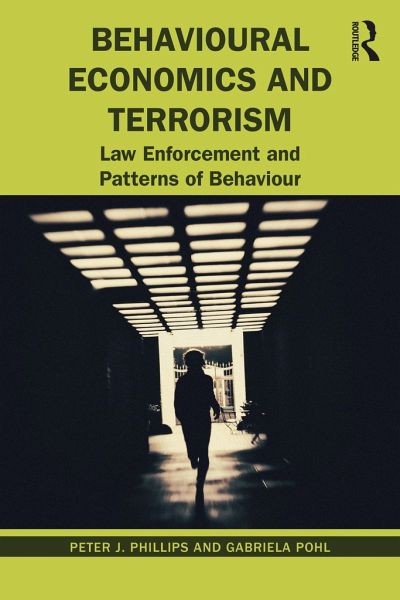
Behavioural Economics and Terrorism can be used as a guide to help us think about thinking and, in doing so, to appreciate the deep quirkiness of human behaviour.
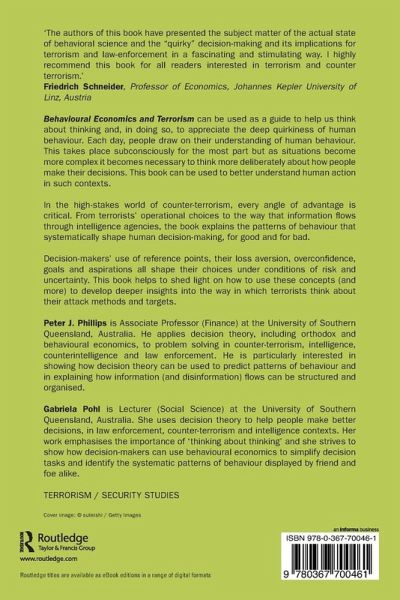
Behavioural Economics and Terrorism can be used as a guide to help us think about thinking and, in doing so, to appreciate the deep quirkiness of human behaviour.
Peter J. Phillips is Associate Professor (Finance) at the University of Southern Queensland, Australia. He applies decision theory, including orthodox and behavioural economics, to problem solving in counter-terrorism, intelligence, counterintelligence and law enforcement. He is particularly interested in showing how decision theory can be used to predict patterns of behaviour and in explaining how information (and disinformation) flows can be structured and organised. Gabriela Pohl is Lecturer (Social Science) at University of Southern Queensland, Australia. She uses decision theory to help people make better decisions, in law enforcement, counter-terrorism and intelligence contexts. Her work emphasises the importance of 'thinking about thinking' and she strives to show how decision-makers can use behavioural economics to simplify decision tasks and identify the systematic patterns of behaviour displayed by friend and foe alike.
Inhaltsangabe
1. Blindfold Chess and Terrorism 2. Patterns of Reason and Unreasonableness 3. Bounded by Rationality 4. Loss Aversion and Terrorist Identity 5. Prospect Theory as a Descriptive Theory of Terrorist Choice 6. The Hidden Side of Attack Method Combinations and International Terrorism 7. Cycles in Terrorism and Evolutionary Stability 8. Overconfidence, Gender Differences and Terrorist Choice 9. Expected Utility as a Measurement Tool in the Terrorism Context 10. Decision-Making with More than One Reference Point 11. A Guide to the Terrorism Studies Conversation 12. Information Cascades and the Prioritisation of Suspects 13. Everyday Decision-Making 14. Reason, Strategy and Discovery
1. Blindfold Chess and Terrorism 2. Patterns of Reason and Unreasonableness 3. Bounded by Rationality 4. Loss Aversion and Terrorist Identity 5. Prospect Theory as a Descriptive Theory of Terrorist Choice 6. The Hidden Side of Attack Method Combinations and International Terrorism 7. Cycles in Terrorism and Evolutionary Stability 8. Overconfidence, Gender Differences and Terrorist Choice 9. Expected Utility as a Measurement Tool in the Terrorism Context 10. Decision-Making with More than One Reference Point 11. A Guide to the Terrorism Studies Conversation 12. Information Cascades and the Prioritisation of Suspects 13. Everyday Decision-Making 14. Reason, Strategy and Discovery
Es gelten unsere Allgemeinen Geschäftsbedingungen: www.buecher.de/agb
Impressum
www.buecher.de ist ein Internetauftritt der buecher.de internetstores GmbH
Geschäftsführung: Monica Sawhney | Roland Kölbl | Günter Hilger
Sitz der Gesellschaft: Batheyer Straße 115 - 117, 58099 Hagen
Postanschrift: Bürgermeister-Wegele-Str. 12, 86167 Augsburg
Amtsgericht Hagen HRB 13257
Steuernummer: 321/5800/1497
USt-IdNr: DE450055826