
Andere Kunden interessierten sich auch für
 Meaning, Reference and Necessity42,99 €
") A Letter To The Rev. Mr. John Palmer, In Defense Of The Illustrations Of Philosophical Necessity (1779)24,99 €
A Letter To The Rev. Mr. John Palmer, In Defense Of The Illustrations Of Philosophical Necessity (1779)24,99 € Meaning, Quantification, Necessity46,99 €
 Divine Foreknowledge and Necessity73,99 €
 The Scheme of Christian and Philosophical Necessity Asserted20,99 €
![Freedom and Necessity [microform]: a Lecture, Delivered in Knox' College on the 6th April, 1870, at the Close of the College Session]( "Freedom and Necessity [microform]: a Lecture, Delivered in Knox' College on the 6th April, 1870, at the Close of the College Session") Freedom and Necessity [microform]: a Lecture, Delivered in Knox' College on the 6th April, 1870, at the Close of the College Session14,99 €
Freedom and Necessity [microform]: a Lecture, Delivered in Knox' College on the 6th April, 1870, at the Close of the College Session14,99 € The Necessity of Errors27,99 €
![Freedom and Necessity [microform]: a Lecture, Delivered in Knox' College on the 6th April, 1870, at the Close of the College Session](https://bilder.buecher.de/produkte/65/65562/65562742m.jpg "Freedom and Necessity [microform]: a Lecture, Delivered in Knox' College on the 6th April, 1870, at the Close of the College Session")
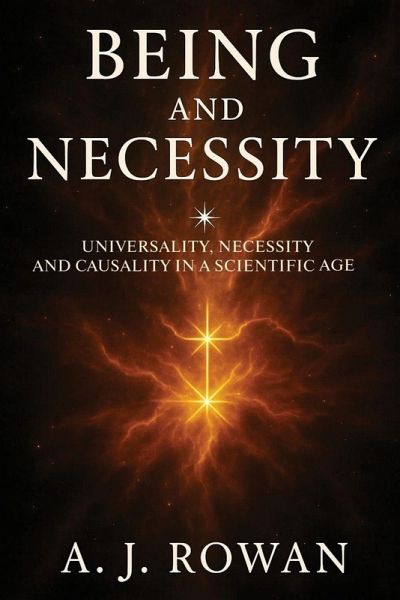
Being and Necessity advances a bold recovery and reformulation of classical metaphysics for a scientific age. Modern philosophy has long struggled with the problem of causality, modality, and the grounds of necessity. Hume reduced causality to mere habit and denied any rational access to necessary connections. Kant reinterpreted universality and necessity as conditions of human cognition rather than features of reality itself. Quine unsettled the analytic-synthetic distinction, and contemporary philosophy fractured into competing accounts of modality, semantics, and scientific explanation. Beneath these long-running debates lies a more basic question: Are universality and necessity rooted in the structure of thought, or in the structure of being? This volume argues that the classical tradition-especially Aristotle and Aquinas-offers the conceptual resources to recover necessity as a property of reality rather than a projection of the mind. Beginning with the givenness of experience, the analysis moves from sensation to the grasp of being as such, and from that vantage it defends the first principles of intelligibility: identity, non-contradiction, and causality. These principles are not invented by thought; they are the universal and necessary features of what exists. Being and Necessity shows how these principles ground a realism capable of bearing the weight of logic, science, and theology without collapsing into skepticism or subjectivism. The book builds upon The First Cause, the first work in this series, which established the metaphysical foundation for a renewed synthetic a priori. On that base, Being and Necessity confronts the apparent divide between sensibility and intelligibility by showing that the mind's capacity to know the world arises from its orientation to being itself. Part I revisits Hume's critique of causality, demonstrating that necessary connection is not an invented conjunction but a real dependence revealed through experience and reason. Part II reformulates Kant's insight while removing its idealist limits, recovering universality and necessity in being rather than in cognition alone. Part III engages modern analytic thought, examining modal semantics, propositions, and the nature of explanation, drawing on Frege, Quine, Kripke, and others. Throughout, the work integrates insights from classical metaphysics with developments in contemporary philosophy and science, offering a rigorous and unified account of necessity, causality, and the structure of reality. Written for philosophers, theologians, scientists, and advanced readers seeking a systematic yet accessible treatment of metaphysics, Being and Necessity presents a realist framework capable of addressing longstanding debates about modality, causation, and the conditions of intelligibility. It is both a continuation of the classical tradition and a constructive proposal for how metaphysics can speak with clarity and force in the modern intellectual landscape.