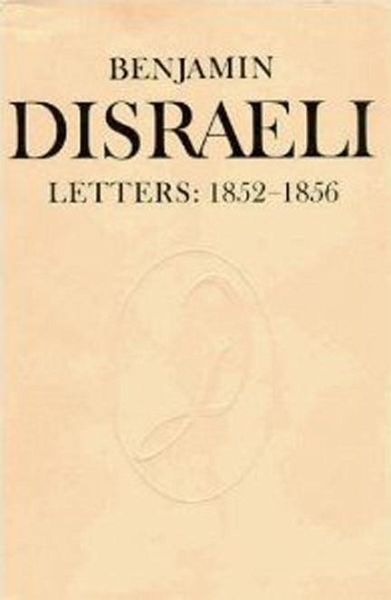
Benjamin Disraeli, Queen Victoria's Favourite Prime Minister, Was, In The Words of Robert Blake, 'the best letter-writer among English statesmen.' This, the latest volume in the critically acclaimed Letters of Benjamin Disraeli series, contains or describes 952 letters (778 previously unpublished) written by Disraeli between 1852 and 1856. These years cover his first cabinet post, as chancellor of the exchequer, his attempts as House leader to unify the Conservative party, and his opposition to the Crimean War, both in the House and in his newspaper, The Press. Included are significant runs of…mehr
Benjamin Disraeli, Queen Victoria's Favourite Prime Minister, Was, In The Words of Robert Blake, 'the best letter-writer among English statesmen.' This, the latest volume in the critically acclaimed Letters of Benjamin Disraeli series, contains or describes 952 letters (778 previously unpublished) written by Disraeli between 1852 and 1856. These years cover his first cabinet post, as chancellor of the exchequer, his attempts as House leader to unify the Conservative party, and his opposition to the Crimean War, both in the House and in his newspaper, The Press. Included are significant runs of correspondence, such as 63 letters (34 previously unpublished) to the fourteenth Earl of Derby, and 75 letters (none previously published) to Lord Stanley, the future fifteenth Earl of Derby, as well as more personal letters, such as those to the eccentric Mrs Brydges Willyams, the "female Croesus" who offered Disraeli a substantial legacy. These illuminate anew both his public and private life, and show the strength of his resolve to re-shape party policies to suit the age of industrialism and free trade. New light is also thrown on other matters, such as the supposed plagiarism in his panegyric on the Duke of Wellington. Ten appendices include full cabinet lists, Disraeli's own reminiscences of the period, and Stanley's remarkable verbatim notes of intimate conversations with Disraeli at Hughenden Manor.
Disraeli's letters show the hand of the novelist in their ability to bring the mid-nineteenth century to life for the modern reader.
Benjamin Disraeli (1804-1881) was one of the most important figures in nineteenth-century Europe, spending three decades in British government and twice serving as prime minister, as well as being a well-known literary figure. A convert to Anglicanism, he was Britain's first and thus far only Prime Minister of Jewish heritage. Mary S. Millar is a co-editor with the Disraeli Project and an independent scholar in Kingston, Ontario. M.G. Wiebe is general editor emeritus of the Disraeli Project and was a professor of English at Queen's University. JOHN M. ROBSON was born educated in Toronto, graduating from the University of Toronto (B.A. 1951, M.A. 1953, PH.D. 1956). After lecturing at the University of British Columbia and the University of Alberta, he joined the staff as Victoria College, University of Toronto, where he is now Professor of English. He is Associate Editor of the Collected Works of John Stuart Mill, and he also edited Edmund Burke’s Appel from the New to the Old Whigs, J.S. Mill: A Selection, and Editing Nineteenth-Century Texts.
Es gelten unsere Allgemeinen Geschäftsbedingungen: www.buecher.de/agb
Impressum
www.buecher.de ist ein Internetauftritt der buecher.de internetstores GmbH
Geschäftsführung: Monica Sawhney | Roland Kölbl | Günter Hilger
Sitz der Gesellschaft: Batheyer Straße 115 - 117, 58099 Hagen
Postanschrift: Bürgermeister-Wegele-Str. 12, 86167 Augsburg
Amtsgericht Hagen HRB 13257
Steuernummer: 321/5800/1497
USt-IdNr: DE450055826