

Andere Kunden interessierten sich auch für
 More92,99 €
 Aquinas115,99 €
 Power and Policy in Liberal de105,99 €
 Brutus87,99 €
 Plato94,99 €
 Hobhouse105,99 €
 Rethinking Comparison114,99 €





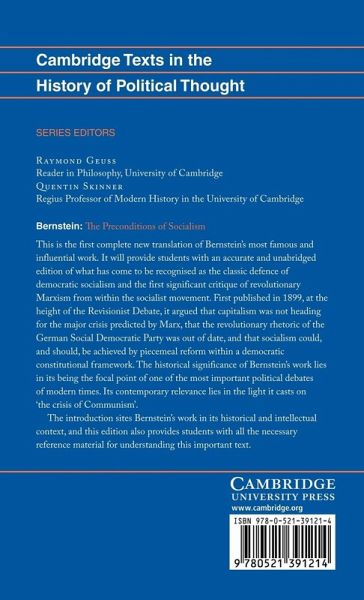
This 1993 book was the first complete new translation of Bernstein's famous and influential work. It will provide students with an accurate and unabridged edition of the classic defence of democratic socialism and the first significant critique of revolutionary Marxism from within the socialist movement. First published in 1899, at the height of the Revisionist Debate, it argued that capitalism was not heading for the major crisis predicted by Marx, and that socialism could be achieved by piece-meal reform within a democratic constitutional framework. Bernstein's work is the focal point of one of the most important political debates of modern times, and crucial for the light it casts on 'the crisis of Communism'. The introduction sites Bernstein's work in its historical and intellectual context, and this edition also provides students with all the necessary reference material for understanding this important text.