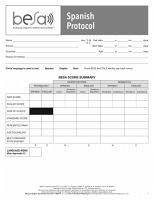
Sold in a package of 20 forms, these three Spanish subtests are a part of the Bilingual English-Spanish Assessment (BESA), a language assessment for use with children ages 4 through 6 years who have varying degrees of bilingualism. Standardized and norm-referenced, the subtests take about 15 minutes each and address the key domains of morphosyntax, semantics, and phonology. * BESA Phonology Subtest. A single-word phonological assessment, the Spanish measure of this subtest assesses phonological production of 28 Spanish words. When conducted with the English measure (learn more here), this…mehr
Sold in a package of 20 forms, these three Spanish subtests are a part of the Bilingual English-Spanish Assessment (BESA), a language assessment for use with children ages 4 through 6 years who have varying degrees of bilingualism. Standardized and norm-referenced, the subtests take about 15 minutes each and address the key domains of morphosyntax, semantics, and phonology. * BESA Phonology Subtest. A single-word phonological assessment, the Spanish measure of this subtest assesses phonological production of 28 Spanish words. When conducted with the English measure (learn more here), this subtest is designed to differentially diagnose typical from atypical phonological skills in Spanish-English bilingual children. * BESA Morphosyntax Subtest. This subtest employs cloze and sentence repetition tasks to target grammatical morphemes and sentence structures that were predicted to be difficult for children with language impairment in Spanish. A grammatical cloze subscore, a sentence repetition subscore, and a total score that is a composite of those two subscores are derived. * BESA Semantics Subtest. This subtest targets six tasks: analogies, characteristic properties, categorization, functions, linguistic concepts, and similarities and differences. The Spanish semantics subtest has a total of 25 items: 12 receptive and 13 expressive. Subscores are provided for semantics receptive and semantics expressive, as well as a total semantics score for each language. ABOUT BESA A valid and reliable assessment that specifically responds to the needs of young Spanish-English bilingual children, BESA was developed to: * identify phonological and/or language impairment in bilingual children and English language learners using a standardized protocol * differentiate between a delay in English language acquisition and a true language disorder * document children's speech and language strengths and needs * monitor children's progress in both languages and use the information to make decisions about intervention Through a combination of subtests for students and surveys for teachers and parents, BESA reveals the big picture of a young bilingual child's language development. Learn more about BESA here.
Elizabeth Peña PhD, CCC-SLP, is George Christian Centennial Professor in Communication at The University of Texas as Austin. Her research focuses on bilingualism and language impairment. Her work on test development for bilinguals addresses assessment skills that differentiate among children with and without language impairment that allow responses that reflect cultural knowledge. In the area of intervention, she is interested in how children from diverse linguistic backgrounds learn new language skills and how they transfer knowledge between two language. Aquiles Iglesias PhD is Professor and Founding Director of the Speech-Language Pathology Program at the University of Delaware. He was formerly a professor at Temple University and held various administrative positions. His major area of research is cultural and linguistic diversity, with a concentration on language acquisition in bilingual children. He developed the BESA (Bilingual English/Spanish Assessmentƞ and has numerous publications. He is a Fellow of the American Speech-Language-Hearing Association (ASHA) and received its highest award, Honors of the Association. Brian A. Goldstein, Ph.D., CCC-SLP, is Provost & VP for Academic Affairs and Professor at the Department of Communication Sciences and Disorders at La Salle University in Philadelphia, PA. He received a masters and doctorate in speech-language pathology from Temple University and a bachelors in Linguistics and Cognitive Science from Brandeis University. He is well-published in the area of speech sound development and disorders in bilingual populations. His focus is on phonological development and disorders in monolingual Spanish-speaking and Spanish-English bilingual children. He is a fellow of the American Speech-Language-Hearing Association (ASHA) and received ASHA's Certificate of Recognition for Special Contribution in Multicultural Affairs. Lisa M. Bedore, Ph.D., is Professor of Communication Sciences and Disorders at The University of Texas at Austin. Dr. Bedore's research interests focus on assessment and intervention for Spanish- English bilingual children with language impairment. Some of her work focuses on the ways that children's language experience and language ability interact in determining their language outcomes.
Es gelten unsere Allgemeinen Geschäftsbedingungen: www.buecher.de/agb
Impressum
www.buecher.de ist ein Internetauftritt der buecher.de internetstores GmbH
Geschäftsführung: Monica Sawhney | Roland Kölbl | Günter Hilger
Sitz der Gesellschaft: Batheyer Straße 115 - 117, 58099 Hagen
Postanschrift: Bürgermeister-Wegele-Str. 12, 86167 Augsburg
Amtsgericht Hagen HRB 13257
Steuernummer: 321/5800/1497
USt-IdNr: DE450055826