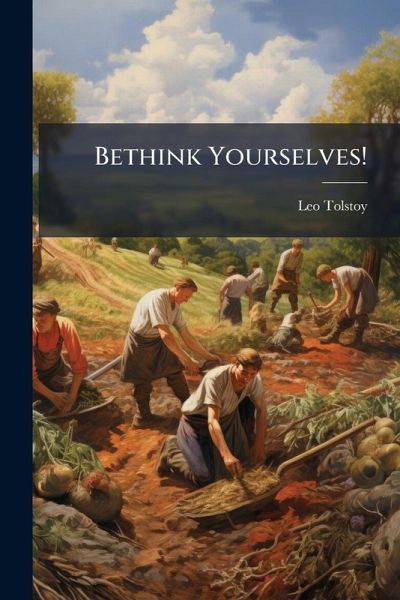
"Bethink Yourselves!" is a powerful essay by Leo Tolstoy urging readers to consider the moral implications of war and violence. Written with characteristic passion and conviction, Tolstoy calls for a rejection of militarism and a return to the principles of Christian love and non-resistance. Tolstoy's work challenges the justifications for war offered by governments and religious institutions, arguing that they are based on falsehoods and self-interest. He implores individuals to recognize their shared humanity and to refuse to participate in acts of violence against one another. A timeless…mehr
"Bethink Yourselves!" is a powerful essay by Leo Tolstoy urging readers to consider the moral implications of war and violence. Written with characteristic passion and conviction, Tolstoy calls for a rejection of militarism and a return to the principles of Christian love and non-resistance. Tolstoy's work challenges the justifications for war offered by governments and religious institutions, arguing that they are based on falsehoods and self-interest. He implores individuals to recognize their shared humanity and to refuse to participate in acts of violence against one another. A timeless exploration of faith, ethics, and the individual's responsibility in the face of societal injustice, "Bethink Yourselves!" remains a relevant and thought-provoking read for anyone concerned with peace and social change. This work has been selected by scholars as being culturally important, and is part of the knowledge base of civilization as we know it. This work was reproduced from the original artifact, and remains as true to the original work as possible. Therefore, you will see the original copyright references, library stamps (as most of these works have been housed in our most important libraries around the world), and other notations in the work. This work is in the public domain in the United States of America, and possibly other nations. Within the United States, you may freely copy and distribute this work, as no entity (individual or corporate) has a copyright on the body of the work. As a reproduction of a historical artifact, this work may contain missing or blurred pages, poor pictures, errant marks, etc. Scholars believe, and we concur, that this work is important enough to be preserved, reproduced, and made generally available to the public. We appreciate your support of the preservation process, and thank you for being an important part of keeping this knowledge alive and relevant.
Count Lev Nikolayevich Tolstoy (9 September [O.S. 28 August] 1828 - 20 November [O.S. 7 November] 1910), usually referred to in English as Leo Tolstoy, was a Russian writer who is regarded as one of the greatest authors of all time.[3] He received multiple nominations for the Nobel Prize in Literature every year from 1902 to 1906 and nominations for Nobel Peace Prize in 1901, 1902 and 1910 and the fact that he never won is a major Nobel prize controversy. Born to an aristocratic Russian family in 1828,[3] he is best known for the novels War and Peace (1869) and Anna Karenina (1877),[8] often cited as pinnacles of realist fiction.[3] He first achieved literary acclaim in his twenties with his semi-autobiographical trilogy, Childhood, Boyhood, and Youth (1852-1856), and Sevastopol Sketches (1855), based upon his experiences in the Crimean War. Tolstoy's fiction includes dozens of short stories and several novellas such as The Death of Ivan Ilyich (1886), Family Happiness (1859), and Hadji Murad (1912). He also wrote plays and numerous philosophical essays. In the 1870s Tolstoy experienced a profound moral crisis, followed by what he regarded as an equally profound spiritual awakening, as outlined in his non-fiction work A Confession (1882). His literal interpretation of the ethical teachings of Jesus, centering on the Sermon on the Mount, caused him to become a fervent Christian anarchist and pacifist.[3] Tolstoy's ideas on nonviolent resistance, expressed in such works as The Kingdom of God Is Within You (1894), had a profound impact on such pivotal 20th-century figures as Mahatma Gandhi[9] and Martin Luther King Jr.[10] Tolstoy also became a dedicated advocate of Georgism, the economic philosophy of Henry George, which he incorporated into his writing, particularly Resurrection (1899).
Es gelten unsere Allgemeinen Geschäftsbedingungen: www.buecher.de/agb
Impressum
www.buecher.de ist ein Internetauftritt der buecher.de internetstores GmbH
Geschäftsführung: Monica Sawhney | Roland Kölbl | Günter Hilger
Sitz der Gesellschaft: Batheyer Straße 115 - 117, 58099 Hagen
Postanschrift: Bürgermeister-Wegele-Str. 12, 86167 Augsburg
Amtsgericht Hagen HRB 13257
Steuernummer: 321/5800/1497
USt-IdNr: DE450055826