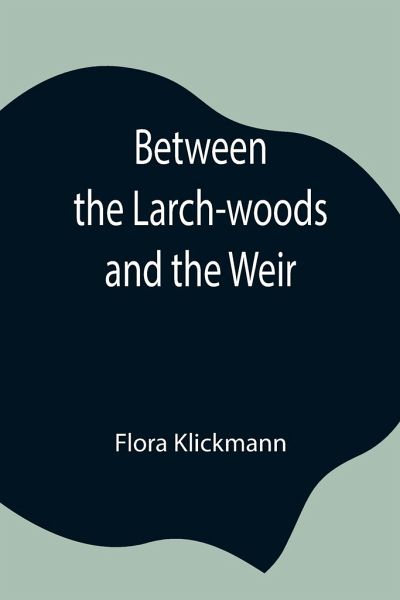
A quiet doorway into a countryside that still feels intimate and real. Between The Larch-Woods And The Weir invites you to wander through English lanes, where weather, work, and wonder weave together in homespun, observational fiction. This collection of rural short stories and nature writing from the early twentieth century offers compact, vividly sketched episodes of countryside life. The tales move with the seasons, cherishing folklore and nature while capturing the rhythms of village hours, harvests, and barbed briers of daily life. It's a book about ordinary lives perceived with a…mehr
A quiet doorway into a countryside that still feels intimate and real. Between The Larch-Woods And The Weir invites you to wander through English lanes, where weather, work, and wonder weave together in homespun, observational fiction. This collection of rural short stories and nature writing from the early twentieth century offers compact, vividly sketched episodes of countryside life. The tales move with the seasons, cherishing folklore and nature while capturing the rhythms of village hours, harvests, and barbed briers of daily life. It's a book about ordinary lives perceived with a patient, clear gaze that reveals memory's glow and the stubborn resilience of place. From a literary and historical standpoint, the work sits at the crossroads of edwardian era britain and the beginnings of modern nature writing. It showcases a strand of british nature writers who observe the land with affection, wit, and disciplined clarity, preserving a voice from the gutenberg classic library that remains resonant today. Alpha Editions presents this edition as more than a reprint. It is restored for today's and future generations, a collectors edition readers will treasure as a cultural treasure. Both casual readers and classic-literature collectors will find in these pages a refined, accessible window into the english countryside setting and a touchstone for nature writing collection fans, seasonal village tales, and the enduring charm of british readers.
Emily Flora Klickmann was an English journalist, author, and editor. She was the second editor of the Girl's Own Paper, but she is best known for her Flower-Patch books of tales, autobiography, and natural descriptions. Flora Klickmann was born on January 26, 1867, in Brixton, London, the sixth child of German-born Rudolf Klickmann and his wife, Fanny Warne. Flora's family relocated to Sydenham, south London, when she was a teenager. She wanted to be a concert pianist and studied at Trinity College of Music and the Royal College of Organists. However, she was diagnosed with arrhythmia and ordered to rest. At the age of 21, she began writing about music for Sylvia's Home Journal and other women's magazines, and by 1895, she was submitting stories and interviews with musicians to The Windsor Magazine, one of the most well-known fiction periodicals of the time. Her mother died in 1903, while they lived on Ondine Road in East Dulwich, and her Prussian-born father, Rudolph Klickmann, remarried in 1908 and moved to Battersea with his new wife, a Russian emigre. Flora lived in the property in Dulwich till she married.
Es gelten unsere Allgemeinen Geschäftsbedingungen: www.buecher.de/agb
Impressum
www.buecher.de ist ein Internetauftritt der buecher.de internetstores GmbH
Geschäftsführung: Monica Sawhney | Roland Kölbl | Günter Hilger
Sitz der Gesellschaft: Batheyer Straße 115 - 117, 58099 Hagen
Postanschrift: Bürgermeister-Wegele-Str. 12, 86167 Augsburg
Amtsgericht Hagen HRB 13257
Steuernummer: 321/5800/1497
USt-IdNr: DE450055826