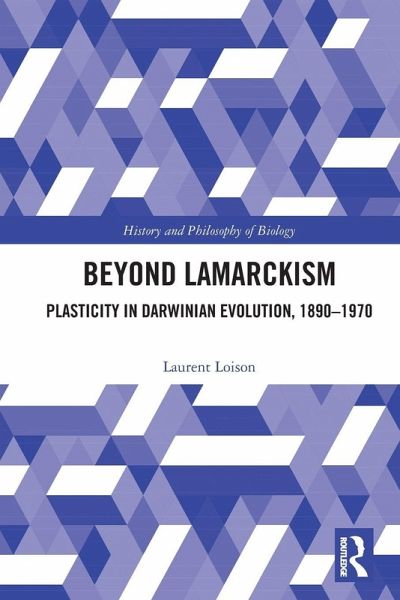
Beyond Lamarckism, Plasticity in Darwinian Evolution shows that the evolutionary impact of plasticity was in fact debated long before the emergence of the current debate on the limits of the Modern Synthesis.
Beyond Lamarckism, Plasticity in Darwinian Evolution shows that the evolutionary impact of plasticity was in fact debated long before the emergence of the current debate on the limits of the Modern Synthesis.
Laurent Loison is a CNRS researcher in history and philosophy of biology (Paris, France). A major part of his work focuses on the history of the various forms of Lamarckism in biology over the past two centuries.
Inhaltsangabe
Introduction. Part I. The rise of organic selection: thinking plasticity ecologically 1. Framing the issue from the viewpoint of natural selection. The confusing birth of organic selection in the pre-Mendelian era. 2. The eclipse of organic selection. The case-study of French-speaking post-Lamarckian biology. 3. The experimental turn, from plastic change to speciation. Conclusion of Part I Part II. Waddington and Schmalhausen: thinking plasticity developmentally Introduction of Part II 4. 'Autonomization', 'canalization' and 'genetic assimilation'. Towards a developmental perspective on the relationship between adaptability and adaptation. 5. A problematic issue: the creativity of the developmental process. 6. An overlooked revolution? Creativity in the evolutionary building of a new reaction norm. Conclusion of Part II Part III. (dis?)Integration into the Modern Synthesis: thinking plasticiy genetically Introduction of Part III 7. The Baldwin effect: "de-ecologizing" organic selection. 8. Re-working Waddingtonian concepts within quantitative genetics. 9. The complex fate of Waddingtonian concepts in the subsequent history of the Modern Synthesis. Conclusion of Part III General Conclusion.
Introduction. Part I. The rise of organic selection: thinking plasticity ecologically 1. Framing the issue from the viewpoint of natural selection. The confusing birth of organic selection in the pre-Mendelian era. 2. The eclipse of organic selection. The case-study of French-speaking post-Lamarckian biology. 3. The experimental turn, from plastic change to speciation. Conclusion of Part I Part II. Waddington and Schmalhausen: thinking plasticity developmentally Introduction of Part II 4. 'Autonomization', 'canalization' and 'genetic assimilation'. Towards a developmental perspective on the relationship between adaptability and adaptation. 5. A problematic issue: the creativity of the developmental process. 6. An overlooked revolution? Creativity in the evolutionary building of a new reaction norm. Conclusion of Part II Part III. (dis?)Integration into the Modern Synthesis: thinking plasticiy genetically Introduction of Part III 7. The Baldwin effect: "de-ecologizing" organic selection. 8. Re-working Waddingtonian concepts within quantitative genetics. 9. The complex fate of Waddingtonian concepts in the subsequent history of the Modern Synthesis. Conclusion of Part III General Conclusion.
Es gelten unsere Allgemeinen Geschäftsbedingungen: www.buecher.de/agb
Impressum
www.buecher.de ist ein Internetauftritt der buecher.de internetstores GmbH
Geschäftsführung: Monica Sawhney | Roland Kölbl | Günter Hilger
Sitz der Gesellschaft: Batheyer Straße 115 - 117, 58099 Hagen
Postanschrift: Bürgermeister-Wegele-Str. 12, 86167 Augsburg
Amtsgericht Hagen HRB 13257
Steuernummer: 321/5800/1497
USt-IdNr: DE450055826