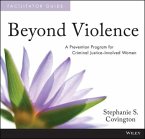
A gender-responsive, trauma-informed treatment program for mental health, addiction, and domestic violence professionals working within the criminal justice system Beyond Violence+: A Prevention Program for Justice-Involved Women and Gender-Diverse People is the revised and expanded version of the evidence-based Beyond Violence (2013). The expansion includes additional sessions focusing on suicide prevention, parenting, relationships in prison, and gender diversity. This treatment program is specifically developed for those who have committed aggressive or violent crimes and are in prisons,…mehr
A gender-responsive, trauma-informed treatment program for mental health, addiction, and domestic violence professionals working within the criminal justice system Beyond Violence+: A Prevention Program for Justice-Involved Women and Gender-Diverse People is the revised and expanded version of the evidence-based Beyond Violence (2013). The expansion includes additional sessions focusing on suicide prevention, parenting, relationships in prison, and gender diversity. This treatment program is specifically developed for those who have committed aggressive or violent crimes and are in prisons, jails, and community correctional settings. The curriculum applies the Social-Ecological Model to understand violent impulses and their management. This same conceptual model is used by the Centers for Disease Control and Prevention and by researchers affiliated with the Prison Rape Elimination Act (PREA). This four-level violence prevention model considers the complex interplay between individual, relationship, community, and societal factors. It addresses key issues that put women at risk of experiencing or perpetrating violence. The Beyond Violence+ program consists of 27 group sessions. Facilitators receive the background information and content necessary to lead practical and effective sessions, and the Participant Workbook allows women to process, record, and refer back to their therapeutic group experiences. By the end of the program, participants will have new skills in communication, conflict resolution, de-escalation, decision-making, and self-soothing. They also will have a newfound understanding of themselves, their backgrounds, and the paths forward in their lives.
Stephanie S. Covington, PhD, LCSW, is an internationally recognized clinician, consultant, lecturer, author, and pioneer in addiction, trauma, and recovery. For more than 35 years, she has created gender-responsive and trauma-informed programs and services. She has also consulted for the Federal Bureau of Prisons, the California Department of Corrections, and many other institutions nationally and internationally. She has published extensively, including 10 gender- and trauma-focused interventions, and co-authored a three-year research project, Gender-Responsive Strategies: Research, Practice, and Guiding Principles for Women Offenders, for the National Institute of Corrections. Her latest book is Hidden Healers: The Unexpected Ways Women in Prison Help Each Other Survive.
Inhaltsangabe
Materials Needed for Each Session xxxv Chapter 1 Part 1: Information for the Facilitator 1 The Therapeutic Environment 2 Before the Session 6 Tips on Conducting a Group Session 9 Part 2: Theoretical Foundation for the Beyond Violence+ Program 16 Introduction 16 The Social-Ecological Model 16 Pathways Theory 18 Relational-Cultural Theory 19 Empowerment Theory 20 Trauma Theory 21 Addiction Theory 24 Best Practices for Prevention Programs 27 Summary 28 Part 3: Research on the Beyond Violence Curriculum 29 A Lack of Studies on Interventions for Women Who Use Force 29 Implementation of Beyond Violence in a Women's Prison 29 Summary 32 References 34 Chapter 2 Part 1: Women and Violence: Describing the Target Treatment Group 39 Introduction 39 Women Involved in the Criminal Justice System 41 Women Convicted of Violent Offenses 41 Violence in Women's Prisons 46 Are Women Becoming More Violent? 47 Women's Pathways to Crime in General 49 Women's Pathways to Violent Crime 51 Part 2: Perspectives on Women and Violence 52 Gender Disparity in Violence 52 Summary 54 References 55 Sessions Orientation Session: Introduction to the Program Session Overview 63 Background Information for the Facilitator 64 Facilitator Welcome and Introduction 65 Group Introductions 67 Quiet Time 67 Overview of Program 68 Group Agreements 71 Session Format 75 Information To Share: Triggers 76 Activity: Five Senses 78 Activity: Breathing and Exhaling 79 Information To Share: Violence 81 Check-in 87 Discussion: What Would You Like To Get from This Group? 87 Information To Share: The Social-Ecological Model 88 Activity: Creating a Container 99 Survey 102 Between-Sessions Activity 105 Self-Soothing Activity: Palms Down, Palms Up 105 Closing 107 References 107 Part A: Self Session One: Thinking Our Thoughts Session Two: Feeling Our Feelings Session Three: Violence and Trauma in Our Lives Session Four: The Effects of Trauma Session Five: Anger and Me Session Six: The Risk of Suicide in Prison Session Seven: Fostering Connection, Hope, and Meaning in Prison Session Eight: Understanding Ourselves Part B: Relationships Session Nine: Our Families Session Ten: Communication Session Eleven: Power and Control Session Twelve: Conflict Resolution Session Thirteen: Our Children Session Fourteen: Nurturing in Action Session Fifteen: Caregiving over Time and with Others Session Sixteen: Relationships in Prison Session Seventeen: Everyday Actions in Our Relationships Session Eighteen: Creating Our Relationships Part C: Community Session Nineteen: Our Communities Session Twenty: The Importance of Safety Session Twenty-One: Creating Community Session Twenty-Two: The Power of Community Part D: Society Session Twenty-Three: Society and Violence Session Twenty-Four: Creating Change Session Twenty-Five: Transforming Our Lives Session Twenty-Six: Honoring Ourselves and Our Community Appendix 1: Ten Truths That Matter When Working with Justice-Involved Women 671 Appendix 2: Yoga Poses 677 Appendix 3: Handouts To Cut Out and Distribute 683 Appendix 4: The Women in the What I Want My Words To Do To You DVD 695 About the Author 701 About the Cover 703
Materials Needed for Each Session xxxv Chapter 1 Part 1: Information for the Facilitator 1 The Therapeutic Environment 2 Before the Session 6 Tips on Conducting a Group Session 9 Part 2: Theoretical Foundation for the Beyond Violence+ Program 16 Introduction 16 The Social-Ecological Model 16 Pathways Theory 18 Relational-Cultural Theory 19 Empowerment Theory 20 Trauma Theory 21 Addiction Theory 24 Best Practices for Prevention Programs 27 Summary 28 Part 3: Research on the Beyond Violence Curriculum 29 A Lack of Studies on Interventions for Women Who Use Force 29 Implementation of Beyond Violence in a Women's Prison 29 Summary 32 References 34 Chapter 2 Part 1: Women and Violence: Describing the Target Treatment Group 39 Introduction 39 Women Involved in the Criminal Justice System 41 Women Convicted of Violent Offenses 41 Violence in Women's Prisons 46 Are Women Becoming More Violent? 47 Women's Pathways to Crime in General 49 Women's Pathways to Violent Crime 51 Part 2: Perspectives on Women and Violence 52 Gender Disparity in Violence 52 Summary 54 References 55 Sessions Orientation Session: Introduction to the Program Session Overview 63 Background Information for the Facilitator 64 Facilitator Welcome and Introduction 65 Group Introductions 67 Quiet Time 67 Overview of Program 68 Group Agreements 71 Session Format 75 Information To Share: Triggers 76 Activity: Five Senses 78 Activity: Breathing and Exhaling 79 Information To Share: Violence 81 Check-in 87 Discussion: What Would You Like To Get from This Group? 87 Information To Share: The Social-Ecological Model 88 Activity: Creating a Container 99 Survey 102 Between-Sessions Activity 105 Self-Soothing Activity: Palms Down, Palms Up 105 Closing 107 References 107 Part A: Self Session One: Thinking Our Thoughts Session Two: Feeling Our Feelings Session Three: Violence and Trauma in Our Lives Session Four: The Effects of Trauma Session Five: Anger and Me Session Six: The Risk of Suicide in Prison Session Seven: Fostering Connection, Hope, and Meaning in Prison Session Eight: Understanding Ourselves Part B: Relationships Session Nine: Our Families Session Ten: Communication Session Eleven: Power and Control Session Twelve: Conflict Resolution Session Thirteen: Our Children Session Fourteen: Nurturing in Action Session Fifteen: Caregiving over Time and with Others Session Sixteen: Relationships in Prison Session Seventeen: Everyday Actions in Our Relationships Session Eighteen: Creating Our Relationships Part C: Community Session Nineteen: Our Communities Session Twenty: The Importance of Safety Session Twenty-One: Creating Community Session Twenty-Two: The Power of Community Part D: Society Session Twenty-Three: Society and Violence Session Twenty-Four: Creating Change Session Twenty-Five: Transforming Our Lives Session Twenty-Six: Honoring Ourselves and Our Community Appendix 1: Ten Truths That Matter When Working with Justice-Involved Women 671 Appendix 2: Yoga Poses 677 Appendix 3: Handouts To Cut Out and Distribute 683 Appendix 4: The Women in the What I Want My Words To Do To You DVD 695 About the Author 701 About the Cover 703
Es gelten unsere Allgemeinen Geschäftsbedingungen: www.buecher.de/agb
Impressum
www.buecher.de ist ein Internetauftritt der buecher.de internetstores GmbH
Geschäftsführung: Monica Sawhney | Roland Kölbl | Günter Hilger
Sitz der Gesellschaft: Batheyer Straße 115 - 117, 58099 Hagen
Postanschrift: Bürgermeister-Wegele-Str. 12, 86167 Augsburg
Amtsgericht Hagen HRB 13257
Steuernummer: 321/5800/1497
USt-IdNr: DE450055826