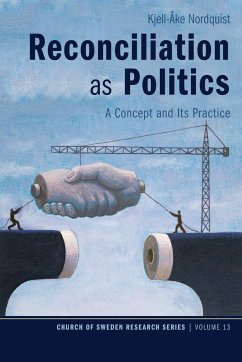
""Reconciliation is a term of wide scope and various application, and it is hardly possible to conceive a life or a religion which should dispense with it. There is always some kind of strain or tension between man and his environment, and man has always an interest in overcoming the strain, in resolving the discord in his situation into a harmony, in getting the environment to be his ally rather than his adversary. The process by which his end is attained may be described as one of reconciliation, but whether the reconciliation is adequate depends on whether his conception of the environment…mehr
""Reconciliation is a term of wide scope and various application, and it is hardly possible to conceive a life or a religion which should dispense with it. There is always some kind of strain or tension between man and his environment, and man has always an interest in overcoming the strain, in resolving the discord in his situation into a harmony, in getting the environment to be his ally rather than his adversary. The process by which his end is attained may be described as one of reconciliation, but whether the reconciliation is adequate depends on whether his conception of the environment is equal to the truth. Men may be very dimly and imperfectly conscious of the nature of the strain which disquiets their life, and may seek to overcome it in blind and insufficient ways. They may interpret it as physical in its origin when it is really ethical, or as the misapprehension of a moral order when it is really antagonism to a personal God, and in either case the reconciliation they seek will fail to give the peace of which they are in quest. Nevertheless, reconciliation and nothing else is what they want, and its place in religion is central and vital."" --From Chapter 1: The Experimental Basis of the Doctrine
James Denney was a Scottish theologian and preacher who lived from 8 February 1856 to 12 June 1917. His theological explanation of the meaning of the atonement within Christian theology-that is, that it is "the most profound of all truths"-is arguably what has made him most famous today. Many claim that he was well-known for supporting the penal substitution theory, but this is an incorrect understanding of his views. That being said, Denney himself objected angrily to this portrayal. Born in Paisley, Scotland on February 5, 1856, The Death of Christ Denney was the son of Cameronian (Reformed Presbyterian) parents. His dad was a Cameronian deacon and joiner. The family joined the Free Church of Scotland in 1876, joining the majority of the Reformed Presbyterian Church of Scotland. From 1874 to 1879, he attended the Highlanders' Academy at Greenock, University of Glasgow, and from 1879 to 1883, he attended Free Church College in Glasgow. While attending Glasgow University, he was awarded the Blackstone Prize and the Moral Philosophy Gold Medal. Edward Caird and Richard Jebb had a big influence on him. He also worked briefly as John Veitch's student assistant.
Es gelten unsere Allgemeinen Geschäftsbedingungen: www.buecher.de/agb
Impressum
www.buecher.de ist ein Internetauftritt der buecher.de internetstores GmbH
Geschäftsführung: Monica Sawhney | Roland Kölbl | Günter Hilger
Sitz der Gesellschaft: Batheyer Straße 115 - 117, 58099 Hagen
Postanschrift: Bürgermeister-Wegele-Str. 12, 86167 Augsburg
Amtsgericht Hagen HRB 13257
Steuernummer: 321/5800/1497
USt-IdNr: DE450055826