
Andere Kunden interessierten sich auch für
 An Introduction to Bispectral Analysis and Bilinear Time Series Models77,99 €
 Athens Conference on Applied Probability and Time Series Analysis77,99 €
 The Analysis of Stochastic Processes using GLIM77,99 €
 Estimation in Conditionally Heteroscedastic Time Series Models39,99 €
 Computing Science and Statistics78,99 €
 Smoothness Priors Analysis of Time Series100,99 €
 Estimation and Analysis of Insect Populations77,99 €

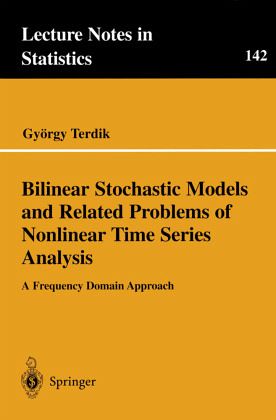
The object of the present work is a systematic statistical analysis of bilinear processes in the frequency domain. The first two chapters are devoted to the basic theory of nonlinear functions of stationary Gaussian processes, Hermite polynomials, cumulants and higher order spectra, multiple Wiener-Itô integrals and finally chaotic Wiener-Itô spectral representation of subordinated processes. There are two chapters for general nonlinear time series problems.
"Ninety percent of inspiration is perspiration. " [31] The Wiener approach to nonlinear stochastic systems [146] permits the representation of single-valued systems with memory for which a small per turbation of the input produces a small perturbation of the output. The Wiener functional series representation contains many transfer functions to describe entirely the input-output connections. Although, theoretically, these representations are elegant, in practice it is not feasible to estimate all the finite-order transfer functions (or the kernels) from a finite sam ple. One of the most important classes of stochastic systems, especially from a statistical point of view, is the case when all the transfer functions are determined by finitely many parameters. Therefore, one has to seek a finite-parameter nonlinear model which can adequately represent non linearity in a series. Among the special classes of nonlinear models that have been studied are the bilinear processes, which have found applica tions both in econometrics and control theory; see, for example, Granger and Andersen [43] and Ruberti, et al. [4]. These bilinear processes are de fined to be linear in both input and output only, when either the input or output are fixed. The bilinear model was introduced by Granger and Andersen [43] and Subba Rao [118], [119]. Terdik [126] gave the solution of xii a lower triangular bilinear model in terms of multiple Wiener-It(') integrals and gave a sufficient condition for the second order stationarity. An impor tant.
"Ninety percent of inspiration is perspiration. " [31] The Wiener approach to nonlinear stochastic systems [146] permits the representation of single-valued systems with memory for which a small per turbation of the input produces a small perturbation of the output. The Wiener functional series representation contains many transfer functions to describe entirely the input-output connections. Although, theoretically, these representations are elegant, in practice it is not feasible to estimate all the finite-order transfer functions (or the kernels) from a finite sam ple. One of the most important classes of stochastic systems, especially from a statistical point of view, is the case when all the transfer functions are determined by finitely many parameters. Therefore, one has to seek a finite-parameter nonlinear model which can adequately represent non linearity in a series. Among the special classes of nonlinear models that have been studied are the bilinear processes, which have found applica tions both in econometrics and control theory; see, for example, Granger and Andersen [43] and Ruberti, et al. [4]. These bilinear processes are de fined to be linear in both input and output only, when either the input or output are fixed. The bilinear model was introduced by Granger and Andersen [43] and Subba Rao [118], [119]. Terdik [126] gave the solution of xii a lower triangular bilinear model in terms of multiple Wiener-It(') integrals and gave a sufficient condition for the second order stationarity. An impor tant.