
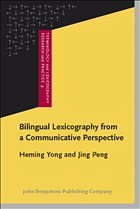
This stimulating new book, as the premier work introducing bilingual lexicography from a communicative perspective, is launched to represent original thinking and innovative theorization in the field of bilingual lexicography. It treats the bilingual dictionary as a system of intercultural communication and bilingual dictionary making as a dynamic process realized by sets of choices, characterizing the overall nature of the dictionary. It examines the dictionary and dictionary making by using a model of lexicography which stresses the three-way relationship of compiler , dictionary context and user and incorporates them into a unified coherent framework. Throughout the study, special focus is on English and Chinese bilingual lexicography. It will serve not only as a valuable guide to those interested in dictionary compilation and theoretical inquiries but also as a textbook for undergraduate and postgraduate courses in bilingual lexicography.
Table of contents:
- Acknowledgements
- Chapter 1. Towards a Communicative Model of Lexicography
- 1.1 The Nature of the Dictionary
- 1.2 Lexicography
- 1.3 Bilingual Lexicography
- Chapter 2. Bilingual Lexicography: A Comparative Approach
- 2.1 Compiler Aspect: Choices of Perspectives and Purposes
- 2.2 Dictionary Context
- 2.3 User Aspect: Language Needs and Reference Skills
- Chapter 3. Modern Linguistics and Bilingual Lexicography
- 3.1 Grammar and Bilingual Lexicography
- 3.2 Semantics and Bilingual Lexicography
- 3.3 Pragmatics and Bilingual Lexicography
- 3.4 Sociolinguistics and Bilingual Lexicography
- Chapter 4. Bilingual Dictionaries: A Communicative Typology
- 4.1 Previous Dictionary Typologies: A General Survey
- 4.2 A Communicative Typology
- Chapter 5. Bilingual Dictionaries: A Structural Description
- 5.1 Outside Matter Structure
- 5.2 Macrostructure
- 5.3 Microstructure
- 5.4 Bidirectionality and Reversibility
- Chapter 6. Bilingual Dictionaries: Fundamental Principles
- 6.1 General Principles
- 6.2 Bilingual Principles
- Chapter 7. Bilingual Dictionaries: Problems and Reflections
- 7.1 Anisomorphism
- 7.2 Equivalence Presentation
- 7.3 Meaning Discrimination
- 7.4 Grammar
- 7.5 Collocation
- 7.6 Style and Register
- 7.7 Exemplification
- 7.8 Illustration
- 7.9 Glossing
- 7.10 Etymology
- 7.11 Revision
- 8.1 Idioms: Their Features
- 8.2 Idioms: Their Status
- 8.3 Idioms: Their Location
- 8.4 Idioms: Their Translation
- 8.5 Idioms: Their Grammar and Usage
- Chapter 9. Bilingual Dictionaries: Recommendations and Samples
- 9.1 Recommendation One: Lexicographic Purposes and Choices
- 9.2 Recommendation Two: Active and Passive Dictionary Designs
- 9.3 Recommendation Three: Macrostrucutral Organization
- 9.4 Recommendation Four: Lexical Classes Discriminated
- 9.5 Recommendation Five: Equivalence Presentation
- 9.6 Recommendation Six: Meaning Discrimination
- 9.7 Recommendation Seven: Grammatical Description
- 9.8 Recommendation Eight: Lexical Combination
- 9.9 Recommendation Nine: Labels and Glosses
- 9.10 Recommendation Ten: Exemplification
- 9.11 Recommendation Eleven: Idiom Treatment
- 9.12 Recommendation Twelve: Word Histories
- Bibliography
- List of Major Dictionaries Cited
Table of contents:
- Acknowledgements
- Chapter 1. Towards a Communicative Model of Lexicography
- 1.1 The Nature of the Dictionary
- 1.2 Lexicography
- 1.3 Bilingual Lexicography
- Chapter 2. Bilingual Lexicography: A Comparative Approach
- 2.1 Compiler Aspect: Choices of Perspectives and Purposes
- 2.2 Dictionary Context
- 2.3 User Aspect: Language Needs and Reference Skills
- Chapter 3. Modern Linguistics and Bilingual Lexicography
- 3.1 Grammar and Bilingual Lexicography
- 3.2 Semantics and Bilingual Lexicography
- 3.3 Pragmatics and Bilingual Lexicography
- 3.4 Sociolinguistics and Bilingual Lexicography
- Chapter 4. Bilingual Dictionaries: A Communicative Typology
- 4.1 Previous Dictionary Typologies: A General Survey
- 4.2 A Communicative Typology
- Chapter 5. Bilingual Dictionaries: A Structural Description
- 5.1 Outside Matter Structure
- 5.2 Macrostructure
- 5.3 Microstructure
- 5.4 Bidirectionality and Reversibility
- Chapter 6. Bilingual Dictionaries: Fundamental Principles
- 6.1 General Principles
- 6.2 Bilingual Principles
- Chapter 7. Bilingual Dictionaries: Problems and Reflections
- 7.1 Anisomorphism
- 7.2 Equivalence Presentation
- 7.3 Meaning Discrimination
- 7.4 Grammar
- 7.5 Collocation
- 7.6 Style and Register
- 7.7 Exemplification
- 7.8 Illustration
- 7.9 Glossing
- 7.10 Etymology
- 7.11 Revision
- 8.1 Idioms: Their Features
- 8.2 Idioms: Their Status
- 8.3 Idioms: Their Location
- 8.4 Idioms: Their Translation
- 8.5 Idioms: Their Grammar and Usage
- Chapter 9. Bilingual Dictionaries: Recommendations and Samples
- 9.1 Recommendation One: Lexicographic Purposes and Choices
- 9.2 Recommendation Two: Active and Passive Dictionary Designs
- 9.3 Recommendation Three: Macrostrucutral Organization
- 9.4 Recommendation Four: Lexical Classes Discriminated
- 9.5 Recommendation Five: Equivalence Presentation
- 9.6 Recommendation Six: Meaning Discrimination
- 9.7 Recommendation Seven: Grammatical Description
- 9.8 Recommendation Eight: Lexical Combination
- 9.9 Recommendation Nine: Labels and Glosses
- 9.10 Recommendation Ten: Exemplification
- 9.11 Recommendation Eleven: Idiom Treatment
- 9.12 Recommendation Twelve: Word Histories
- Bibliography
- List of Major Dictionaries Cited