
Andere Kunden interessierten sich auch für
 Billy Budd, Sailor11,99 €
 (Case Laminate Hardcover with Jacket)") Billy Budd, Sailor (Royal Collector's Edition) (Case Laminate Hardcover with Jacket)37,99 €
Billy Budd, Sailor (Royal Collector's Edition) (Case Laminate Hardcover with Jacket)37,99 € (Laminated Hardback with Jacket)") Billy Budd, Sailor (Collector's Edition) (Laminated Hardback with Jacket)37,99 €
Billy Budd, Sailor (Collector's Edition) (Laminated Hardback with Jacket)37,99 € (Laminated Hardback with Jacket) Large Print") Billy Budd, Sailor (Grand Type Collector's Edition) (Laminated Hardback with Jacket) Large Print41,99 €
Billy Budd, Sailor (Grand Type Collector's Edition) (Laminated Hardback with Jacket) Large Print41,99 € Billy Budd, Sailor15,99 €
 Billy Budd, Bartleby, and Other Stories14,99 €
 Tom Trueman the Sailor13,90 €
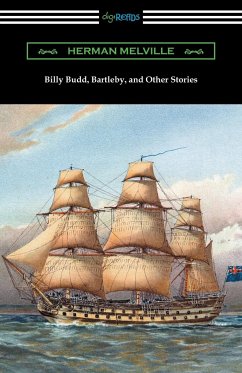

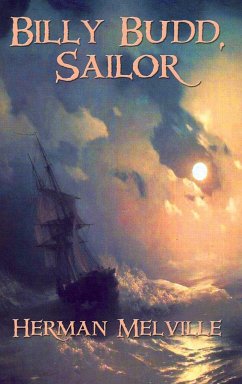
While Moby Dick is Herman Melville’s best known book Billy Budd, Sailor is considered by many to be his greatest work. Billy, a foundling from Bristol, has an innocence, good looks and a natural charisma that make him popular with the crew. His only physical defect is a stutter which grows worse when under intense emotion. He arouses the antagonism of the ship’s master-at-arms, John Claggart. Claggart, while not unattractive, seems somehow defective or abnormal next to Billy. Despite Claggart’s animosity towards him, Billy saves Claggart’s life further infuriating the man. Claggart then accuses Billy of conspiring to mutiny. Billy, dumfounded by the accusation, becomes unable to defend himself against Claggart’s words because of his stuttering and in frustration strikes the lying Claggart with a blow so powerful that it kills the man instantly. In the ensuing trial Melville explores good and evil, justices and mercy, right and wrong, and natural law verses man’s law. A Masterpiece for the Ages!
Herman Melville (August 1, 1819 - September 28, 1891) was an American novelist, short story writer, and poet of the American Renaissance period. His best known works include Typee (1846), a romantic account of his experiences in Polynesian life, and his whaling novel Moby-Dick (1851). His writing draws on his experience at sea as a common sailor, exploration of literature and philosophy, and engagement in the contradictions of American society in a period of rapid change. He developed a complex, baroque style; the vocabulary is rich and original, a strong sense of rhythm infuses the elaborate sentences, the imagery is often mystical or ironic, and the abundance of allusion extends to biblical scripture, myth, philosophy, literature, and the visual arts. Melville was born in New York City, the third child of a merchant in French dry goods and his wife. His formal education ended abruptly after his father died in 1832, as this left the family in financial straits. He briefly became a schoolteacher before he took to sea in 1839 as a sailor on a merchant ship. In 1840, he signed aboard the whaler Acushnet for his first whaling voyage but jumped ship in the Marquesas Islands. He returned to Boston in 1844 after further adventures. In August 1850, Melville moved his growing family to Arrowhead, a farm in Pittsfield, Massachusetts, where he established a profound but short-lived friendship with Nathaniel Hawthorne, to whom he dedicated Moby-Dick.