
Andere Kunden interessierten sich auch für
 Natural Computing Algorithms38,99 €
 Java Methods for Financial Engineering61,99 €
 Advances in Metaheuristics for Hard Optimization113,99 €
 Advances in Metaheuristics for Hard Optimization113,99 €
 Neural Networks and the Financial Markets115,99 €
 Advances in Biologically Inspired Information Systems113,99 €
 Integer Programming and Network Models123,99 €


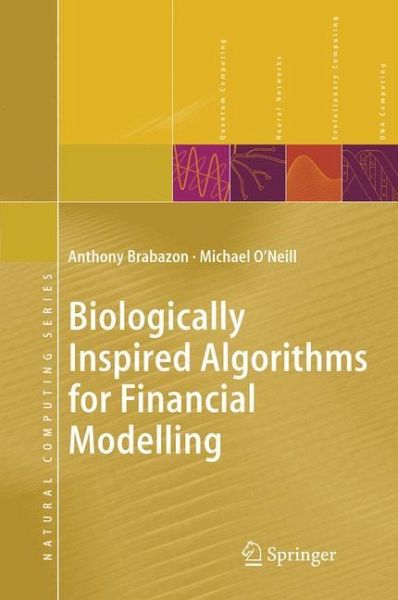
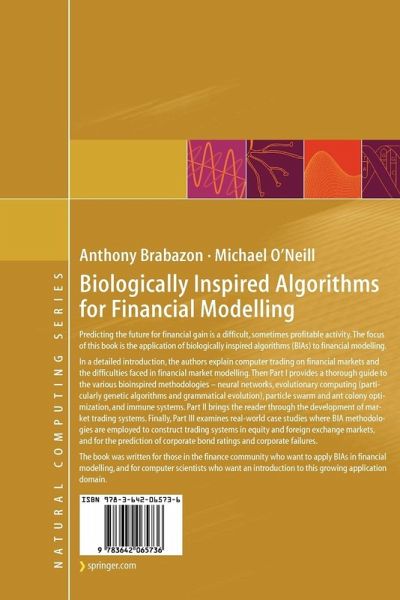
Predicting the future for financial gain is a difficult, sometimes profitable activity. The focus of this book is the application of biologically inspired algorithms (BIAs) to financial modelling.
In a detailed introduction, the authors explain computer trading on financial markets and the difficulties faced in financial market modelling. Then Part I provides a thorough guide to the various bioinspired methodologies - neural networks, evolutionary computing (particularly genetic algorithms and grammatical evolution), particle swarm and ant colony optimization, and immune systems. Part II brings the reader through the development of market trading systems. Finally, Part III examines real-world case studies where BIA methodologies are employed to construct trading systems in equity and foreign exchange markets, and for the prediction of corporate bond ratings and corporate failures.
The book was written for those in the finance community who want to apply BIAs in financial modelling, and for computer scientists who want an introduction to this growing application domain.
In a detailed introduction, the authors explain computer trading on financial markets and the difficulties faced in financial market modelling. Then Part I provides a thorough guide to the various bioinspired methodologies - neural networks, evolutionary computing (particularly genetic algorithms and grammatical evolution), particle swarm and ant colony optimization, and immune systems. Part II brings the reader through the development of market trading systems. Finally, Part III examines real-world case studies where BIA methodologies are employed to construct trading systems in equity and foreign exchange markets, and for the prediction of corporate bond ratings and corporate failures.
The book was written for those in the finance community who want to apply BIAs in financial modelling, and for computer scientists who want an introduction to this growing application domain.
From the reviews: "Anthony Brabazon and Michael O'Neill ... have just published an interesting book that introduces a wide range of biologically inspired algorithms and their applications in financial modelling. ... This book is a well-written, easy to read, brief introduction to the state-of-the-art biologically inspired algorithms." (Mak Kaboudan, Genetic Programming and Evolvable Machines, Vol. 7, 2006) "The objective of this book is to provide an introduction to biologically inspired algorithms and some tightly scoped practical examples in finance. ... provides some new insights and alternative tools for the financial modelling toolbox. ... The goal and objective of the book is to provide practical examples using these evolutionary algorithms and it does that decently ... . Overall I found the book very enlightening ... and it has provided ideas and alternative ways to think about solutions." (Brad G. Kyer, SIGACT News, Vol. 40 (4), 2009)