
Andere Kunden interessierten sich auch für
 Epidemien und Pandemien in historischer Perspektive89,99 €
 Die großen Volkskrankheiten des Mittelalters45,90 €
 Seuchen, alte und neue Gefahren14,99 €
 Die großen Volkskrankheiten des Mittelalters40,90 €
 Die großen Volkskrankheiten des Mittelalters45,90 €
 AIDS, Rhetoric, and Medical Knowledge69,99 €
 Seuchen. 100 Seiten10,00 €







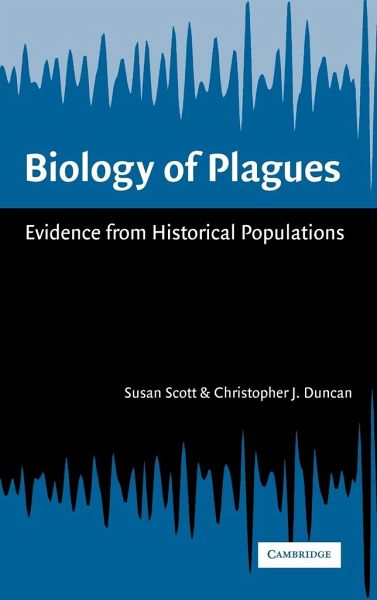
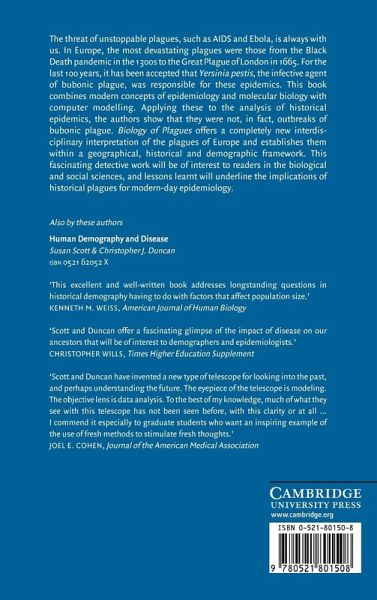
The threat of unstoppable plagues, such as AIDS and Ebola, is always with us. In Europe, the most devastating plagues were those from the Black Death pandemic in the 1300s to the Great Plague of London in 1665. For the last 100 years, it has been accepted that Yersinia pestis, the infective agent of bubonic plague, was responsible for these epidemics. This book combines modern concepts of epidemiology and molecular biology with computer-modelling. Applying these to the analysis of historical epidemics, the authors show that they were not, in fact, outbreaks of bubonic plague. Biology of Plagues offers a completely new interdisciplinary interpretation of the plagues of Europe and establishes them within a geographical, historical and demographic framework. This fascinating detective work will be of interest to readers in the social and biological sciences, and lessons learnt will underline the implications of historical plagues for modern-day epidemiology.