

Andere Kunden interessierten sich auch für
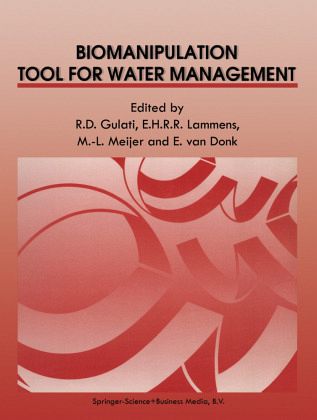
 Biomanipulation Tool for Water Management229,99 €
 Eutrophication of Shallow Lakes with Special Reference to Lake Taihu, China113,99 €
 Shallow Lakes '95154,99 €
 Shallow Lakes '95151,99 €
 Intermediate Disturbance Hypothesis in Phytoplankton Ecology115,99 €
 Trophic Relationships in Inland Waters39,99 €
 Intermediate Disturbance Hypothesis in Phytoplankton Ecology115,99 €

One: Biomanipulation: Past, Present and Future.- Biomanipulation: retrospective and future development.- Biomanipulation: the next phase - making it stable.- Two: Zooplankton-Phytoplankton Interactions.- Are blue-green algae a suitable food for zooplankton? An overview.- Effectiveness of phytoplankton control by large-bodied and small-bodied zooplankton.- Analysis of phytoplankton-zooplankton relationships in an oligotrophic lake under natural and manipulated conditions.- Biomanipulation by introduction of herbivorous zooplankton. A helpful shock for eutrophic lakes?.- The zooplankton-phytoplankton interface in lakes of contrasting trophic status: an experimental comparison.- Why do cladocerans fail to control algal blooms?.- Structural and grazing responses of zooplankton community to biomanipulation of some Dutch water bodies.- Three: Enclosure Studies.- Biomanipulation and food-web dynamics - the importance of seasonal stability.- Impact of whitefish on an enclosure ecosystem in a shallow eutrophic lake: selective feeding of fish and predation effects on the zooplankton communities.- Impact of whitefish on an enclosure ecosystem in a shallow eutrophic lake: changes in nutrient concentrations, phytoplankton and zoobenthos.- A fading recovery: the role of roach (Rutilus rutilus L.) in maintaining high phytoplankton productivity and biomass in Lake Vesijärvi, southern Finland.- Bottom-up effects of bream (Abramis brama L.) in Lake Balaton.- Applicability of planktonic biomanipulation: for managing eutrophication in the subtropics.- Four: Whole Lake Studies.- Conditions for effective biomanipulation; conclusions derived from whole-lake experiments in Europe.- Fish manipulation as a lake restoration tool in shallow, eutrophie temperate lakes 1: cross-analysisof three Danish case-studies.- Fish manipulation as a lake restoration tool in shallow, eutrophic, temperate lakes 2: threshold levels, long-term stability and conclusions.- Phytoplankton biomass reduction after planktivorous fish reduction in a shallow, eutrophie lake: a combined effect of reduced internal P-loading and increased zooplankton grazing.- Ecological consequences of a manual reduction of roach and bream in a eutrophic, temperate lake.- Predictability and possible mechanisms of plankton response to reduction of planktivorous fish.- Oligotrophication as a result of planktivorous fish removal with rotenone in the small, eutrophic, Lake Mosvatn, Norway.- Whole-lake food-web manipulation as a means to study community interactions in a small ecosystem.- First attempt to apply whole-lake food-web manipulation on a large scale in The Netherlands.- Is reduction of the benthivorous fish an important cause of high transparency following biomanipulation in shallow lakes?.- Early responses of plankton and turbidity to biomanipulation in a shallow prairie lake.- Effects of planktivorous fish mass mortality on the plankton community of Lake Mendota, Wisconsin: implications for biomanipulation.- Effects of planktivore abundance on chlorophyll-a and Secchi depth.- Factors related to variance of residuals in chlorophyll-total phosphorus regressions in lakes and reservoirs of Argentina.- Three years of experience in biomanipulating a small eutrophic lake: Lago di Candia (Northern Italy).- Five: Macrophytes.- Engineering and biological approaches to the restoration from eutrophication of shallow lakes in which aquatic plant communities are important components.- The potential of artificial refugia for maintaining a community of large-bodied cladocera against fish predation ina shallow eutrophic lake.- Ecosystem development in different types of littoral enclosures.- Can macrophytes be useful in biomanipulation of lakes? The Lake Zwemlust example.- Biomanipulation of Lago di Candia (Northern Italy): a three-year experience of aquatic macrophyte management.- Impact of mechanical deweeding on Dal lake ecosystem.- Proposals for macrophyte restoration in eutrophic coastal lag
' In conclusion, this book is strongly recommended for anyone involved in eutrophication control. More generally, it provides useful and stimulating information for ecologists interested in trophic interactions in lacustrine communities. ' -- Acta Oecologica
` In conclusion, this book is strongly recommended for anyone involved in eutrophication control. More generally, it provides useful and stimulating information for ecologists interested in trophic interactions in lacustrine communities. '
Acta Oecologica
Acta Oecologica