
Andere Kunden interessierten sich auch für
 Biopolitik bei Giorgio Agamben49,90 €
 La biopolitique chez Giorgio Agamben32,99 €
 Biopolitica in Giorgio Agamben32,99 €
 In convergente disaccordo. Giorgio Agamben lettore di Martin Heidegger45,99 €
 Biopolítica em Giorgio Agamben32,99 €
 El lenguaje como límite de la vida en la Biopolitica26,99 €
 Aberrant routes33,99 €



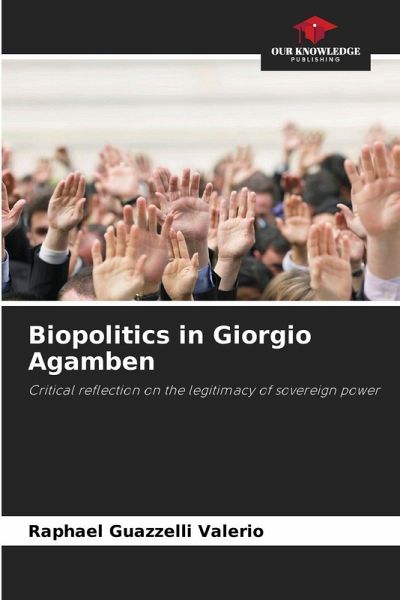
The aim is to map the concept of biopolitics in the work of Italian philosopher Giorgio Agamben, more precisely in his 1995 work, which inaugurated the Homo Sacer series, whose title bears the same name: Homo Sacer: Sovereign Power and Bare Life. Drawing on the thinking of Foucault and Arendt on the one hand, and Benjamin and Schmitt on the other, Agamben traces the concept of biopolitics back to the foundations of Western politics. It is important to show how the structure, logic and topology of biopolitics animate political relations from their very foundations and how modernity was able to unveil this, radically transforming contemporary political spaces. It is well known that this concept was forged by Foucault and that in his thinking it functions as a mode of power, but in Agamben it appears centrally, as a kind of base concept from which four others emerge: homo sacer, sovereign power, state of exception, and concentration camp. Modern politics, by creating a permanent state of exception, isolates and produces bare life and takes upon itself the right to administer it. In this operating structure, we have the concentration camp as a paradigm of political space.